
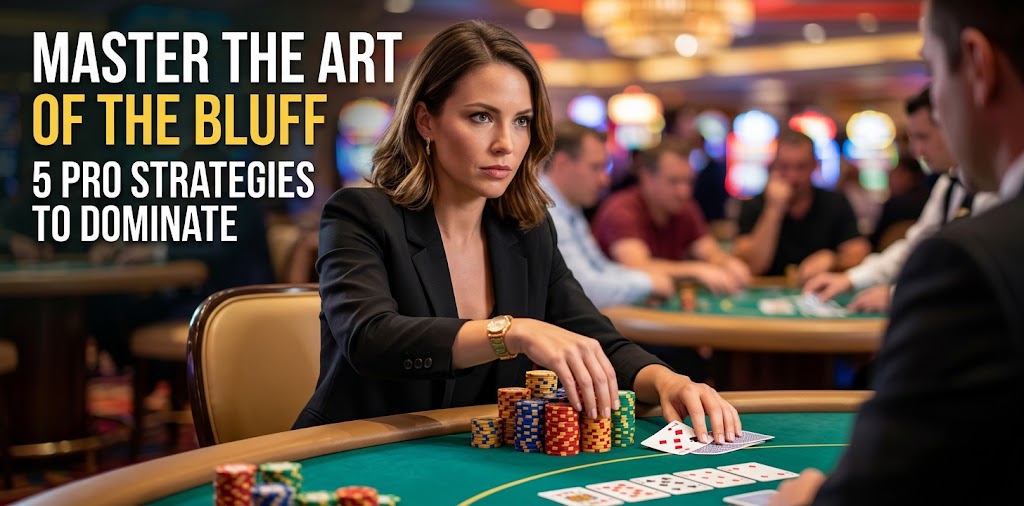
Understanding Why Bluffing is Essential
In the game of poker, relying solely on premium hands will only take a player so far. Opting to play poker without incorporating bluffs means abandoning half of the game’s inherent strategy. While novice players often prefer a highly cautious approach, professional strategy dictates that players must always seek profitable opportunities, and bluffing is the primary vehicle for achieving this.
The fundamental art of the bluff involves forcing an opponent to discard a hand that is statistically better than your own. It serves as the direct inverse of a value bet: when betting for value, a player wants to be called by a weaker hand, but when bluffing, the goal is to force a stronger hand to fold.
According to professional player Phil Ivey, avoiding bluffs entirely makes a player incredibly easy to read. If opponents realize your range contains zero bluffs, they can navigate your strategy with ease. Conversely, establishing a reputation as someone capable of bluffing forces opponents into making significant, costly errors they would normally avoid.
The 4 Primary Types of Bluffs
Every bluffing scenario generally falls into one of four distinct categories, though specific hands can overlap:
- The Continuation Bet Bluff: A wager made when a player already holds the betting initiative, relying entirely on the assumption that the opponent failed to connect with the community cards.
- The Semi-Bluff: A bet executed when a player’s hand is currently weak—or entirely lacking in showdown value—but maintains a strong mathematical probability of improving into a winning hand, such as open-ended straight draws or flush draws.
- The Stone-Cold (Zero Equity) Bluff: A highly risky maneuver where the bettor has virtually no mathematical chance of improving to the best hand. This strategy relies 100% on fold equity to generate a profit.
- The Opportunistic Bluff: Executed in scenarios where no other players at the table have demonstrated any interest in the pot. The bettor expects the wager to succeed frequently enough to be profitable, assuming no one is hiding a premium hand.
Pro Strategy 1: Target the Right Opponent and Exploit Weakness
The specific opponent sitting across the table is the single most important variable when determining a hand’s strategy. Almost all players exhibit recognizable tendencies that create windows of opportunity for deception.
The optimal time to execute a bluff is when an opponent’s perceived hand range is weaker than average. This is most easily identified when a player takes a highly passive betting line throughout multiple streets of a hand. Furthermore, against less-experienced opponents, small bluffs are often just as effective as massive ones. Because lesser-skilled players frequently fail to calculate pot odds before deciding to call, risking a massive portion of your stack is unnecessary when a small wager will accomplish the exact same goal.
Consider a standard $1/$2 game scenario: You are in the cutoff, and three opponents call the blind. A famously loose and wild player on the button raises to $15 to steal the pot. The other players fold, and you call. The flop is entirely dry and misses your hand. You check, and the wild player makes a $20 continuation bet into a $37 pot with nothing. You can execute a check-raise bluff here to take the pot, and you only need to raise the minimum. If they were purely stealing, a minimum raise forces a fold; if they actually hit a monster hand, raising a massive amount will not push them off their cards, and you will simply lose more money.
Pro Strategy 2: Read Situational and Physical Tells
Knowing when to abort a bluff is just as critical as knowing when to launch one. Certain situational tells heavily indicate that an opponent is not bluffing and holds immense strength:
- Departing Players: Casual players who are preparing to leave the table for a meal or for the night rarely engage in deceptive, creative plays. They typically fold borderline hands, meaning if they suddenly raise, they are holding a monster.
- The “Sweated” Player: If an opponent deliberately shows their cards to a spouse or friend watching from the rail, they are highly unlikely to be bluffing. Players prefer to show onlookers how strong their cards are, not showcase risky deception.
- Fatigued Opponents: Players who have been at the table for 24 hours straight generally adopt passive styles, calling or folding while waiting to hit a premium hand to break even. If a sleeping player suddenly wakes up and unleashes a massive raise, they are virtually never bluffing.
- The Short-Stack Shove (The Exception): Conversely, an all-in bet from a severely short-stacked player usually signals weakness. Driven by a “double up or go home” mentality, they will often shove all of their chips into the middle with marginal holdings out of sheer futility.
Pro Strategy 3: Construct a Believable Narrative
A bluff is fundamentally a story, and the narrative must make logical sense to the opponent. Failing to credibly represent a dominant hand guarantees the bluff will be called.
Phil Ivey highlights that an illogical bluff occurs when the story of the hand is told incorrectly. For instance, imagine a flop of 8, 6, 3 featuring two hearts. Both players check. The turn is a 2, and both players check again. The river reveals a 7 of hearts, completing the flush draw. If a player suddenly makes a massive bet here, the bluff makes zero sense. A player legitimately holding a flush draw would have placed a bet on the flop or the turn. Suddenly betting only when the flush card arrives contradicts the previous actions, making the deception highly transparent.
Furthermore, players must assess the overall game flow. If a player has recently dragged several pots with strong hands without ever having to show their cards, the table may perceive them as an aggressive bluffer. In this environment, attempting sophisticated bluffs is a massive error, as opponents are heavily primed to retaliate.
Pro Strategy 4: Master Hand Ranges and Blockers
The key to advanced bluffing lies in analyzing complete hand ranges rather than isolating single cards. Visualizing an opponent’s specific range allows a player to accurately assess the ratio of strong versus weak hands, which is mandatory for executing “thin bluffs” that yield marginal but consistent long-term profits.
Players must also identify the absolute bottom of their own ranges. Knowing this threshold emboldens a player to execute a bluff precisely when mathematically appropriate, while preventing them from needlessly overplaying hands that sit just above that baseline.
Additionally, utilizing “blockers” is vital. A blocker is a card you hold that physically prevents your opponent from having the best possible hand. If the community board features three spades, and you are holding the Ace of Spades, you know with absolute certainty that your opponent cannot have the nut flush. Because you possess the blocker, you can confidently bet aggressively, knowing the unbeatable hand is impossible for them to hold.
Pro Strategy 5: Deploy the Overbet Carefully
Daniel Negreanu advises that the “overbet”—a wager sized larger than the total pot (traditionally between 33% and 100% of the pot)—is a powerful but dangerous bluffing tool.
The overbet essentially acts as a new pricing mechanism to see a hand. If a pot contains 2,000 chips, an opponent with a strong hand might be willing to call a 1,500 bet, but might also call a 5,000 bet. When overbetting for value, the condition requires you to accurately peg your opponent’s range as incredibly strong, while yours is slightly stronger.
However, when deploying the overbet as a bluff, players must ensure their opponent does not have a high concentration of “nutted” (unbeatable) hands in their range that they will refuse to fold regardless of the bet size. If they do, the overbet will be called too frequently to be profitable. Because this strategy requires immense precision, balancing, and reliance on blockers, massive overbets should be strictly reserved until a player has completely mastered fundamental poker mechanics.
Sources: MasterClass (Phil Ivey and Daniel Negreanu strategy modules) and PokerNews strategy guides.
Leo Falsafi is a digital marketing veteran and senior journalist at Virlan.co, where he covers the intersection of digital marketing, gaming, and breaking US trending news. With nearly two decades of hands-on experience in SEO and digital strategy, Leo has consulted for and scaled hundreds of companies. His deep industry roots allow him to deliver sharp, fact-checked insights and analysis on the trends shaping today's digital landscape.