
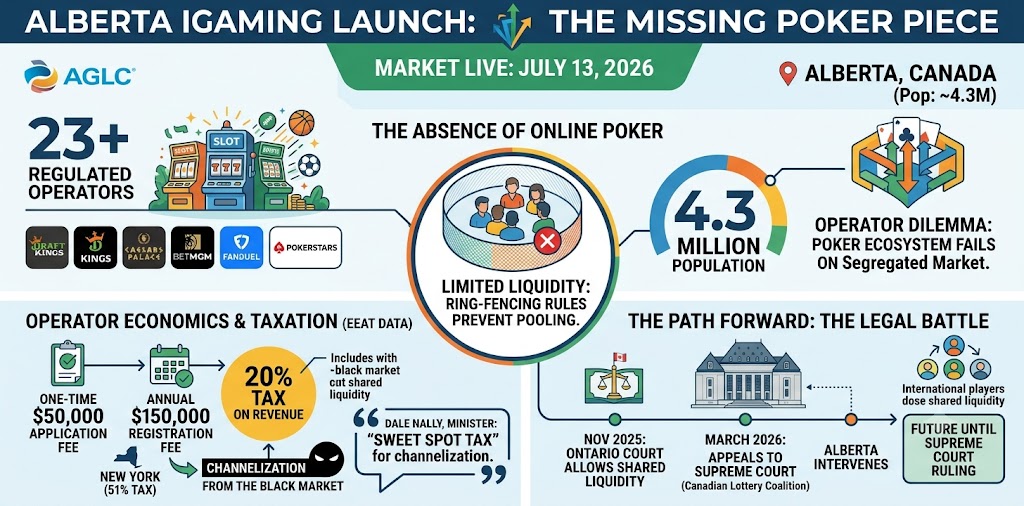
At midnight on Monday, July 13, 2026, Alberta officially flipped the switch on its highly anticipated, regulated online gambling market. Following in the footsteps of Ontario, the province welcomed dozens of private operators to go live on day one. Yet, as the digital casino doors swung open, card players across the province were met with a quiet, empty lobby.
There was not a single online poker hand dealt.
For a market that has been teased as Canada’s next big poker haven, the total lack of cardroom options at launch has left local players feeling shortchanged. While sports fans can readily wager on the CFL or the upcoming World Cup, and casino enthusiasts have thousands of slots at their fingertips, poker players find themselves completely stuck in limbo.
Why Alberta’s iGaming Launch Left Poker Players in the Cold
The reason for the missing poker tables isn’t a lack of operator interest, but rather a fundamental commercial reality. Unlike slot machines or sportsbooks, which operate on a house-versus-player model, poker is a multiplayer ecosystem. It lives and dies on liquidity—the volume of active players required to keep tables running, tournaments funded, and game selection diverse.
The 4.3 Million Population Problem: Why Ring-Fencing Kills Poker
Alberta has a population of roughly 4.3 million people. In the world of online poker, that is barely enough to sustain a single, modest tournament schedule. If operators like PokerStars, GGPoker, or BetMGM were to launch today, provincial regulations dictate that their platforms must be “ring-fenced.” This means Alberta players would only be allowed to compete against other players physically located within provincial lines.
Going from a massive international player pool to a segregated market of just 4.3 million is a massive step backward. Tournament prize pools would shrivel, high-stakes games would dry up, and players would likely migrate back to unregulated offshore platforms. Because of this, major poker giants are playing a game of wait-and-see.
Regulated Casino Giants Take the Field
While poker is on hold, the rest of the iGaming sector is thriving. A total of 23 operators kicked off their campaigns at launch. The Alberta Gaming, Liquor and Cannabis (AGLC) commission approved a stellar lineup of household names.
Breaking Down the $200,000 Barrier to Entry
To set up shop in Alberta, operators must pay a one-time $50,000 application fee and a $150,000 annual registration fee. On top of that, the province levies a highly competitive 20% tax on gaming revenue. It’s a pricing structure carefully designed to lure operators away from the black market, which currently commands roughly 70% of Alberta’s online betting handle.
| Jurisdiction | Revenue Tax Rate | Live Operators | Primary Focus |
| Alberta | 20% | 23 | Sports Betting, Online Casino (No Poker) |
| Ontario | ~20% | ~28 | Sports Betting, Casino, and Ring-Fenced Poker |
| New York | 51% | 4 | Sports Betting Only |
Speaking on the competitive tax structure, Minister of Service Alberta and Red Tape Reduction Dale Nally emphasized the province’s player-first goals:
“We had to find that sweet spot. New York State charges a 51% tax rate, and they had four operators go live when the market launched. We have 22 [at the time of licensing negotiations], so we know we’re pretty close to getting the tax rate right.”
“At the end of the day, this is not about the revenue. This is about the channelization. How much of that black market can we channelize into the legal regulated market?”
While the 20% tax rate is proving highly attractive for casino brands like DraftKings, Caesars Palace, FanDuel, and BetMGM, the operational math for poker remains unsolved without shared player pools.
The Supreme Court Battle That Holds the Key to Alberta Poker
The ultimate path forward for Albertan poker players is currently locked inside a federal courtroom.
In November 2025, the Ontario Court of Appeal delivered a landmark decision, ruling that Ontario’s regulated operators could legally pool their players with those in other provinces and countries. However, that victory was contested. In March 2026, the Canadian Lottery Coalition—representing state-run lotteries across six provinces—appealed the decision directly to the Supreme Court of Canada.
Recognizing that its own poker future hangs in the balance, Alberta’s Attorney General was recently approved to intervene in the Supreme Court case, allowing the province to submit written testimony and present its views in court.
Until the Supreme Court hands down a final verdict on shared domestic and international liquidity, poker operators are taking a tactical approach. For instance, PokerStars has officially pulled its casino and sportsbook products from Alberta’s grey market to comply with local laws, but has quietly allowed its poker platform to remain playable “for now” on its international client. It keeps the player base warm while the lawyers do the heavy lifting in Ottawa.
Until the legal dust settles, Alberta’s poker players will have to settle for watching the casino players have all the fun.
Sources Quoted:
- Sean Chaffin (Card Player): Sourced for hard figures regarding the 23 live operators, registration fees, the 20% tax rate, and the Supreme Court appeal details.
- Dale Nally (Minister of Service Alberta and Red Tape Reduction): Directly quoted on Alberta’s “sweet spot” tax rate and the province’s focus on black-market channelization.
Leo Falsafi is a digital marketing veteran and senior journalist at Virlan.co, where he covers the intersection of digital marketing, gaming, and breaking US trending news. With nearly two decades of hands-on experience in SEO and digital strategy, Leo has consulted for and scaled hundreds of companies. His deep industry roots allow him to deliver sharp, fact-checked insights and analysis on the trends shaping today's digital landscape.