
The Oracle of Omaha has quietly orchestrated one of the most aggressive defensive postures in corporate history.
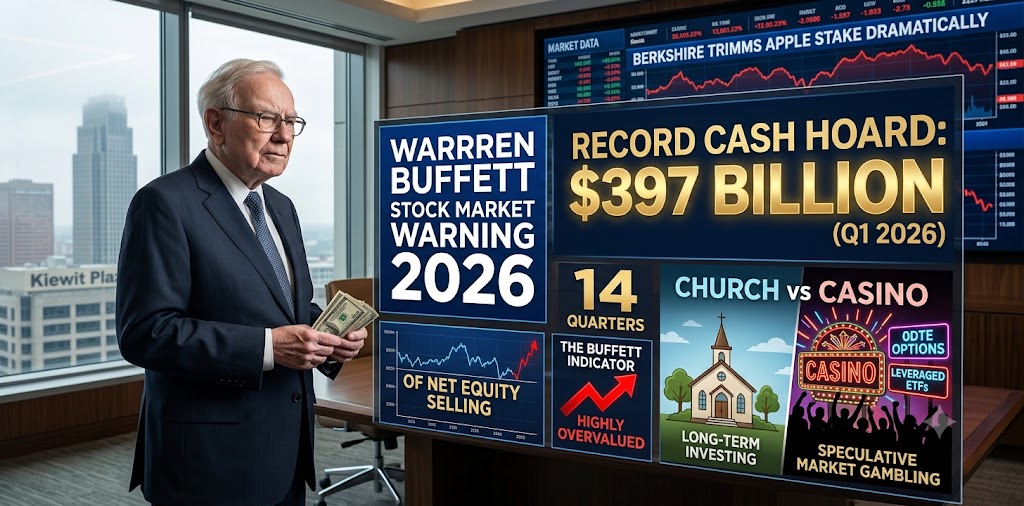
While the broader investing public debates the longevity of artificial intelligence bull runs and momentum trading, Berkshire Hathaway has spent the last three years methodically pulling chips off the table. By the first quarter of 2026, Warren Buffett’s cash and Treasury bill pile swelled to a staggering $397 billion.
This isn’t a passive accumulation. It is a deliberate, mathematically driven warning shot from the most successful investor of the modern era. Berkshire has been a net seller of equities for 14 consecutive quarters, an unprecedented streak that culminated in $24 billion sold versus just $15.9 billion bought in Q1 2026 alone.
Even long-held cornerstones of the Berkshire portfolio haven’t been spared. Buffett’s famous stake in Apple has been dramatically trimmed from its peak valuation of nearly $200 billion down to roughly $75 billion. The message is unmistakable: value—true, fundamental value—has virtually evaporated from the public equity markets.
The Church and the Casino: An 11-Word Warning
At the 2026 Berkshire Hathaway shareholder meeting, the now-retired CEO delivered an 11-word indictment of modern market psychology that landed harder than any SEC filing:
“We’ve never had people in a more gambling mood than now.”
Buffett expanded on this by deploying a familiar, but sharpened, analogy. He described the stock market as a church with a casino attached. Historically, the two coexisted. In 2026, however, Buffett observes that the casino has taken over the congregation.
The data firmly supports his critique. The financial landscape is currently saturated with retail speculation. In the first half of 2026 alone, nearly 700 new Exchange Traded Funds (ETFs) hit the market. Crucially, roughly 200 of these are “leveraged” or “inverse” products mostly tied to single stocks, alongside a massive proliferation of zero-days-to-expiration (0DTE) option-income strategies.
When enough market participants abandon fundamentals for short-term derivative gambling, Buffett noted, prices for many assets “will look very silly.” To him, investing in U.S. stocks at their current, sky-high valuation levels is nothing short of “playing with fire.”
Why is Warren Buffett holding so much cash in 2026?
Buffett’s $397 billion cash pile is driven by a lack of attractive, fairly valued equities combined with the high yield of risk-free assets. By parking capital in short-term U.S. Treasury bills, Berkshire is earning between 3.64% and 3.82% across the yield curve. This generates over $13 billion annually in risk-free interest. Buffett is essentially being paid handsomely to wait out what he views as an overpriced, highly speculative market environment until genuine distress creates bargain opportunities.
What is the Warren Buffett indicator signaling right now?
The “Buffett Indicator”—a metric that divides the total value of the U.S. stock market by the nation’s annualized Gross Domestic Product (GDP)—is flashing bright red. Alongside a Shiller CAPE ratio hovering near all-time highs, the Buffett Indicator suggests the market is heavily overvalued. Buffett famously stated in a 2001 Fortune interview that buying equities when this ratio approaches 200% is equivalent to playing with fire, a dynamic that history has shown repeatedly precedes severe market corrections.
Core Insights: The 2026 Berkshire Blueprint
For investors trying to navigate the current climate, Berkshire’s structural positioning offers a clear, data-driven framework:
- Valuations Matter Over Momentum: Despite a noticeable market pullback early in 2026, Buffett dismissed the dip as “nothing.” A 10% slump does not trigger his buying impulse; he is waiting for a genuine dislocation where high-quality assets are sold out of fear.
- Cash is Strategic Optionality: Retail investors often fear that holding cash during inflation means “dead money.” Buffett proves otherwise. A massive cash reserve guarantees you are never a forced seller and provides the liquidity needed to strike aggressively when systemic panics finally occur.
- Beware the “Synthetic Income” Trap: The explosion of leveraged single-stock ETFs and 0DTE options is a structural vulnerability. Heavily speculative retail products magnify downside risk in a way that will disproportionately wipe out “casino” participants during a true market correction.
- Focus on Tangible Durability: Berkshire’s capital isn’t entirely idle; its controlled, non-public businesses (like BNSF railway and Berkshire Hathaway Energy) represent domestic, tangible assets insulated from the tech-valuation bubble and supply chain disruptions.
The Oracle’s silence on the buy-side is the loudest warning Wall Street has received this decade. The casino may be winning today, but Warren Buffett has $397 billion betting that the house eventually goes bust.
Sources Quoted:
- BitMEX Blog: Provided specific data on the $397 billion cash reserve and the 14-consecutive-quarter net-selling streak.
- Barchart.com: Cited Buffett’s characterization of the 2026 market dip as “nothing” and his historical threshold for deploying capital.
- The Motley Fool (David Dierking & Katie Brockman) / Finviz: Sourced the 11-word “gambling mood” quote, statistics on the 700 new ETFs in 2026, and analysis of the Buffett Indicator.
Leo Falsafi is a digital marketing veteran and senior journalist at Virlan.co, where he covers the intersection of digital marketing, gaming, and breaking US trending news. With nearly two decades of hands-on experience in SEO and digital strategy, Leo has consulted for and scaled hundreds of companies. His deep industry roots allow him to deliver sharp, fact-checked insights and analysis on the trends shaping today's digital landscape.