
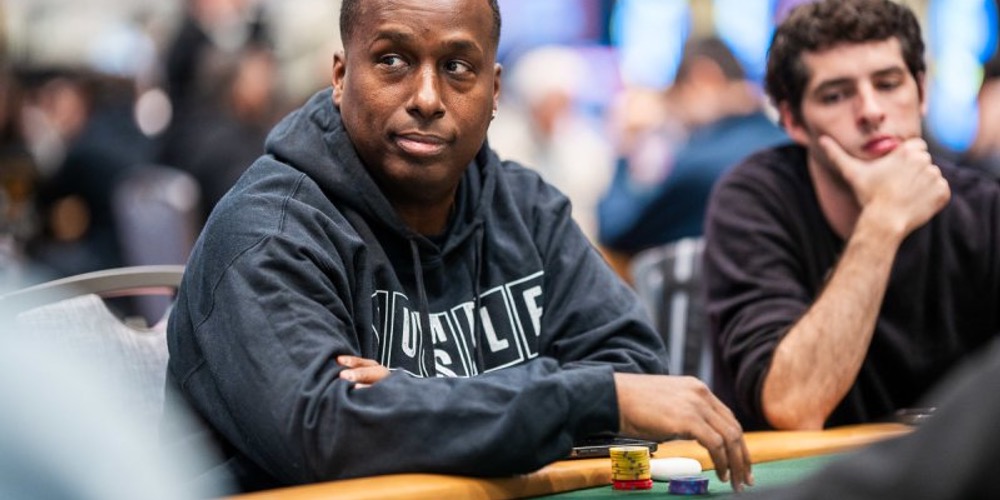
In a stunning legal maneuver that has captivated the competitive poker community, Maurice Hawkins—one of the most decorated players in the history of the World Series of Poker (WSOP) Circuit—has officially filed for Chapter 7 bankruptcy. The filing comes on the heels of a long-standing financial dispute and an aggressive legal garnishment that recently intercepted a portion of his tournament winnings.
For a player with nearly $7 million in lifetime tournament earnings, the decision to declare bankruptcy presents a glaring contradiction. Hawkins has spent the last two years enjoying some of the most lucrative runs of his career, yet he now finds himself in the United States Bankruptcy Court seeking a legal shield against his creditors.
The Catalyst: A Garnished Payout in Tunica
The immediate trigger for the bankruptcy filing appears to be an aggressive collection effort tied to an outstanding six-figure debt. Last week, sources on-site at a poker tournament in Tunica revealed that Hawkins had successfully cashed in the event. However, upon attempting to collect his payout, he was reportedly blindsided by the news that his winnings had been frozen due to an active legal garnishment.
The garnishment was filed by attorney Rogen Chhabra on behalf of Randy Garcia, a former backer to whom Hawkins owed a substantial sum of money. Unable to access his tournament earnings, Hawkins took immediate legal action. Just one day after the garnishment blocked his payout, Hawkins, through his attorney Michael A. Kaufman, filed for Chapter 7 bankruptcy in the United States Bankruptcy Court for the Southern District of Florida (Case 26-15116-EPK).
By filing for liquidation bankruptcy, Hawkins initiated an automatic stay—a legal provision that immediately halts collection actions, including wage garnishments. For the poker community, the timing of the filing has raised profound questions about whether this is a legitimate case of financial insolvency or a calculated tactic to bypass accountability for his debts.
The Financial Contradiction: $7 Million in Earnings vs. Chapter 7
The most perplexing aspect of Hawkins’s bankruptcy is the stark contrast between his courtroom declarations and his undeniable success on the felt. According to The Hendon Mob database, Hawkins has accumulated nearly $7 million in lifetime tournament earnings.
Furthermore, the last two years have been arguably the best of his entire professional career. In 2024, he racked up an impressive $853,068 in tournament earnings, followed by another stellar year in 2025 with $741,937. His momentum has shown no signs of slowing down in 2026; he has already amassed $217,254 in tournament earnings this year alone.
His recent string of victories is nothing short of spectacular. Hawkins chopped the Gulf Coast Poker Beau Rivage Heater Event #6 ($500 Triple Stack NLH) for a massive $80,944. A week later, he emerged victorious at the WSOPC Tunica Event #2 ($400 Mini Main), securing $35,146. Less than three weeks prior to his bankruptcy filing, he won the WSOP Circuit Elgin Event #3 ($400 NLH) for $17,419. This victory was historically significant, as it awarded him his record-extending 24th WSOP Circuit gold ring.
In his bankruptcy petition, Hawkins listed his rented residence as Wellington, Florida. When required to estimate the value of his assets, he indicated the bracket between $500,001 and $1,000,000. Conversely, he estimated his liabilities to be between $100,001 and $500,000. His listed creditors primarily consist of consumer debts, including Boca Raton Pawn Shop, Nordstrom, several finance companies, and most notably, Randy Garcia.
The Randy Garcia Dispute and a Broken Deal
The financial friction between Maurice Hawkins and Randy Garcia has been brewing for years. The dispute reached a legal climax when the Circuit Court of the 15th Judicial Circuit in Palm Beach County, Florida (Case No. 502019CA000052XXXXMB) issued a final judgment against Hawkins for $115,828.
Rather than enforcing the full weight of the judgment immediately, Garcia publicly agreed to a highly favorable settlement plan just months ago. Under the terms of the agreement, Hawkins was required to pay $2,500 by the 30th of every month until a significantly reduced total of $30,000 was repaid. Given his multi-six-figure annual earnings, the $2,500 monthly payment seemed easily manageable.
However, after successfully making payments for only a few months, Hawkins allegedly defaulted on the agreement. His failure to live up to his side of the bargain prompted Garcia to escalate the matter, leading to the involvement of attorney Rogen Chhabra and the subsequent garnishment order that intercepted Hawkins’s Tunica winnings.
Social Media Bravado: “More Disposable Income Than Your Regular Income”
Complicating Hawkins’s claims of financial distress is his highly public, boastful persona on social media. While simultaneously preparing a bankruptcy petition, Hawkins has been actively taunting detractors and flexing his financial muscle online.
In a recent challenge directed at high-stakes professional Shaun Deeb, Hawkins proposed a massive $100,000 wager, a sum that heavily contradicts his bankruptcy filing.
“I win every trip I go on, check my hendon. I have more disposable income, than your regular income. I live rent free in your mind,” Hawkins wrote on X (formerly Twitter). He confidently added, “All, I have to say is ‘Happy New Year.’ This will Be my Biggest year. It’s nothing your words, posts and ill intent against me. Can do about it.”
Following one of his massive tournament scores, he further flaunted his wealth, stating, “Some people talk, and then some people do. Let’s eat 2026….. Plus 80k HIGH Hater. This is for those I told, I would make the salary in one week. This one is for you.”
In February, after securing his 23rd WSOPC gold ring and winning a $10,000 Main Event seat to the 2026 WSOP for finishing as Casino Champ, he proudly announced to his followers that he was “going to Disney with the kids.”
These statements paint a picture of a player flush with cash, making the Chapter 7 filing a highly controversial move.
Legal Implications: Chapter 7 vs. Chapter 11
The choice to file for Chapter 7 bankruptcy is a specific and highly consequential legal strategy. According to the IRS, Chapter 7, often referred to as “liquidation bankruptcy,” is a legal process designed to erase most unsecured debts—such as medical bills, credit card debts, and civil judgments like the one held by Garcia—within a relatively short window of three to six months. It aims to provide the debtor with a “fresh start.” In this process, a court-appointed trustee may liquidate non-exempt assets to pay off creditors, though many debtors manage to keep their essential assets through various exemptions.
This stands in stark contrast to Chapter 11 bankruptcy, which is a reorganization process that allows individuals or businesses to keep their assets while restructuring their debts through a court-approved repayment plan. By opting for Chapter 7, Hawkins is seemingly aiming to entirely wipe out the $115,828 judgment rather than restructure his payments to Garcia.
What’s Next? The Pushback from Creditors
The bankruptcy filing may have paused the garnishment of Hawkins’s immediate tournament winnings, but the legal battle is far from over. Attorney Rogen Chhabra, speaking on a recent episode of the PokerNews Podcast, made it clear that Garcia does not intend to quietly accept the discharge of the debt.
While the bankruptcy serves as a massive speedbump in the collection process, Chhabra outlined a potential counter-strategy. Creditors have the right to challenge the legitimacy of a bankruptcy filing. Given Hawkins’s robust tournament earnings over the last 24 months, his estimated assets of up to $1 million, and his public braggadocio regarding his “disposable income,” Garcia’s legal team plans to fight the Chapter 7 discharge. They aim to demonstrate to the bankruptcy court that Hawkins is not genuinely destitute, but rather fraudulently exploiting the federal bankruptcy system to dodge a legally binding poker debt.
As the 2026 World Series of Poker approaches, all eyes will be on Maurice Hawkins. He remains a dominant force at the tables, but the shadow of federal bankruptcy court now looms heavily over his record-breaking career. The poker industry is watching closely, as the outcome of this case could set a fascinating precedent for how state-court judgments, tournament payouts, and federal bankruptcy laws intersect in the volatile world of professional poker.
Leo Falsafi is a digital marketing veteran and senior journalist at Virlan.co, where he covers the intersection of digital marketing, gaming, and breaking US trending news. With nearly two decades of hands-on experience in SEO and digital strategy, Leo has consulted for and scaled hundreds of companies. His deep industry roots allow him to deliver sharp, fact-checked insights and analysis on the trends shaping today's digital landscape.