
When choosing a messaging app for personal communication or business operations, the debate usually boils down to two heavyweights: WhatsApp and Telegram. In recent years, widespread discussions around digital privacy, data security, and platform decentralization have intensified. Since WhatsApp updated its data-sharing policies regarding its parent company, Meta, millions of users and businesses have explored alternatives like Telegram to gain more control over their information.
But what are the actual, technical differences between these two applications? Are Telegram’s “secret chats” more secure than WhatsApp’s default encryption? Which app provides the best environment for building a loyal customer base?
By analyzing the architecture, security frameworks, and business integrations of both platforms, we can uncover which application truly aligns with your communication needs.
1. The Basics: User Base and Core Philosophy
WhatsApp is the undisputed king of global reach. Acquired by Meta (formerly Facebook) in 2014, it boasts over 2.5 billion active users worldwide. Its sheer scale makes it a default choice; practically everyone you know—from family members to corporate clients—already has it installed. Its primary philosophy is simplicity and reliability, offering an intuitive interface designed for everyday use.
Telegram, founded by Pavel Durov in 2013, operates with a slightly different ethos. Nearing the 1 billion user mark, Telegram defines itself as an independent, self-funded, cloud-based platform. While it does seek monetization strategies, it pledges not to do so through intrusive advertising or by selling user data. Telegram is built for power users, emphasizing speed, versatility, customization, and massive community building over sheer simplicity.
2. Privacy and Security: Where the Main Differences Lie
The most hotly debated topic between these two giants is how they handle your private conversations and personal data. Both utilize encryption, but their approaches are fundamentally different.
End-to-End Encryption (E2EE)
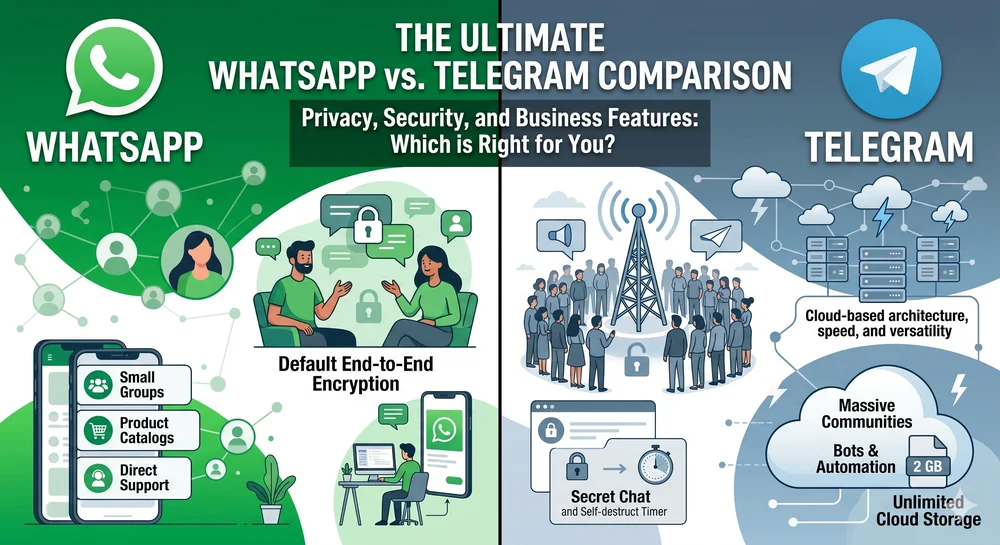
WhatsApp champions automatic, default end-to-end encryption for all personal chats and calls. This means that from the moment you send a message to the moment it is received, only you and the recipient can read it. Not even WhatsApp or Meta can intercept or read the contents of your texts, listen to your voice notes, or view your shared media.
Telegram operates on a hybrid security model. Regular chats are not end-to-end encrypted by default. Instead, they use server-side encryption, meaning messages are encrypted between your device and Telegram’s servers, and then stored securely in the cloud. This allows for seamless multi-device synchronization. If you want true end-to-end encryption on Telegram, you must manually initiate a “Secret Chat.” Secret chats are device-specific, do not sync to the cloud, and come with additional privacy features like self-destructing messages and screenshot blocking.
Data Collection and Metadata
While WhatsApp wins on default message encryption, it falls short in the eyes of many privacy advocates due to its metadata collection. WhatsApp records a vast amount of metadata—such as who you contact, timestamps, connection data, your IP address, device details, and approximate location. This information is integrated into the broader Meta ecosystem (including Facebook and Instagram) for service improvement, personalization, and targeted advertising mapping.
Telegram, by contrast, collects significantly less data. It only stores your phone number, username, saved contacts, and basic technical logs (like IP and device info). Because it operates independently of a massive advertising conglomerate, Telegram guarantees that user data is never shared with third parties or utilized for targeted ads, providing a much higher degree of anonymity regarding user behavior.
Additional Privacy Controls
Both apps offer two-step verification, biometric/PIN app locks, and disappearing messages. However, Telegram goes a few steps further for privacy purists. Telegram allows users to completely hide their phone numbers from others, whereas WhatsApp still requires your phone number to be visible to anyone you chat with. Furthermore, Telegram allows users to delete messages from both sides of a conversation at any time, while WhatsApp maintains tighter time restrictions on when a message can be deleted for everyone.
3. Features and Usability: Groups, Channels, and Cloud Storage
When it comes to features, Telegram heavily leans into its cloud-based architecture, offering a suite of functionalities that WhatsApp simply cannot match natively.
Groups and Broadcasting: WhatsApp is designed for intimate or mid-sized groups. Its group chat limit is currently capped at 1,024 members, and its broadcast feature (WhatsApp Channels) is strictly one-way communication.
Telegram, however, is a community-building powerhouse. Its “Supergroups” can hold a staggering 200,000 members. Telegram Channels allow for unlimited subscribers and are publicly searchable, making it an incredible tool for content creators, news outlets, and marketers to distribute content globally.
File Sharing and Cloud Storage:
Historically, WhatsApp has struggled with file compression and sharing limits (though it recently upgraded its limits). Media is downloaded directly to your device, eating up local storage space.
Telegram serves as an unlimited cloud storage drive. Users can share files of up to 2 GB per file (and up to 4 GB for Premium users) without sacrificing quality. Because data is stored on Telegram’s cloud, you don’t need to clog up your smartphone’s hard drive to keep years’ worth of videos and documents.
Multi-Device Access:
WhatsApp Web requires your primary phone to be linked, and historically struggled if the phone went offline. While WhatsApp has improved its multi-device support, Telegram’s independent cloud access means you can log in natively across your mobile, tablet, desktop, and web simultaneously without your primary phone even being turned on.
4. Corporate and Business Use: Reaching the Customer
For businesses, the choice between WhatsApp and Telegram depends entirely on their specific communication strategy, budget, and customer demographic.
The Case for WhatsApp Business
WhatsApp’s massive user base makes it an indispensable tool for direct customer support and sales. The free WhatsApp Business app gives small businesses essential tools like product catalogs, automated away messages, quick replies, and chat labels.
For enterprise-level needs, the WhatsApp Business API allows companies to integrate the messenger into their CRM platforms, enabling multi-agent support. However, proactive outreach on WhatsApp is heavily regulated. Businesses must use pre-approved message templates, and WhatsApp employs a conversation-based pricing model that can become expensive for large-scale marketing.
The Case for Telegram Business
Telegram is the ultimate tool for scalable, automated, and community-driven business. Telegram’s Bot API is entirely open-source, flexible, and free of charge. Developers can build incredibly sophisticated chatbots to process orders, share news, or provide customer support without waiting for corporate approvals or paying per-message fees.
Furthermore, Telegram’s massive public channels make it a goldmine for brand discoverability. Companies focusing on content marketing, cryptocurrency, tech, and broad broadcasting often find Telegram to be a much more liberating platform.
Compliance and Third-Party Integrations
In the corporate world, data compliance (such as GDPR or LGPD) is critical. WhatsApp is often preferred in traditional corporate sectors due to user trust. However, neither app natively provides robust corporate auditing tools.
To bridge this gap, businesses rely on third-party integrations. Solutions like Tuvis help companies transform these personal messaging apps into auditable corporate tools by enforcing Data Loss Prevention (DLP) policies and recording chats securely. Similarly, omnichannel platforms like Umnico and Lark Suite allow businesses to combine both WhatsApp and Telegram into a single, unified inbox. This empowers customer service teams to seamlessly manage interactions across both platforms, utilizing CRM integrations without having to switch between apps.
5. Conclusion: Which Messaging App is Right for You?
The battle between WhatsApp and Telegram does not have a single winner; the best app depends entirely on what you value most.
- Choose WhatsApp if: Your primary goal is universal reach, instant familiarity, and default end-to-end encryption for all your daily conversations. If you run a local business or need to guarantee that clients can reach you without installing a new app, WhatsApp remains the gold standard.
- Choose Telegram if: You value cloud-based convenience, require massive file-sharing limits, and want to participate in huge community groups. For businesses heavily invested in automated bots, content broadcasting, and avoiding per-message API fees, Telegram is fundamentally superior. Additionally, if you prefer to hide your phone number and limit corporate metadata tracking, Telegram offers a more private overarching ecosystem.
Ultimately, the smartest approach for modern businesses is to stop choosing sides. By utilizing integrated omnichannel messaging platforms, you can leverage WhatsApp’s unmatched market penetration alongside Telegram’s powerful automation and community features, ensuring you meet your customers exactly where they want to be.
Leo Falsafi is a digital marketing veteran and senior journalist at Virlan.co, where he covers the intersection of digital marketing, gaming, and breaking US trending news. With nearly two decades of hands-on experience in SEO and digital strategy, Leo has consulted for and scaled hundreds of companies. His deep industry roots allow him to deliver sharp, fact-checked insights and analysis on the trends shaping today's digital landscape.