
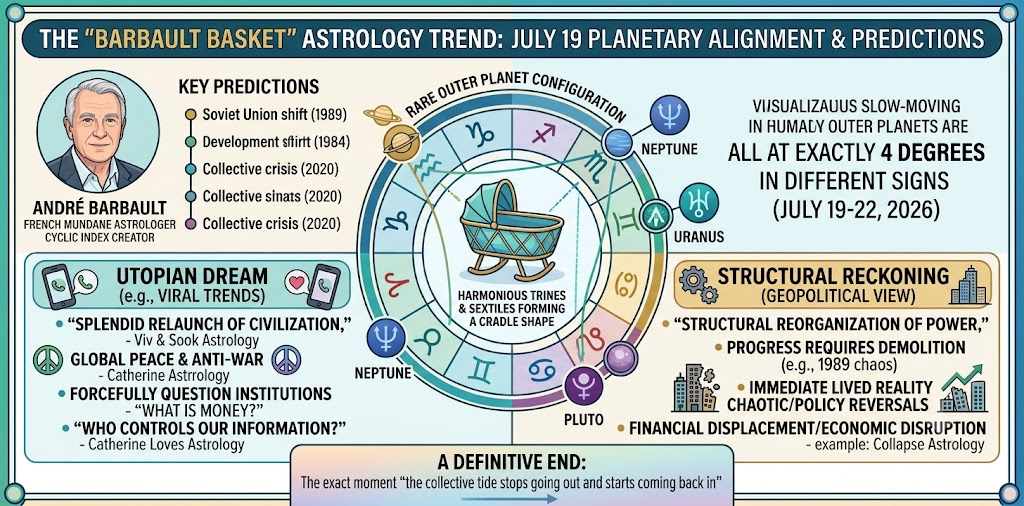
The internet is fixated on a single date: July 19, 2026. Across social media platforms and deep-dive astrology forums, talk of a looming “utopian shift” has dominated the cultural conversation. The catalyst for this sudden surge of optimism is an exceptionally rare astrological configuration known as the “Barbault Basket.”
But behind the viral trends and promises of sudden global harmony lies a much more complex, historically grounded reality. The geometric pattern forming in the sky this summer wasn’t discovered by a modern influencer. It is the final, highly anticipated calculation of a late French astrologer who spent decades tracking the macro-movements of the cosmos against the rise and fall of global superpowers.
Here is the verified data, the astronomical math, and the historical context behind the July 19 planetary alignment.
The Architect Behind the Trend: Who Was André Barbault?
Before dissecting the upcoming alignment, one must understand the man who named it. French mundane astrologer André Barbault did not deal in daily horoscopes or personal birth charts. Instead, he specialized in macroeconomics, geopolitics, and what he called the “Cyclic Index”—a tool designed to map the slow-moving outer planets to major world events.
Barbault’s track record forces even heavy skeptics to pause. In 1955, observing a specific Saturn-Neptune conjunction, he predicted that a major structural shift tied to the Kremlin would occur around 1989. Thirty-four years later, the Berlin Wall fell, and the Soviet Union subsequently collapsed. He also mapped out a period of severe collective crisis for the year 2020.
In his 2014 book Planetary Cycles, Barbault looked ahead to the summer of 2026. He noted an incredibly rare alignment of the outer planets, predicting it would trigger a “splendid relaunch of civilization.”
What is the Barbault Basket? The Astronomy of July 19
Astrologers define the Barbault Basket as a rare geometric cradle formed by the four slow-moving outer planets. What makes the July 2026 window so statistically unusual is the precise mathematical symmetry occurring on the zodiac wheel.
Between July 19 and July 22, Saturn, Neptune, Uranus, and Pluto will all position themselves at exactly 4 degrees in different zodiac signs. Connected primarily by harmonious angles—trines and sextiles—they form a distinct basket shape.
How rare is this? According to practicing astrologers, a configuration of this specific scale and harmonious outer-planetary geometry hasn’t been witnessed since 1922. To find a truly comparable astrological equivalent, researchers suggest you would have to look back to the Renaissance. Because of its sheer rarity, virtually no astrologer working today has ever experienced this specific pattern in their lifetime.
The 4-Degree Power Players
To understand the forecast, analysts look at the specific domains these planets are occupying:
- Pluto in Aquarius: The planet of transformation is moving through the sign of technology, rebellion, and social structures. The last time Pluto resided in Aquarius, the world witnessed the American Revolution in 1775 and the French Revolution in 1789.
- Uranus in Gemini: Activating mental breakthroughs, decentralized communication, and a disruption of standard information streams.
- Neptune in Aries: Driving spiritual action, demanding that societal values translate into tangible, forward momentum.
- Jupiter in Leo: At the peak of the alignment, Jupiter opposes Pluto. Historically, Jupiter governs justice systems, national wealth, and state-imposed belief systems, signaling intense scrutiny over how power and resources are concentrated.
Utopian Dream or Structural Reckoning?
The current social media trend surrounding the Barbault Basket leans heavily into utopian ideals. Content creators, including the popular duo Viv & Sook Astrology and Catherine Loves Astrology, point to the alignment’s harmonious angles as proof of an impending era of global peace. The prevalent online narrative suggests that humanity will abruptly become anti-war, close the wealth gap, and forcefully question institutions: What is money? Who serves the government? Who controls our information?
However, seasoned geopolitical astrologers warn against this wave of toxic positivity. Barbault never promised an overnight utopia; he forecasted a structural reorganization of power.
We can look to his 1989 prediction for context. While the fall of the Berlin Wall is celebrated today as a global triumph, the immediate lived reality was chaotic. East Germany experienced severe economic disruption, with local industries shuttering and regional unemployment skyrocketing to roughly 30 percent. Progress required demolition.
Similarly, the 2026 basket arrives amidst a backdrop of friction. Concurrent astrological movements during the July 19 peak—including a Mercury retrograde and a Libra Moon highlighting the financial houses—point to imminent policy reversals and a public hyper-focused on the cost of goods and personal financial displacement.
The Barbault Basket does not guarantee that the world will suddenly be bathed in sunshine. Rather, it marks the definitive end of the exhausting sociopolitical cycle that began in 2020. As one astrologer recently summarized, July 19 simply represents the exact moment “the collective tide stops going out and starts coming back in.”
Sources Quoted:
This report synthesized data, quotes, and astrological context from YourTango (citing André Barbault, Astrologer Ashley, Viv & Sook Astrology, and Catherine Loves Astrology), Hindustan Times, Sage Goddess, Medium (Collapse Astrology), and Reddit (r/Advancedastrology).
Leo Falsafi is a digital marketing veteran and senior journalist at Virlan.co, where he covers the intersection of digital marketing, gaming, and breaking US trending news. With nearly two decades of hands-on experience in SEO and digital strategy, Leo has consulted for and scaled hundreds of companies. His deep industry roots allow him to deliver sharp, fact-checked insights and analysis on the trends shaping today's digital landscape.