
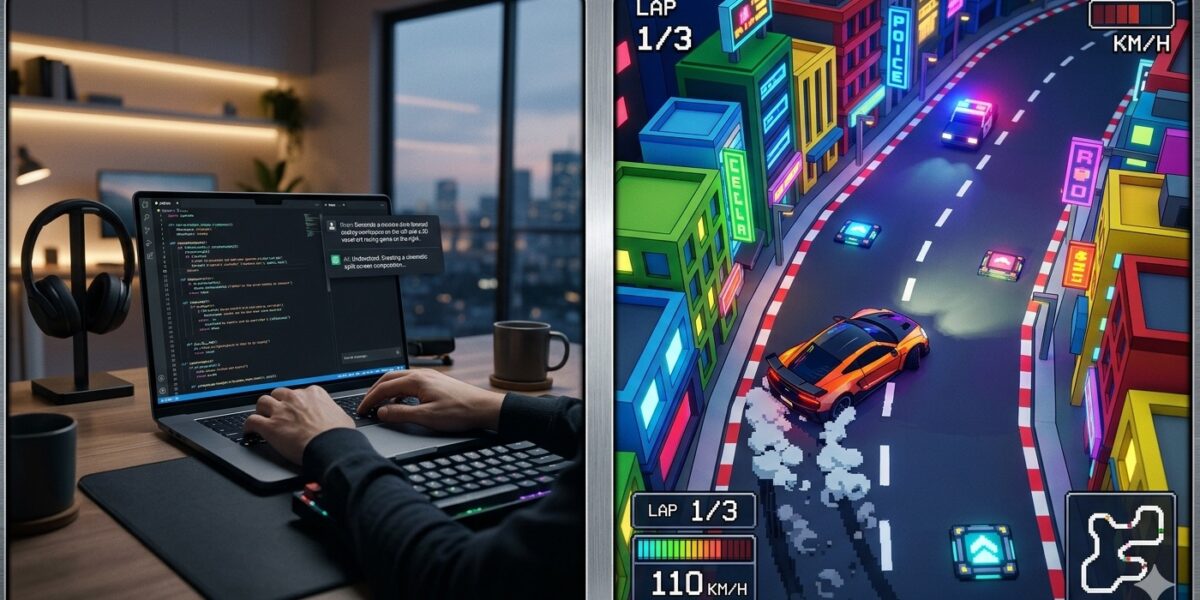
The landscape of game development has undergone a permanent shift. For decades, the barrier to entry was defined by the need for massive teams, expensive engines, and thousands of hours of manual labor. Today, that barrier has evaporated. With the right strategic use of Large Language Models (LLMs) like Gemini, a single developer can architect, build, and monetize high-end browser games in a matter of days.
This master case study examines the development of Signal Smash: Wanted, a project that demonstrates how modern web technologies and AI-driven workflows converge to create scalable digital assets.
The Paradigm Shift: Architecting vs. Coding
The most critical transition for the modern developer is moving from a “coder” mindset to an “architect” mindset. When you work with AI, you are not typing every line of syntax; you are managing a complex system of logic, physics, and user experience.
The Signal Smash Case Study
Signal Smash: Wanted was engineered to be lightweight, high-performance, and monetization-ready. By leveraging the Web Audio API and HTML5 Canvas, the project avoids the bloat of traditional game engines.
- Procedural Generation: Instead of relying on heavy audio files, the game utilizes the Web Audio API to synthesize engine noise, sirens, and explosions procedurally. This results in a lightning-fast load time, which is critical for browser-based retention.
- A Pathfinding:* To create the “mission guide” and AI enemy behaviors, we implemented A* pathfinding. Gemini served as the senior developer, helping structure the logic to ensure enemies could navigate complex city blocks without breaking immersion.
- Backend Integration: The game utilizes Firebase Firestore to facilitate real-time global leaderboards and player statistics, proving that simple browser games can offer deep, competitive social loops.

- Play the game directly here: Signal Smash: Wanted
- Read the full mechanics guide: Game Introduction & Briefing
Monetization: How to Turn Games into Revenue
Building the game is only half the battle. To earn money in this field, you must treat your game as a piece of digital real estate. Here are three proven strategies for monetizing AI-assisted browser games:
1. Lead Generation and “Blue Ocean” Marketing
Browser games serve as excellent top-of-funnel assets. By creating high-quality, free-to-play experiences like Signal Smash, you establish authority in the gaming niche. This traffic is then directed toward your primary business ecosystem—such as the Virlan.co platform—which focuses on evergreen guides and expert-authored content.
2. Playable Advertisements
The demand for interactive, browser-based “playable ads” is massive. By mastering HTML5 game development, you can create high-converting assets for other brands. A game that takes you three days to build with AI can be licensed or repurposed as a lead-generation tool for major gambling or tech platforms.
3. AI-Driven Business Intelligence (The “Project Vertex” Model)
Move beyond the game itself. The skills learned while building game engines (managing data, optimizing front-end displays, integrating APIs) are directly transferable to business intelligence tools. We are currently utilizing similar workflows to develop “Project Vertex,” an AI-powered business dashboard designed to solve monetization problems for digital marketers.
Master Workflow: From Prompt to Play
For enthusiasts looking to replicate this success, adopt the following four-step workflow:
- Define the Core Loop: Before writing code, define the “fun.” For Signal Smash, the loop was simple: Listen for the signal $\rightarrow$ Navigate the grid $\rightarrow$ Evade the police. Use AI to refine this loop before a single line of code is written.
- Modular Development: Break the game into isolated systems: Audio, Physics, AI, and UI. Tackle these one by one. Use Gemini to write the boilerplate for the Canvas rendering, then iterate on the physics specific to your game’s movement.
- Optimization for Retention: Browser games live or die by load times. Prioritize procedural assets over static ones. If you can generate it with code, do not load it from a server.
- SEO-First Publishing: Do not just launch a game—launch a page. Optimize your game’s landing page for search engines by providing expert commentary, mechanics breakdowns, and guides. This provides the “evergreen” value that search engines prioritize.
Also read: How to Monetize HTML5 Games Using Gemini (Without a Dev Team)
Why Virlan.co is the Blueprint
The strategy behind Virlan.co is simple: we provide the “how” (the game) and the “why” (the expert guidance). By focusing on specialized, authoritative content rather than the noise of daily news, we capture high-intent traffic.
For anyone looking to enter this field, stop waiting for the “perfect” engine. Use the tools available today. Whether you are building browser-based racing games or enterprise-grade business dashboards, the ability to rapidly turn an idea into an executable asset is the most valuable skill set in the digital economy.
The AI revolution in game development has arrived. It is time to start building.
Leo Falsafi is a digital marketing veteran and senior journalist at Virlan.co, where he covers the intersection of digital marketing, gaming, and breaking US trending news. With nearly two decades of hands-on experience in SEO and digital strategy, Leo has consulted for and scaled hundreds of companies. His deep industry roots allow him to deliver sharp, fact-checked insights and analysis on the trends shaping today's digital landscape.