
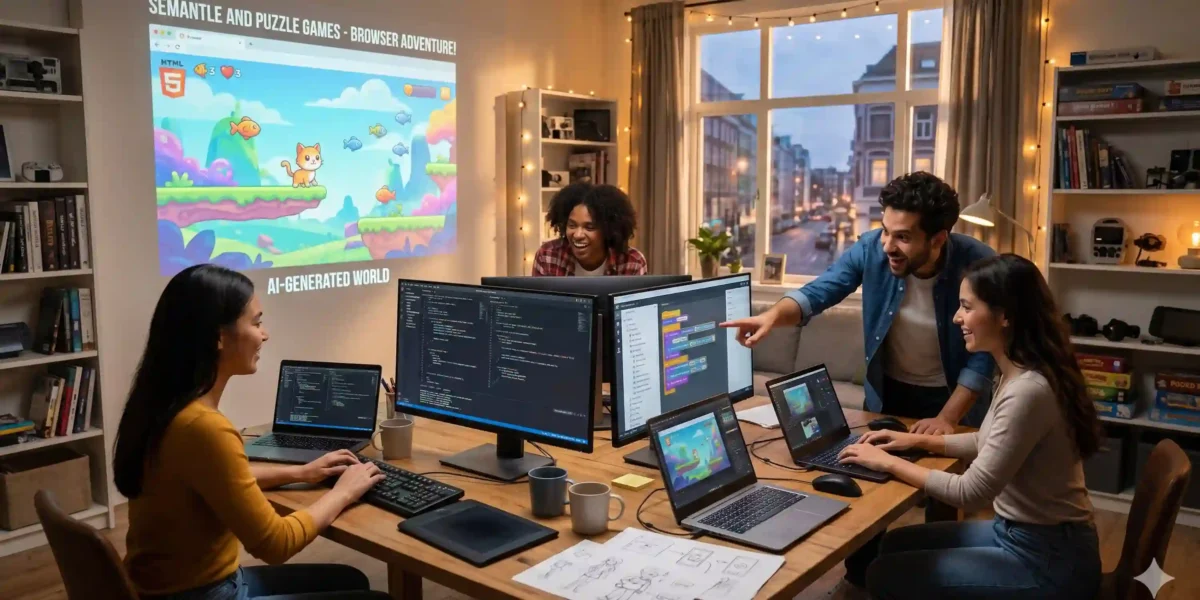
The use of artificial intelligence in a medium like video games is seen as a double-edged sword. Despite this resistance, it’s likely that some of your games are already using these tools, and you don’t even know it.
In an interview with mobilegamer.biz, Jack Buser, Google Cloud’s Global Director for Games, spoke during GDC and revealed key details: “The cost of game development across the entire industry, including mobile, has nearly doubled since 2017. More than half of all playtime is spent on games that are over six years old. So you’re spending twice as much to reach less than half of the audience.”
I think what players don’t realize is that their favorite games right now were already built with AI. Roughly nine out of 10 game developers told Google Cloud they are using it. One of the big problems that they have is they’re building massive worlds and they’ve got to fill it with content. What they’re doing is using AI like Nano Banana and Gemini to rapidly generate countless ideas and curate them for the art director.
Also read: How I Built “Signal Smash: Wanted” in Days Using Gemini
The AAA Blockbusters Using GenAI Tools
The topic of GenAI tools and game developers using them continues to be a controversial point across the industry. Yet, Steam games that openly use generative AI earned $660 million this year, as studios continue to rely on the technology.
- Tomb Raider: Legacy of AtlantisThe latest AAA game made with GenAI tools in an “early exploration” development phase. The statement on the game’s Steam page reads, “AI-assisted tools were used during development to support some early exploration and temporary development content. Any AI-assisted assets were either replaced or refined by humans in order to maintain the creative and artistic vision of the development team.”
- Clair Obscur: Expedition 33One of the highest-profile cases, this game won more Game of the Year awards than any other game in history so far and has over 8 million copies sold. It faced a wave of backlash for using AI-generated textures as placeholders that ended up as player-facing assets, but that didn’t stop it from being a commercial and critical success.
- ARC RaidersARC Raiders has shot past 16 million copies sold since October 2025. Cutscenes use AI-generated voicelines, and AI-trained voice changers are also in the gameplay.
- Crimson DesertAlready one of the best-selling games in the US for 2026, made with the help of GenAI tools in the process.
- Major Franchises: Call of Duty, Battlefield, and StellarisTitles like Call of Duty: Black Ops 6, Call of Duty: Black Ops 7, and Battlefield 6 have utilized AI for post-launch calling cards, emblems, and other art assets.
The Rise of Fully AI-Generated Indie Hits
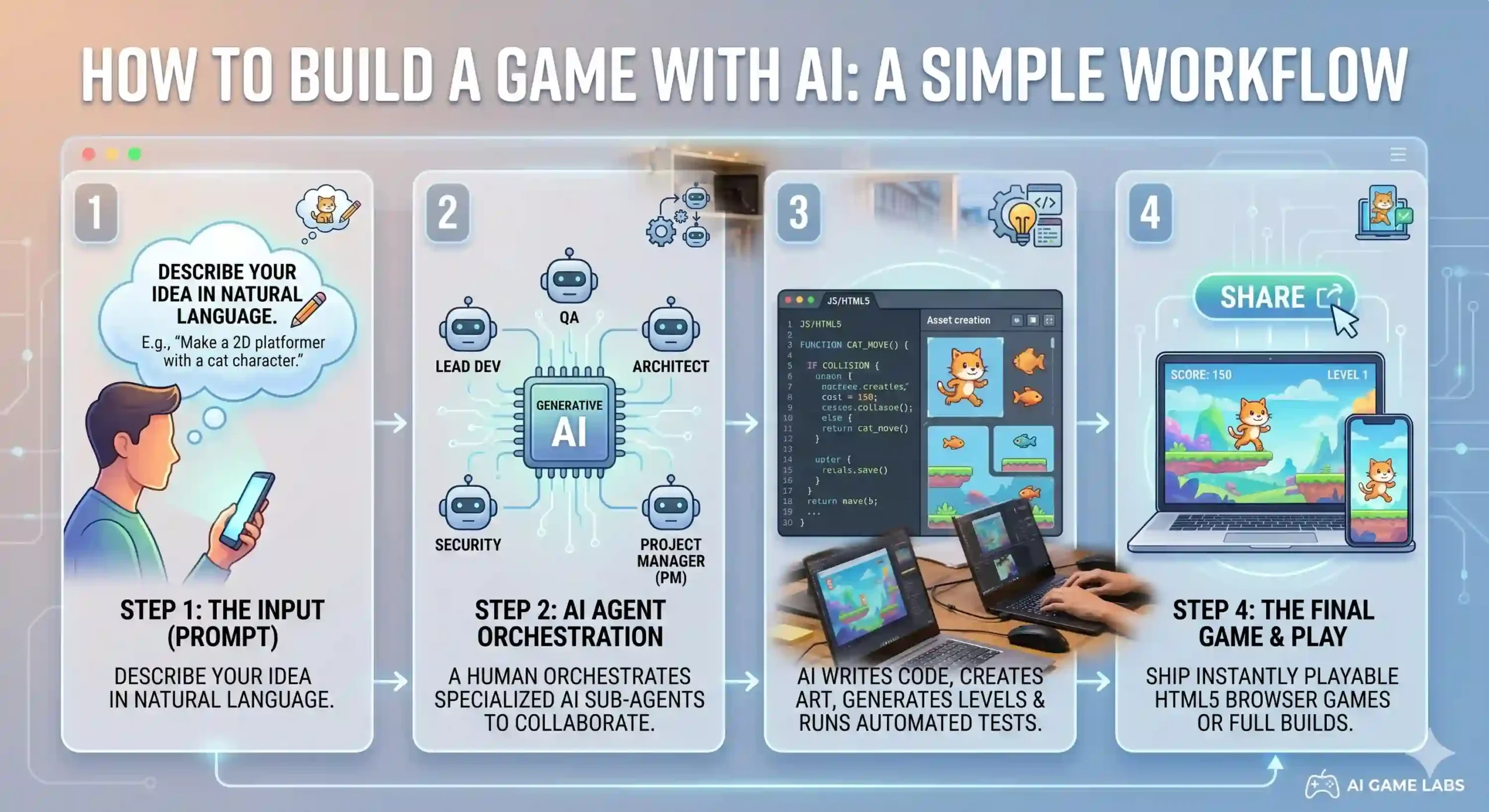
AI-generated games have evolved from simple experiments to fully playable experiences. Developers describe what they want through natural language prompts, and the AI generates the game logic, assets, animations, and code. Games that once took weeks or months to prototype can now be created in minutes to hours. Here are real examples of famous AI-generated games:
- The Last Free Man (3D Sci-Fi Shooter): One of the most ambitious AI-generated games to date. Built primarily through AI-powered code generation and asset creation, reducing development from months to days. Technical achievements include full 3D shooter mechanics, enemy AI with navmesh pathfinding, and dynamic lighting.
- Castle Destroyer (Physics-Based Strategy Game): The entire physics simulation, block placement system, and enemy targeting AI were generated through conversational prompting. This showcases AI’s ability to handle complex physics interactions and strategic game logic without manual coding.
- Happy Llama: Magical Meadow (Cozy Adventure): The creator used AI to generate the entire adventure structure, character behaviors, and environmental effects through descriptive prompts. This example proves AI can handle narrative-driven games with emotional storytelling.
Players Are Voting With Their Wallets
Whenever a developer admits to using GenAI tools, there’s usually a public outcry and backlash towards that studio. But either way, it doesn’t seem to have any bearing on the games players buy. While it’s certainly still up for debate as to whether the kinds of GenAI tools we see today will inevitably be a part of the game development process like any other, what’s keeping that future possible is the fact that players aren’t voting against it with their wallets. As long as whatever public controversy caused by developers using GenAI doesn’t meaningfully impact their bottom line, we’re going to continue seeing studios at all levels continue to experiment with the technology.
Watch an AI Agent Build a Game Entirely from Scratch
This video demonstrates the practical workflow of orchestrating an AI agent to go from a simple prompt to a fully playable game without writing manual code.
The HTML5 Game Development Revolution: Best AI Tools and Engines in 2026
Picture this: In just the first six months of 2025, over 15,000 HTML5 games launched—that’s nearly three times more than the entire previous year. Now, as we sit here in early 2026 looking back, the numbers tell an even more compelling story. The HTML5 games market was valued at $4.22 billion in 2024 and is projected to reach $9.87 billion by 2033, growing at a robust 10.2% CAGR. What changed? Not developer talent or market demand, but something more fundamental: the tools themselves.
Today’s HTML5 game development tools have evolved from basic frameworks into sophisticated ecosystems that handle everything from physics simulation to AI-driven character dialogue. The secret? HTML5 games run directly in web browsers across every device—smartphones, tablets, desktops—without downloads or installations. This instant accessibility transforms everything about game distribution and player acquisition.
How to build a game with AI
AI Tools: The Game Development Revolution
Artificial intelligence is transforming HTML5 game development tools by automating tasks that traditionally consumed 40-60% of production schedules. Industry reports indicate AI-assisted workflows reduce production timelines by 30-50% and lower creative asset costs by 40-60%. For indie developers on constrained budgets, this transforms feasibility—12-month projects might ship in 6 months with strategic AI integration.
Intelligent NPC behavior through Inworld AI eliminates the need for thousands of dialogue branches. Define character archetypes and background; Inworld generates contextually appropriate responses, extending to voice synthesis and narrative generation. Automated quality assurance via Modl:test applies AI agents to simulate player behavior and detect bugs systematically.
The Best AI Game Generators and Tools (2026)
Most lists of AI game generators in 2026 are filler. They name twenty tools, slap a star rating on each, and skip the part where most of them cannot ship a real game. This guide does the opposite. If you only have thirty seconds: Summer Engine is the best AI game generator in 2026 for shipping a real game. Rosebud wins for a five minute browser prototype.
- Rosebud AI (Best Browser Generator): Hosted browser based AI game generator. Best for: Quick playable web prototypes, game jams, sharing a link with a friend. Rosebud generates HTML5 games from a prompt. Type “Make a platformer where a cat collects fish” and you get a playable browser game in seconds. The bar to get to a thing you can share is the lowest in the industry. Zero setup, instant feedback, shareable link.
- Summer Engine (Best Overall): AI native game engine, compatible with Godot 4. Best for: Solo devs and small teams shipping a real 2D or 3D game to Steam. Summer Engine treats natural language as a first class input. You describe what you want and the engine builds it inside your project. It sees your scene tree, your scripts, and your assets, so prompts compound instead of starting from zero every time.
- Cursor for Game Development: AI native code editor. Best for: Developers writing code heavy game systems in C#, GDScript, or C++. Cursor is a VS Code based editor with AI built into the core. For game dev it shines on systems code: networking, save systems, AI behavior trees, anything that lives in a script rather than a scene.
Code vs. No-Code: Powerhouse HTML5 Engines
Before diving into specific tools, you need to answer one fundamental question: Do you want to write code or work visually?
- Phaser (The 2D Champion): Phaser dominates the 2D space, accounting for 7.1% of all new HTML5 releases. This open-source JavaScript framework excels at arcade-style games, casual titles, and physics-based experiences.
- Construct 3 (Zero Code Required): Construct 3 eliminates programming entirely. Instead of writing code, you specify game logic through a condition-action interface: “If player collides with enemy, subtract 10 health points and play damage sound.”
- PlayCanvas (Collaborative Cloud Development): PlayCanvas revolutionizes team collaboration through browser-based development. Multiple developers edit the same 3D project simultaneously—like Google Docs for game development.
The Future Is Already Here
The explosive growth of HTML5 games reflects a fundamental democratization. Team size, budget, and prior experience no longer represent immovable barriers. Talented individuals with good ideas can now build, polish, and ship engaging games without massive infrastructure. Whether coding in Phaser, designing in Construct 3, or accelerating with AI tools, the barrier to entry has never been lower.
Best AI Games to Play Right Now: The Browser Revolution
AI games are no longer a niche curiosity — they are one of the most exciting frontiers in gaming. From text adventures that write themselves to fully playable RPGs built entirely by AI, the landscape has exploded in the last two years.
Browser games have always been about accessibility — no downloads, no installs, just click and play. AI has supercharged this category.
The Most Popular AI Browser Games
- Semantle and Puzzle Games: Several browser games use AI to generate unique puzzles for each player. Instead of hand-designed levels, the AI creates challenges calibrated to your skill level and play style. Games like Semantle use word embeddings (a form of AI) to create daily word puzzles that went viral.
- AI Dungeon and Storium: Platforms like Storium and web-based versions of AI Dungeon bring full AI storytelling to the browser. No app required — just open a tab and start playing.
- Experimental Interactions: Some of the most creative AI games are small browser experiments: AI that plays 20 Questions, chatbots you have to trick into revealing a secret password, or games where you negotiate with an AI merchant. These micro-games showcase what is possible when AI is the core mechanic rather than an enhancement.
This is a Snake Io game I made in one day with Gemini AI : Snake: Pro Arena

Vibe-Coded Games: A New Category
One of the most significant developments in AI gaming is the rise of vibe-coded games — games built entirely or primarily using AI coding tools. A creator describes what they want in natural language, and tools like Cursor, Claude Code, or Lovable generate the code.
Vibe coding has dramatically lowered the barrier to game creation. People who have never written a line of code are shipping playable games in hours or days. This has produced an explosion of creative, quirky, and sometimes brilliant games that would never have existed under traditional development economics.
The results range from simple but addictive browser puzzles to surprisingly polished arcade games, strategy titles, and even narrative experiences. What they share is a distinctive quality — they tend to be more experimental, more personal, and more willing to try unusual ideas than commercially-developed games.
Many of these games are shared on platforms like itch.io, but the best curated collection lives at the HowWorks AI Games Collection. The best time to start playing AI games was two years ago. The second best time is right now.
From Prompt to Playable: Can AI Agents Build an Entire Game Alone?
Generative AI in gaming represents a fundamental shift in how games are created, designed, and experienced. Unlike traditional game development where every asset, dialogue line, and environment must be manually crafted by artists, writers, and designers, generative AI systems can automatically create vast amounts of high-quality game content in minutes or hours instead of weeks or months. Generative AI Gaming refers to artificial intelligence tools that automatically create game content including 3D models, textures, environments, character sprites, NPC dialogue, quest narratives, and procedurally generated worlds.
What if you could build a full game prototype — not a toy demo, but something with 14 interconnected systems — in a single day? That’s exactly what I did with Somnia, a cozy life-sim RPG built in Godot 4.6 with GDScript. The twist: I orchestrated a team of AI sub-agents working in parallel, each with a dedicated role. Let me be clear — this wasn’t ‘paste a prompt into ChatGPT and get a game.’ These agents worked in parallel — while the Architect was designing the combat system, QA was already writing tests for the farming system that Lead Dev had just finished. The PM kept everything sequenced so agents weren’t blocked on each other. Every system followed the same cycle: QA writes test cases based on the Architect’s spec. Lead Dev implements until tests pass. Security reviews for edge cases, QA adds regression tests.
The question isn’t “Can AI write code?” — it obviously can. The real question is: “Can you design a system where multiple AI agents collaborate effectively?” The game dev landscape is shifting, and the developers who learn to orchestrate AI teams will build things that were previously impossible solo.
Chrono Shift: Time Weaver represents a new frontier in game development – human creativity guided by AI assistance. This game was built entirely with the help of Lovable, an AI coding assistant. The codebase includes: HTML5 Canvas for rendering the game world. Custom game engine handling physics, collisions, and timeline switching. Particle system for time-shift effects and visual feedback. The entire game was generated through natural language prompts, demonstrating how AI can accelerate game development while maintaining creative control.
With platforms like Rosebud, you can craft games in 2D or 3D, and also any kind of interactive web based project. Just describe your idea, let AI generate it, and start playing — no coding or downloads needed. Rosebud’s AI engine instantly turns your description into a playable game, complete with mechanics, visuals, and code. You can use Seele as your AI game maker to turn one prompt into a playable browser-game prototype. Generate scenes, gameplay logic, first-pass assets, and export-ready directions without starting from a blank engine project.
Leo Falsafi is a digital marketing veteran and senior journalist at Virlan.co, where he covers the intersection of digital marketing, gaming, and breaking US trending news. With nearly two decades of hands-on experience in SEO and digital strategy, Leo has consulted for and scaled hundreds of companies. His deep industry roots allow him to deliver sharp, fact-checked insights and analysis on the trends shaping today's digital landscape.