
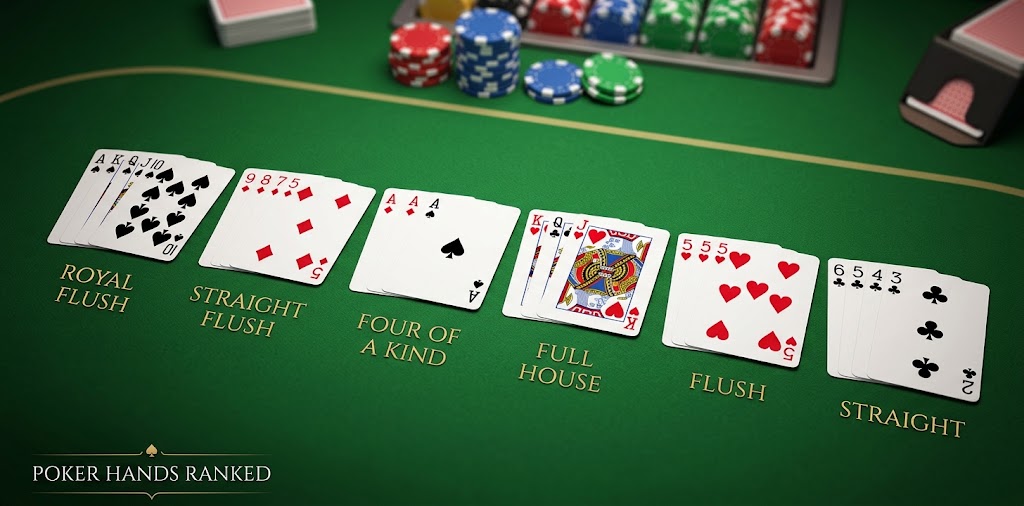
Poker Hands Ranked From Highest to Lowest
Poker hands ranked from highest to lowest: There are 2.6 million different five-card combinations in poker, but only ten different hand ranks, from a lowly high card up to that elusive royal flush. Card ranks run from 2 (lowest) to Ace (highest): 2–3–4–5–6–7–8–9–10–J–Q–K–A. Suits carry no relative ranking ♣= ♦ =♥=♠ so two otherwise identical hands of different suits split the pot. An Ace can serve as high (above King) or low (below 2) only in straights Your odds of getting dealt each of those types of hands go down as you move up the ranking chart.
#1. Royal Flush
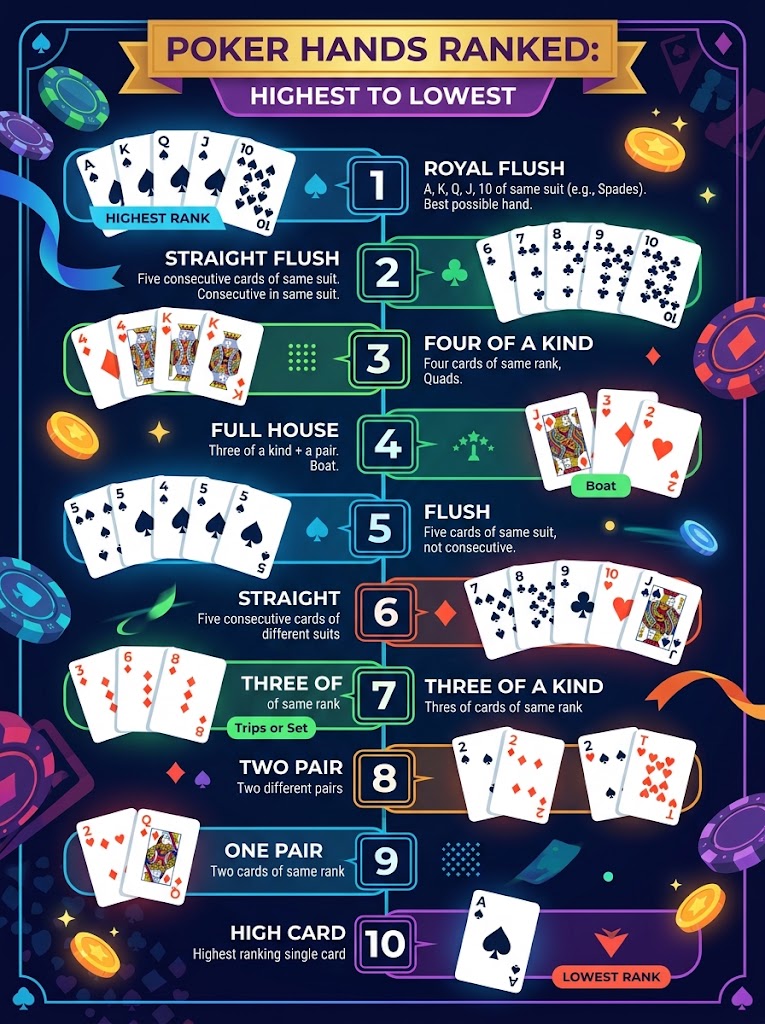
The Royal Flush is the very best hand in poker and is impossible to beat in a standard game. An ace, king, queen, jack, ten – all the same suit. Because it’s so incredibly rare, it’s the most sought-after hand in poker. It’s the rarest combination, only four possible per suit in a 52-card deck. odds ≈1-in 649,739. A Royal Flush cannot be beaten. In the event that two players have royal flushes of different suits (mirrored decks), the pot is split.
#2. Straight Flush
A Straight Flush is a hand with five cards of the same suit that are in a row. Any straight with all cards in the same suit is a straight flush, but this hand is also very rare. 36 possible combinations per deck (excluding Royal flushes) odds ≈1-in 72,192. If two players both have a Straight Flush, the one with the highest card in their sequence wins.
#3. Four of a Kind (Quads)
The third best hand possible in poker, four cards of the same rank with a side card. Also known as quads. 624 combinations; odds ≈1-in-4,164. If both you and your opponent share the same Four of a Kind on the board, the player who has the higher side card has the winning hand.
#4. Full House
A Full House is a hand made up of three cards of one rank and two cards of another, which is a mix of a Three-of-a-Kind and a Pair. Combinations: 3,744; odds ≈1-in-694. The value of a Full House is first decided by the rank of the three cards, and then by the rank of the pair.
#5. Flush
A Flush in poker is a hand that has five cards, all of the same suit. Combinations: 5,108; odds ≈1-in-508. The suit of the Flush doesn’t matter as all suits are equal, but as long as you have five cards that are all the same suit, for instance five diamonds, then you have a Flush. The strength of it is based on its highest card, followed by its second highest and so on. When two or more players have a Flush, this is the tie-breaker used to determine the winner of the hand.
#6. Straight
A Straight in poker is five cards that have consecutive numeric values. Combinations: 10,200; odds ≈1-in-254. Suit is irrelevant (unless all five cards are the same suit, in which case the hand becomes a Straight Flush), as long as five cards are in consecutive order of value. If there are two Straights in a hand, then the one with the highest cards wins.
#7. Three of a Kind (Trips/Set)
Three cards of one rank plus two unrelated kickers. Combinations: 54,912; odds ≈1-in-46. If two or more players have this hand, the Three-of-a-kind with the higher rank wins.
#8. Two Pair
Two different pairs of cards with the same value. Combinations: 123,552; odds ≈1-in-20. The higher pair of the two determines the rank of the Two Pair in case two or more players hold Two Pair. If those are equal, it goes to the highest value of the second Pair. If those are also equal, the tiebreaker is the kicker (the fifth, unpaired card).
#9. One Pair
One Pair is a hand with two cards of the same rank and three other cards of different ranks. This is the most common winning hand in Texas Hold’em. Combinations: 1,098,240; odds ≈1-in-1.37. If two players have a pair of the same rank, the hand is decided by the highest-ranking extra cards, or kickers.
#10. High Card
A High Card hand is the lowest-ranked combination, where none of the cards form any of the hands listed above. Combinations: 1,302,540; odds ≈ roughly 1:1. When comparing two High Card hands, the highest-ranking card in each hand decides the winner.
Math & Odds of Improving Poker Hands
Poker hand odds tell you how likely a specific outcome is compared to how unlikely it is. Every hand you’re dealt, every card that comes on the flop, turn, or river, and every decision your opponent makes can be measured against known odds. In Texas Hold’em, you’ll often encounter situations where you have four out of five cards for a strong hand and are hoping to improve with the next community card. The cards that will help you improve are called outs.
Drawing to a Straight
Open-Ended Straight Draw – 4.8:1. An open-ended straight draw occurs when you have four consecutive cards, giving two possible ways to complete a straight — top and bottom. The odds of completing your straight on the turn are about 4.8-to-1. You have a 31.5% chance of making your straight by the river, or about once every 3.17 times. Gutshot Straight Draw – 10.5:1. A gutshot straight draw happens when you need one specific card in the middle of your hand to complete a straight. Your odds of hitting this specific card are about 10.5-to-1. Your odds of hitting it on either turn or river are about once every six times, or 16.5%.
Hitting a Set
Improving to a Set – 22:1. If you’re holding a pocket pair, the odds of improving to three of a kind (a set) on the turn are about 22-to-1. Your chance to hit it by the river is around 8.4%.
The Craziest Poker Hands of 2026: Foxen Defies GTO & The 11-Minute WSOP Tank
Biggest Poker Hands 2026: Alex Foxen Hero Call vs Chidwick
There aren’t many players you’d want to face in a massive river spot less than Stephen Chidwick. Chidwick had fired 525,000 into a pot of 344,000. Foxen went deep into the tank before eventually finding the call with ace-five suited. Chidwick turned over a stone-cold bluff, while Foxen’s pair of fives was enough to drag a pot worth almost 1.4 million. Great call, right? In practice, absolutely. In theory, not quite.
High Stakes Poker Hero Calls: GTO Wizard Poker Analysis
GTO Wizard folds 64.4% of Foxen’s range in this spot, slightly more than the figure suggested by minimum defence frequency, and A5 overwhelmingly belongs in the muck. It might seem strange that Foxen should fold A5 when some weaker five-x hands are allowed to call. The answer comes down to blockers. Foxen’s hand removes one of those potential bluff combinations from Chidwick’s range. When you’re facing an enormous polarized river bet, that can matter more than the small difference in showdown value between two bluff-catchers. Against a perfectly constructed range, A5 should mostly fold. Against Stephen Chidwick, in this particular hand, Foxen found a reason to do something else.
2026 WSOP Main Event Final Hand: Lucas Jumalon vs Lauri Saaskilahti
Lucas Jumalon is an American poker player from Spokane, Washington. In 2026, he defeated a 9,208-player field to win the WSOP Main Event. He became the second-youngest WSOP Main Event champion ever, aged just 22 years, four months and 27 days old. Jumalon’s path to the chip lead on Day 8 was defined by aggressive gear-shifting and immense composure. By the dinner break, Jumalon had surged into the overall chip lead with 155,000,000 in chips.
Jumalon remained composed across the first two days of final table action, never relinquishing his chiplead as he bagged ahead of the final day with just himself and Lauri Saaskilahti left standing. He defeated Finland’s Lauri Saaskilahti heads-up to win the $10,000,000 first prize. By navigating his way to this final table, he has already locked up a career-defining minimum payout of $1,000,000. Now he’s among poker’s immortals.
11-Minute WSOP Tank
The heads-up battle for the $10 million prize between Saaskilahti and champion Lucas Jumalon featured a grueling 11-minute tank. The controversial hero calls made under this extreme pressure have sparked debate across the community about decision trees and tournament life preservation at the highest level.
Fight Erupts in Low-Stakes Event
A wild scene transpired in a low-stakes tournament in Michigan. Fight Erupts in $20 Tournament After Player and Dealer Argue Over Blinds.
Poker Hands Cheat Sheet: Rankings From Best to Worst
Before you hit the online poker tables, you’ll need to familiarise yourself with the basic hand rankings and rules that govern Texas Hold’em. Here are the 10 hands every player should know before joining the action.
1. Royal Flush
A Royal Flush is the Ace, King, Queen, Jack, and 10 all of the same suit. Poker’s most famous hand, a royal flush, cannot be beaten. This hand is the rarest and highest possible hand in poker, so getting one is a guaranteed win. Combinations: 4. Hand Probability: 0.000154%.
2. Straight Flush
Five consecutive cards of any suit – 8s 7s 6s 5s 4s. A straight flush beats four-of-a-kind and any worse hands. It’s strong, but definitely a ‘once in a lifetime’ type hand. Combinations: 36. Hand Probability: 0.00139%.
3. Four of a Kind (Quads)
Four cards of the same rank plus one card of a different rank (e.g., Q♠ Q♥ Q♦ Q♣ 7♣). You’re practically certain to win with this hand as well. Combinations: 624. Hand Probability: 0.0240%.
4. Full House
Three cards of one rank plus two cards of another rank (three-of-a-kind combined with a separate pair). A full beats a flush in poker. It also beats a straight and all lower-ranked hands. Combinations: 3,744. Hand Probability: 0.1441%.
5. Flush
Five cards of the same suit in any order, not forming a straight (e.g., K♣ 10♣ 8♣ 5♣ 3♣). As a plus, it looks pretty and wins a lot. Combinations: 5,108. Hand Probability: 0.1965%.
6. Straight
Five cards in sequential order with mixed suits, without all five being the same suit. Straights beat three-of-a-kind and any lower-ranked hands. Combinations: 10,200. Probability: 0.39%.
7. Three of a Kind (Trips/Set)
Three cards of the same ranking + two unpaired cards – 6s 6d 6c Jh 4d. Combinations: 54,912. Probability: 2.1128%.
8. Two Pair
Two pairs of came ranking cards – Kd Ks 8h 8s 5d. If both players have an identical Two Pair, the highest side card (‘kicker’) wins. Combinations: 123,552. Probability: 4.7539%.
9. One Pair
Two cards of matching rank, and three unrelated side cards. One pair only beats a non-ranked high-card hand. If two players have one pair, the highest-value pair wins. Combinations: 1,098,240. Probability: 42.2569%.
10. High Card
Five cards that don’t form any ranked hand; the hand’s value is determined by the highest card. Combinations: 1,302,540. Probability: 50.12%.
Poker Starting Hands Cheat Sheet – Pick Wisely
There is no better way to learn Texas Holdem’s basics than to grab a printable poker hands cheat sheet. Good cards are closely related in value. An ace and a king are next to each other in terms of card values. Similarly, the 4♦ and the J♦ are closely related because they’re both diamonds. Cards that are closely related give you a better chance of making ranked hands in poker.
- AA (American Airlines, Pocket Rockets): The best hand in Texas Hold’em Poker, Pocket Aces are an absolute powerhouse that you never want to fold before the flop. If given the option, always get it all-in with the Aces!
- KK (Cowboys): Pocket Kings are the second strongest poker hand. This powerful pocket pair will make you heaps of money, but remember to always play it aggressively before the flop.
- QQ (Ladies): A pair of Queens is a powerful hand in almost every scenario, but a hand that can often be forced into coin flips with AK. Don’t expect miracles from your Ladies, but don’t get rid of them too fast either.
- AK (Big Slick): An Ace and a King is a powerful combination in poker, but a hand you should not necessarily get married to or put all the chips into the pot with.
A weak starting hand contains two cards that are unconnected in terms of numerical value and suits. The weakest starting hand in poker is 7-2 offsuit, e.g. 7♥ 2♠. These two cards are as unconnected as they could possibly be.
Pot Odds: Rule of 4 and 2
Start with pot odds and the Rule of 4 and 2. Pot odds compare the size of a bet to the size of the pot to tell you… how to calculate poker odds and pot odds … rule of 4 and 2 is more than enough to get you started. A quick shortcut (the ‘rule of 4 and 2’): multiply outs by 4 on the flop, or
Leo Falsafi is a digital marketing veteran and senior journalist at Virlan.co, where he covers the intersection of digital marketing, gaming, and breaking US trending news. With nearly two decades of hands-on experience in SEO and digital strategy, Leo has consulted for and scaled hundreds of companies. His deep industry roots allow him to deliver sharp, fact-checked insights and analysis on the trends shaping today's digital landscape.