
Dutch Regulatory Landscape 2026: Balancing Legality and Compliance
While the Netherlands legally permits both online gambling and sex work, authorities recognize the potential for these sectors to be targeted by criminal exploitation. To protect vulnerable individuals, the government maintains a framework of strict oversight, alongside a closely regulated toleration policy for soft drugs.
Online Gambling and the 2026 Licensing Framework
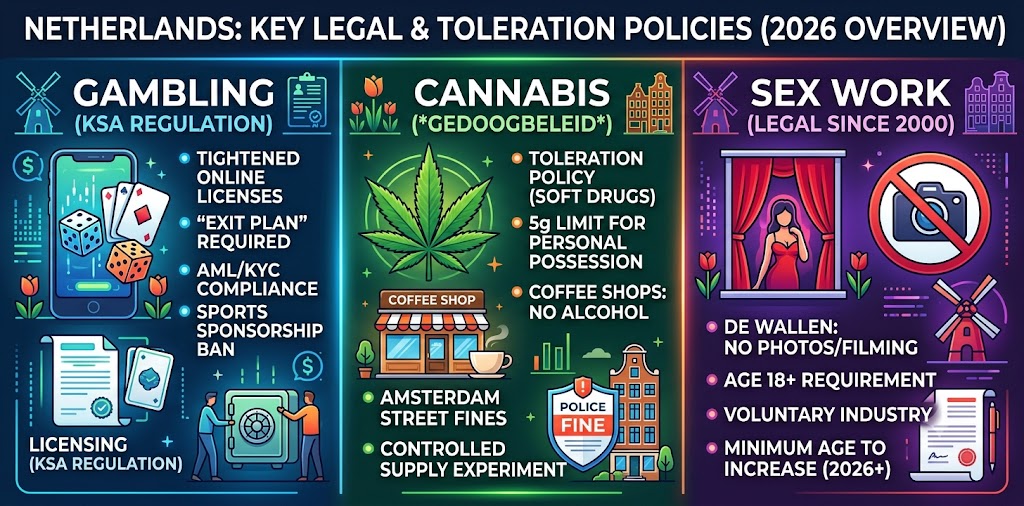
Beginning January 1, 2026, the Dutch gambling authority (KSA) is implementing tightened regulations to prepare the market for the expiration of the initial five-year licenses issued in late 2021. To improve player protection and market compliance, operators must submit extensive documentation, including a mandatory “exit plan” detailing how they would safely cease operations and withdraw from the country if a license is not renewed. Additionally, operators must conduct risk analyses adhering to the Dutch Anti-Money Laundering and Anti-Terrorist Financing Act. The KSA is also enforcing a comprehensive ban that recently removed gambling sponsorships from sports teams, athletes, and competitions.
Sex Work Regulation and Red Light District Rules
Voluntary prostitution has operated as a legally regulated industry in the Netherlands since the year 2000. However, local rules in areas like Amsterdam’s Red Light District (De Wallen) strictly govern visitor conduct. It is explicitly forbidden to photograph or film sex workers, and establishments require patrons to be at least 18 years of age. To further combat exploitation and protect vulnerable groups, the Dutch government’s 2026-2030 coalition agreement outlines plans to raise the minimum legal age for individuals engaging in sex work.
The ‘Gedoogbeleid’: Marijuana Toleration Policy and Controlled Supply
Under Dutch law, producing, possessing, or selling drugs remains technically illegal. However, the nation applies a formal toleration policy (gedoogbeleid) for soft drugs. Under this framework, authorities generally do not prosecute individuals for possessing small amounts—defined as up to five grams—of cannabis for personal use. Furthermore, specialized “coffee shops” are permitted to sell cannabis under rigid conditions, such as prohibiting the sale of alcohol on the premises and requiring ID checks. Public consumption is also increasingly regulated; since May 2023, smoking cannabis on the street in central Amsterdam carries a substantial fine. Looking forward, the government is proceeding with the Controlled Cannabis Supply Chain Experiment to evaluate if a legally regulated supply chain can better protect public health and safety.
Sources Quoted:
Facts synthesized from Government.nl (2026-2030 Coalition Agreement, Drug Policy Guidelines), IGA Group (KSA Gambling Rules), and Amsterdam Red Light District Tour advisories.
Leo Falsafi is a digital marketing veteran and senior journalist at Virlan.co, where he covers the intersection of digital marketing, gaming, and breaking US trending news. With nearly two decades of hands-on experience in SEO and digital strategy, Leo has consulted for and scaled hundreds of companies. His deep industry roots allow him to deliver sharp, fact-checked insights and analysis on the trends shaping today's digital landscape.