
Pennsylvania’s online gambling industry is facing its most significant regulatory overhaul in years. Driven by record-breaking market expansion, regulators are actively targeting the aggressive marketing tactics and permissive platform features that have fueled the state’s gambling sector.
On July 11, 2026, the Pennsylvania Gaming Control Board (PGCB) published a sweeping proposed rulemaking aimed directly at how betting apps and online casinos operate. Operating on a parallel track, state lawmakers are reviewing a separate legislative report recommending even harsher restrictions, including a total ban on credit card deposits. The core motivation is clear: state officials believe implementing robust guardrails now is necessary to prevent severe consumer protection failures down the line.
The PGCB’s July 2026 Proposed Rulemaking
The PGCB’s newly published guidelines center on player protection, advertising transparency, and mandatory internal reporting. Rather than waiting for lawmakers to pass bills, the regulatory board is utilizing its own oversight authority to enforce immediate, structural changes to online casino platforms. The public comment period for these new rules remains open until August 10, 2026.
If finalized by the board, the new regulations will implement the following requirements:
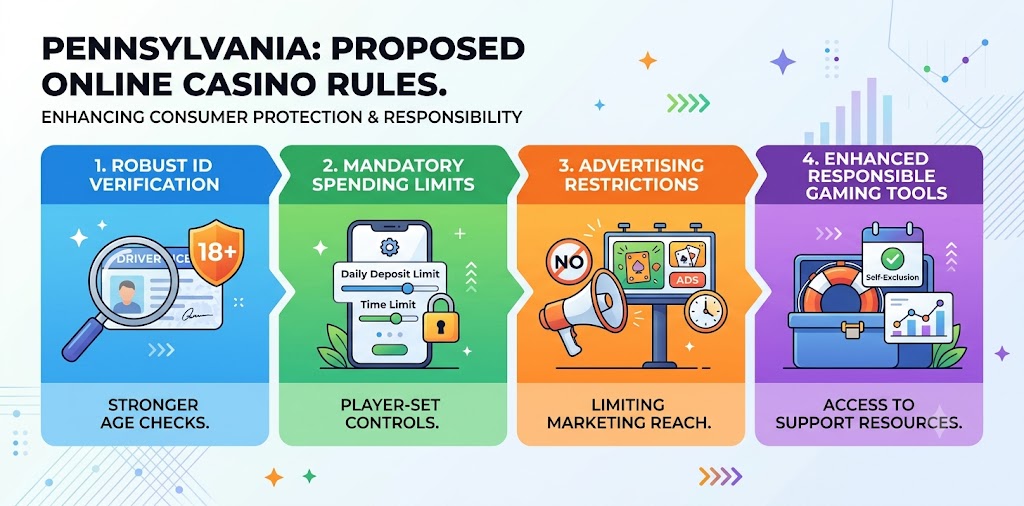
- Expanded Player Limits: Operators must provide users with prominent options to cap their daily deposits, total spending, and time spent actively logged into betting applications.
- Voluntary Suspensions: Players will gain the ability to completely pause their own accounts for up to one year.
- Advertising Restrictions: Online casinos face a strict ban on deploying advertisements where the majority of the audience consists of minors. Operators are also prohibited from sending marketing materials to individuals who have self-excluded or those mathematically shown to face a higher risk of gambling harm.
- The End of “Risk-Free” Phrasing: Following a trend seen in other mature state markets, the PGCB will outright ban the use of “free” or “risk-free” promotional language in scenarios where players still risk their own actual capital.
- Monthly Operator Reports: Platforms will be required to file monthly compliance reports specifically detailing player self-limiting and self-exclusion activity.
Legislative Study Pushes for Credit Card Ban and Live Betting Limits
While the PGCB handles platform-level operational rules, the Pennsylvania General Assembly is weighing deeper statutory restrictions. In mid-July 2026, the Joint State Government Commission released an exhaustive study examining gambling addiction within the commonwealth.
The commission noted that the rapid surge in online casinos and sports betting likely contributed to increasing consumer credit issues and domestic friction. To combat this, the report proposed several aggressive legislative shifts:
- Banning Credit Card Funding: Similar to recently introduced legislation in Colorado, the commission recommends blocking players from funding their gambling accounts via credit cards.
- Ending In-Game Wagering: The report suggests a ban on live, in-game sports betting—a highly profitable segment for operators that allows users to make rapid, impulsive wagers during live events.
- Data Sharing Programs: To proactively protect vulnerable users, the commission recommends requiring gambling companies to submit anonymized player data to a centralized agency to help detect and stop at-risk behavior.
Because these recommendations require changing state law, they cannot be enacted by the PGCB alone and must pass through the General Assembly.
Why Regulators Are Forcing the Issue Now
The urgency behind these proposed rules directly correlates to the sheer size and speed of the state’s gambling economy. On July 17, 2026, the PGCB reported that Pennsylvania’s fiscal year gaming revenue surpassed the $7 billion threshold for the first time in history.
With online casino play driving massive portions of that revenue, consumers are interacting with deposit prompts, VIP outreach programs, and bonus offers at an unprecedented rate. The Joint State Government Commission explicitly acknowledged the necessity of balancing consumer safety with this lucrative revenue stream, noting that while online gambling is economically beneficial, maximizing revenue must coincide with precise protections for the end user.
For the gaming industry, these restrictions strike directly at customer acquisition. Marketing and promotional bonuses remain the primary tools betting apps use to lure users away from competitors. By shrinking the advertising toolkit and forcing operators to remove aggressive language, Pennsylvania is signaling a permanent shift away from unbridled expansion and toward highly regulated, sustainable market retention.
Sources Quoted:
Data and regulatory insights were extracted from the Pennsylvania Gaming Control Board (PGCB) July 2026 regulatory filings, the Joint State Government Commission’s July 2026 report, Lower Bucks Times, and Legal Sports Report.
Leo Falsafi is a digital marketing veteran and senior journalist at Virlan.co, where he covers the intersection of digital marketing, gaming, and breaking US trending news. With nearly two decades of hands-on experience in SEO and digital strategy, Leo has consulted for and scaled hundreds of companies. His deep industry roots allow him to deliver sharp, fact-checked insights and analysis on the trends shaping today's digital landscape.