
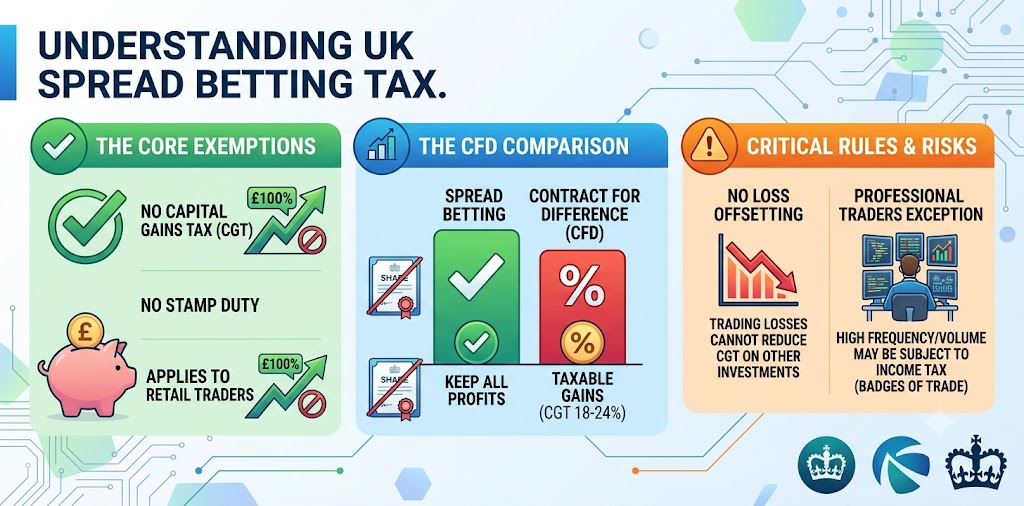
When the October 2024 UK Budget pushed Capital Gains Tax (CGT) rates on financial assets to 18% for basic-rate taxpayers and 24% for higher earners, the calculus for active market participants shifted abruptly. The widening gap between taxable derivatives and tax-exempt vehicles has placed a renewed spotlight on financial spread betting.
For the vast majority of retail traders in the UK and Ireland, spread betting remains completely insulated from Capital Gains Tax and Stamp Duty. But this tax-exempt status is highly conditional. Navigating these rules requires a clear understanding of HMRC’s legal definitions, the mechanics of derivative losses, and the strict boundaries that separate speculative trading from a taxable professional business.
The Mechanics of HMRC’s Tax Exemption
The UK tax code treats financial spread betting fundamentally differently than traditional share dealing or Contracts for Difference (CFDs). HMRC classifies spread betting not as an investment, but as a speculative bet.
Because traders are only speculating on price movements rather than purchasing physical shares, there is no transfer of underlying asset ownership. No ownership immediately negates the standard 0.5% Stamp Duty. By legally categorizing the activity as gambling, HMRC places spread betting profits entirely outside the Capital Gains Tax regime. Traders are not even required to declare these profits on a self-assessment tax return.
According to Charles Archer, Financial Writer at trading provider IG, this distinction makes spread betting “the most tax-efficient way to trade in the UK for most retail traders”.
The financial divergence between spread betting and CFDs is stark under the current 2025/2026 tax brackets. A higher-rate taxpayer generating £10,000 in net CFD profits above the £3,000 annual allowance now faces a £2,400 tax liability. An equivalent return realized through a spread betting account nets the full £10,000—saving the trader 24 pence on every pound relative to a CFD gain.
The Double-Edged Sword: No Capital Loss Relief
Spread betting involves significant leverage and carries a high risk of capital loss. Many traders overlook the severe opportunity cost embedded in HMRC’s gambling classification: tax-free wins mean tax-blind losses.
Because spread betting operates outside the CGT framework, accumulated losses carry zero tax relief. If a market participant loses £5,000 on a spread bet, that deficit stays isolated. It cannot be used to reduce their overall CGT liability from other successful investments.
In contrast, a £5,000 loss on a CFD can be offset against broader portfolio gains in the same tax year, effectively acting as a deduction against capital gains. For individuals maintaining diverse, long-term investment portfolios, this lack of loss offsetting makes spread betting structurally rigid. While the absence of taxation on gains is mathematically advantageous during profitable periods, the inability to harvest losses leaves traders entirely exposed when the market moves against them.
The ‘Badges of Trade’ Threshold: When HMRC Demands Income Tax
The tax-free perimeter around spread betting is not absolute. If a trader scales their operations to the point where their activity mimics a full-time profession, HMRC can revoke the gambling exemption.
When trading scale, frequency, and intent meet the legal criteria known as the “badges of trade,” HMRC views the activity as a primary business rather than occasional speculation. If a trader crosses this threshold, their profits instantly become subject to standard UK Income Tax.
HMRC’s internal manual (BIM22020), which references historic precedents like Down v Compston, clarifies exactly how this distinction is applied. To be taxable as income, HMRC dictates that spread betting wins “must arise from the carrying on of that trade” rather than just an opportunity presented by it. The determination relies entirely on the economic substance of the trader’s daily operations. While this reclassification is exceedingly rare for casual retail traders, it is a material risk for high-volume, professional-level algorithmic or day traders whose primary household income relies on leveraged market speculation.
Sources Quoted
- IG / Charles Archer (Financial Writer): “How are spread bets and CFDs taxed in the UK? 2025/26 guide” regarding CFD tax calculations, allowance figures, and budget changes.
- Trade Nation: “Is Spread Betting Tax-Free in the UK?” regarding Stamp Duty percentages and asset ownership rules.
- GOV.UK (HMRC Internal Manuals): BIM22020 guidelines on the “badges of trade,” the Down v Compston precedent, and income tax triggers.
Leo Falsafi is a digital marketing veteran and senior journalist at Virlan.co, where he covers the intersection of digital marketing, gaming, and breaking US trending news. With nearly two decades of hands-on experience in SEO and digital strategy, Leo has consulted for and scaled hundreds of companies. His deep industry roots allow him to deliver sharp, fact-checked insights and analysis on the trends shaping today's digital landscape.