
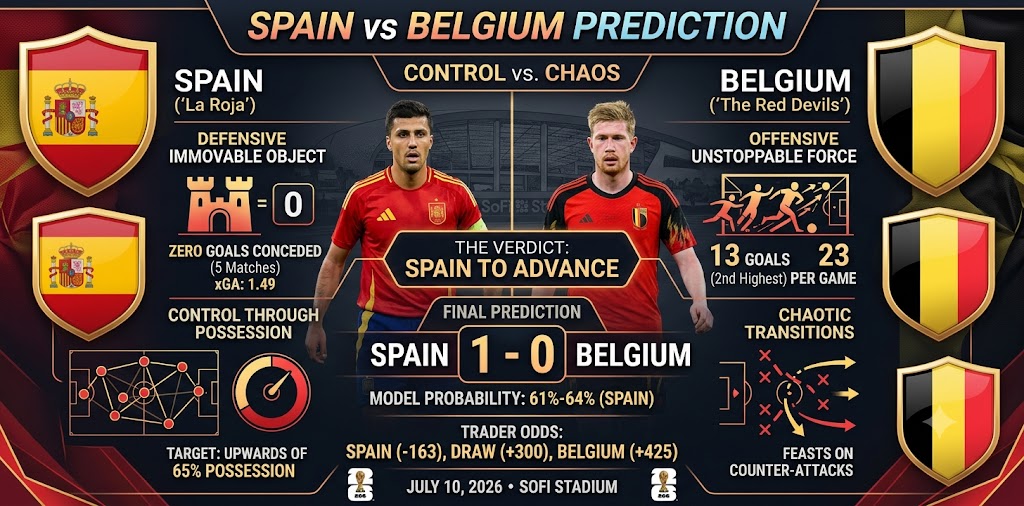
The ultimate test of immovable object versus unstoppable force arrives this Friday, July 10, 2026, at SoFi Stadium. Spain and Belgium will collide in a 2026 World Cup quarter-final that has bookmakers, analytical models, and tactical purists entirely captivated.
On one side stands Luis de la Fuente’s Spain—a masterclass in possession and defensive suffocation. They have yet to concede a single goal in this tournament. On the other side is a relentless, high-octane Belgian squad that just dismantled the host nation, the United States, in a 4-1 thrashing.
This is more than a match. It is a legacy-defining 90 minutes. For Spain, it validates a modernized, pragmatic approach to their traditional possession game. For Belgium’s heralded core, it is quite literally the last dance.
The Tactical Landscape: Control vs. Chaos
To understand how this match will unfold, you have to look at how both teams navigate pressure. Spain does not just want the ball; they weaponize it to kill the opposition’s rhythm. Expect La Roja to target upwards of 65% possession, neutralizing transition threats by keeping the ball far away from Belgium’s primary playmakers.
Spain’s route to the quarter-finals has been ruthlessly efficient. Following a 3-0 dismantling of Austria in the Round of 32, they edged out Portugal 1-0 in the Round of 16 thanks to a 91st-minute dagger from Mikel Merino. They are incredibly comfortable suffering through long stretches of stalemate, knowing their backline—anchored by Aymeric Laporte and Pau Cubarsí ahead of Unai Simón—remains impenetrable.
Belgium, conversely, thrives in the chaos that Spain desperately wants to avoid.
The Red Devils are averaging a staggering 23 shots per game, the highest of any remaining nation. Their 4-1 victory over the USA was a breathtaking display of offensive variety. Even after the Americans equalized, Charles De Ketelaere immediately restored the lead, ultimately bagging a brace alongside goals from Hans Vanaken and a late Romelu Lukaku strike. Belgium is perfectly content to sit in a mid-block, absorb sterile Spanish possession, and detonate on the counter-attack through Leandro Trossard (two goals, two assists, 2.66 xG) and Kevin De Bruyne.
Spain vs Belgium: Match Insights
If you are looking for the absolute hardest data points defining this quarter-final clash, here is the verified tactical snapshot:
- Spain’s Defensive Dominance: Spain has played five matches, kept five clean sheets, and allowed an astronomically low 1.49 expected goals against (xGA) across the entire tournament.
- Belgium’s Offensive Firepower: Belgium possesses the second-highest scoring attack in the competition with 13 goals. However, their defense is leaking, having conceded five goals from a 6.16 xGA.
- The Key Men: Mikel Oyarzabal is Spain’s leading threat, boasting four goals from 3.36 xG with nine shots on target. For Belgium, Romelu Lukaku remains the focal point with three goals and one assist (1.39 xG).
- Injury Concerns: Belgium’s midfield structure could be compromised. Amadou Onana is a major doubt following a knee injury sustained against the USA, and defender Zeno Debast is also questionable. Spain boasts a fully fit squad.
Betting Markets & Predictive Models
The betting syndicates and quantitative models are remarkably aligned on this fixture. Spain is the clear favorite to advance.
Traders on the Kalshi prediction market give Spain a 61% implied probability to win in regulation time, pricing the draw at 24% and a Belgian upset at just 17%. Squawka’s proprietary Signal model tracks almost identically, assigning Spain a 64% likelihood to progress. Traditional sportsbooks reflect this reality, with bet365 listing Spain at -163 on the moneyline, Belgium at +425, and the draw at +300.
Vegas Insider analysts highlight a fascinating divergence in goal markets. While Squawka leans heavily into a low-scoring affair—backing “Both Teams To Score: No” at -106 and “Under 2.5 Goals” at +100—Vegas Insider notes that Belgium’s 2.11 xG per fixture makes them the most likely candidate to finally breach Spain’s armor. They flag “Spain to Qualify and Both Teams To Score – Yes” as a high-value play at +140.
Also read: The Trump-Infantino-Ronaldo Axis: How Political Power Overturned a World Cup Red Card
Who is expected to win between Spain and Belgium in the 2026 World Cup?
Spain is the consensus favorite to defeat Belgium and advance to the semi-finals. Predictive models and sportsbooks give Spain an approximate 61% to 64% chance of winning, heavily factoring in their flawless defensive record of zero goals conceded in five matches.
What are the predicted starting lineups for Spain vs Belgium?
Spain is expected to deploy a 4-2-3-1 formation featuring Simón; Cucurella, Laporte, Cubarsí, Porro; Pedri, Rodri; Baena, Olmo, Yamal; and Oyarzabal. Belgium will likely counter with a 4-2-3-1 or 4-3-2-1 system relying on De Ketelaere, Doku, De Bruyne, and Lukaku up top, though their defensive midfield remains fluid pending Amadou Onana’s fitness test.
The Final Verdict
Can Belgium’s golden generation finally seize their moment, or will Spain choke the life out of another explosive attack?
Belgium undeniably carries the bigger names and the busier offensive statistics. But in knockout football, defensive stability travels best. Spain’s ability to completely dictate the tempo of a match prevents games from turning into the track meets that Belgium desires. If Spain manages the transitions and isolates De Bruyne, they will squeeze through.
Expect a highly technical chess match. Final Prediction: Spain 1-0 Belgium. —
Sources Quoted: Data, betting odds, and tactical models were sourced directly from Squawka (“Spain vs Belgium: Predictions, Picks, Odds & Lineups”), Vegas Insider (“Spain vs Belgium Prediction, Picks & Odds”), and Fittux (“What Is the Prediction for Spain vs Belgium? World Cup 2026”).
Leo Falsafi is a digital marketing veteran and senior journalist at Virlan.co, where he covers the intersection of digital marketing, gaming, and breaking US trending news. With nearly two decades of hands-on experience in SEO and digital strategy, Leo has consulted for and scaled hundreds of companies. His deep industry roots allow him to deliver sharp, fact-checked insights and analysis on the trends shaping today's digital landscape.