
The Technical Engine of iGaming: How Online Casino RNG Algorithms Actually Work
Ever wonder what actually happens at the exact millisecond you hit “spin” on a digital slot or “deal” at a virtual blackjack table? As the iGaming sector rapidly expands, understanding the mechanics separating legitimate platforms from the rest comes down to one core technology: the Random Number Generator (RNG).
Here is a technical breakdown of the engine powering modern online casinos, entirely bypassing the myths.
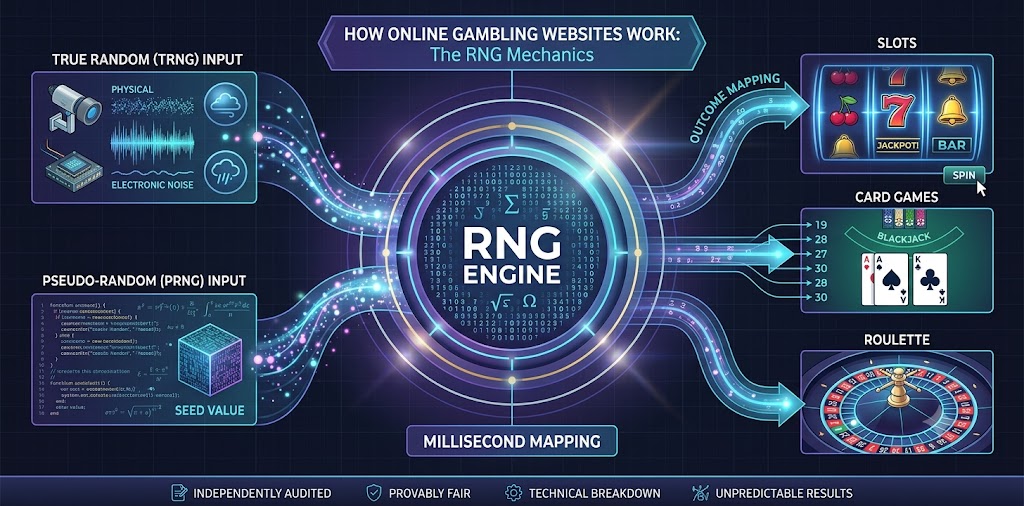
The Heartbeat of the Platform: TRNG vs. PRNG
At its core, a digital casino game doesn’t “know” if you are winning or losing. It relies on a relentless stream of high-speed mathematics. There are two primary ways platforms generate this randomness:
- TRNG (True Random Number Generator): Often referred to as Hardware RNG (HRNG), this system pulls randomness from unpredictable physical processes in the real world—like electronic noise, tiny timing variations in circuits, or even atmospheric noise. Because it requires physical hardware and avoids strict mathematical formulas, it is mostly reserved for highly secure cryptographic tasks.
- PRNG (Pseudo-Random Number Generator): This is the industry standard for online casino game architecture. Because speed is critical, PRNG uses a highly complex mathematical algorithm and a secret “seed” value to generate long, rapid streams of statistically random numbers. As long as the seed remains perfectly secure, the sequence is completely unpredictable.
The Millisecond Mapping Process
The PRNG software is always running in the background, generating thousands of numbers per second, even when no one is actively playing. The outcome of your game is decided the exact moment you place a bet.
The software utilizes a process called mapping to translate these raw numbers into the graphical elements you see on the screen:
- Number Capture: When you initiate a game, the system captures the exact number sequence generated at that precise millisecond.
- Internal Value Assignment: The algorithm maps that sequence to a preset rule. For example, in a digital slot, every reel position and symbol has an assigned numerical value (e.g., Cherry = 1, Lemon = 2, Bell = 3).
- Visual Translation: The reels spinning on your screen are purely visual entertainment. The result was already locked in by the PRNG the moment you clicked. If the math mapped to a losing combination, the animation simply plays out that loss. In virtual roulette, the number maps directly to a pocket (0-36). In digital card games, the RNG determines the exact shuffled order of the virtual deck before the first card is even dealt.
The RTP vs. RNG Distinction
These two metrics are frequently confused, but they govern completely different aspects of the gambling architecture:
- RNG (Random Number Generator): Dictates the trustworthiness and absolute independence of each individual round.
- RTP (Return-to-Player): A long-term statistical metric built directly into the game’s mathematical model. An RTP of 96% means the game is mathematically designed to pay back 96% of total stakes over millions of rounds. It does not mean a player will retain $96 from a $100 daily session.
Verification and Provably Fair Architecture
A legitimate RNG isn’t just claimed; it must be audited. Independent testing laboratories (such as BMM Testlabs, iTech Labs, GLI, and eCOGRA) rigorously analyze the software’s source code before regulators allow games to go live. They conduct:
- Implementation Reviews: Auditing how the algorithm is integrated and ensuring the seed is properly protected against tampering.
- Statistical Testing: Running massive data sets to mathematically prove the absence of trackable patterns.
- Outcome Distribution Testing: Ensuring the “mapping” phase doesn’t accidentally skew the intended mathematical odds (for example, verifying that the rules converting numbers into cards don’t alter the true frequency of a deck).
Furthermore, modern platforms are increasingly adopting Provably Fair systems. This cryptography-based approach allows players to use a built-in check to independently verify the round data on their own machine, proving the outcome wasn’t altered post-bet.
The Reality Check: There are no “hot” or “cold” machines. Because the PRNG generates entirely fresh numbers for every event, every single round is strictly independent. No amount of timing, stake variation, or streak-chasing will influence the algorithm.
Source Report: This article synthesizes technical architectural data directly extracted from the official educational publications of BGaming, a prominent iGaming content provider.
Leo Falsafi is a digital marketing veteran and senior journalist at Virlan.co, where he covers the intersection of digital marketing, gaming, and breaking US trending news. With nearly two decades of hands-on experience in SEO and digital strategy, Leo has consulted for and scaled hundreds of companies. His deep industry roots allow him to deliver sharp, fact-checked insights and analysis on the trends shaping today's digital landscape.