

Anthropic recently dropped a massive 31-page prompting guide, arriving just on the heels of the highly anticipated Claude Opus 4.7 release.
If you are still prompting Claude like it is 2024, you are wasting tokens and leaving massive potential on the table.
The landscape of generative AI has shifted drastically. Old tactics like “think step by step” or vague requests are no longer optimal. Today, models take you literally, and explicit instruction beats implicit assumption.
Thanks to insights distilled by AI educator Ruben Hassid, alongside deep technical analysis of Anthropic’s recent API documentation, we now have a clear roadmap for maximizing Claude Opus 4.7.
This article breaks down the 10 core rules from Anthropic’s prompting guide, analyzes the new technical features of Claude Opus 4.7, and explores opposing viewpoints on cost and token efficiency.
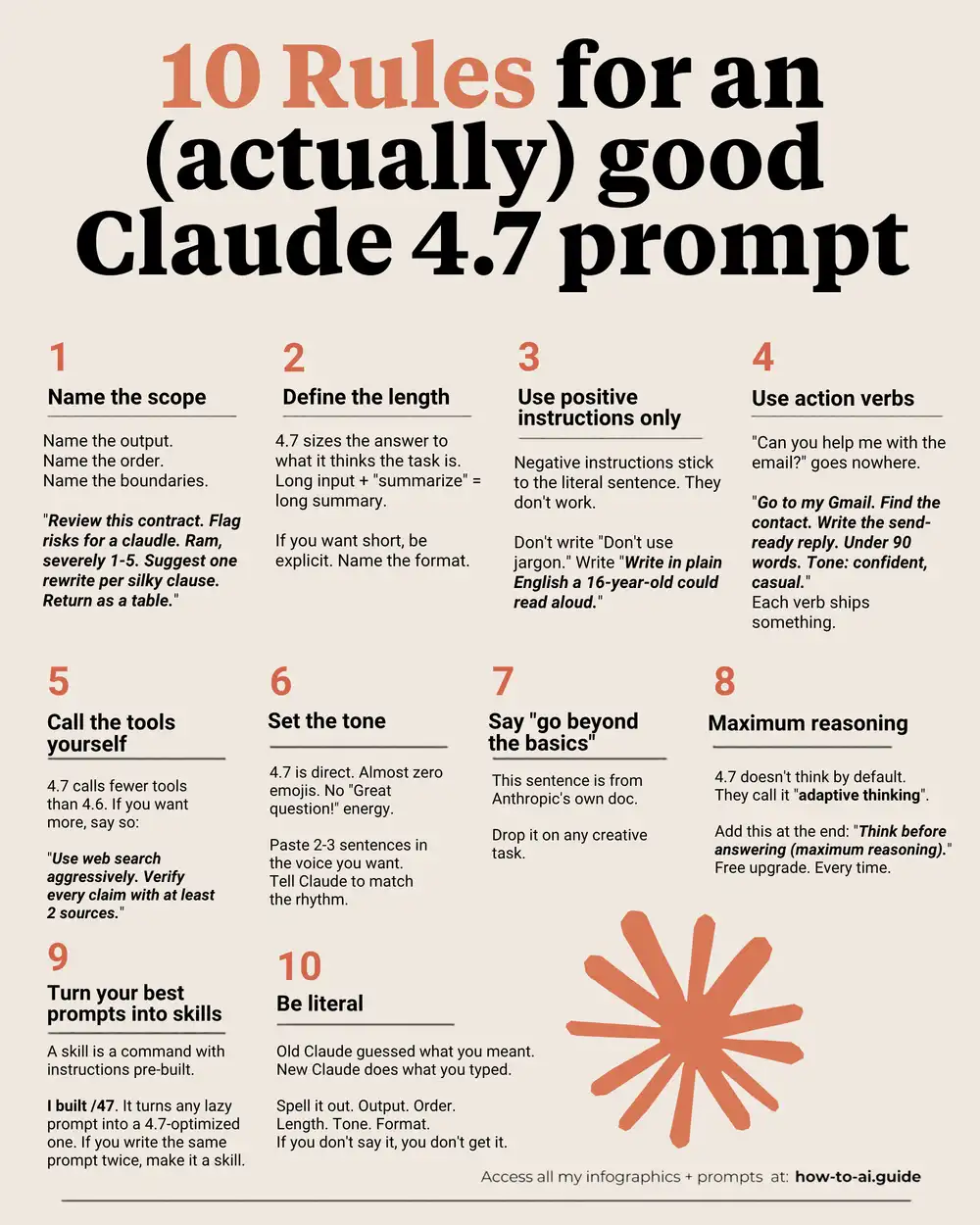
The 10 Core Rules from the Anthropic 31-Page Prompting Guide
Anthropic’s latest documentation reveals that the biggest prompting mistake of recent years was over-engineering. The correction for 2026 is strategic simplicity.
Here are the 10 essential rules to transform your prompts from hopeful wishes into precise commands.
1. Name the Output, Not the Task
You write “review this contract” and hope for the best. Vague verbs get vague drafts.
The fix is to name exactly what you want the output to be. Instead of asking for a review, tell Claude Opus 4.7 to flag risks per clause, rate severity from 1 to 5, and return the final data as a structured table.
2. Define the Length Up Front
When you say “summarize this” on a 40-page report, the model guesses the desired length.
Claude Opus 4.7 sizes the answer to the input by default. You need to cap it. Specify “5 bullets,” “Under 15 words each,” and dictate that each bullet must start with an action verb.
3. Flip Every “Don’t” Into a “Do”
Negative instructions do not stick well in large language models. Telling an AI “don’t use jargon” or “don’t be salesy” often makes it hyper-focus on those exact concepts.
Instead, flip the instruction to a positive one. Tell the model to “Write in plain English a 16-year-old could read aloud.”
4. Lead With Action
Politeness costs tokens. Stop typing “Can you please help me write an email?”
Each verb you use should ship something concrete. Lead with action: “Go to Gmail. Find the contact. Draft a send-ready reply under 90 words. Tone: confident.” Action ships work.
5. Force Maximum Reasoning
Claude Opus 4.7 does not default to maximum reasoning. It features a new “adaptive thinking” mode where it decides how much effort to apply.
To force the highest quality output for complex tasks, add the phrase “Think before answering (maximum reasoning)” at the end of your prompt. This triggers the “Extra High” effort setting, ensuring rigorous logic.
6. Add “Go Beyond the Basics”
If you ask for a landing page, you will often get the bare minimum template.
Anthropic’s own documentation highlights a magic phrase for creative tasks: “Go beyond the basics.” This sets the bar higher, pushing the model to polish the output like a real client deliverable.
7. Upload Your Voice
Many users miss the warm tone of older models. Claude Opus 4.7 is naturally more direct and uses almost zero emojis.
To fix this, paste 2-3 sentences written exactly how you sound into the prompt. Instruct Claude to “match the rhythm and style of these examples.”
8. Control Tools On Purpose
Claude Opus 4.7 calls fewer external tools by default compared to Opus 4.6. If you wait for it to web search on its own, you might be disappointed.
Force tool usage when needed. For research, explicitly state: “Use web search aggressively. Verify every claim with at least 2 sources.”
9. Turn Repetition into a Skill
If you rewrite the same complex prompt 14 times a week, you are wasting time.
A “skill” is a command with instructions pre-built. Turn your frequent workflows into saved skills or custom system prompts so you can trigger them instantly.
10. State the Goal Before the Task
A prompt without a goal is a wish. Old models guessed your intent; Claude Opus 4.7 does exactly what you type.
Open your prompt with “Goal: [what winning looks like].” Name the audience explicitly, such as “Write this for a Chief Revenue Officer, not a software engineer.” Spell out the exact output, order, length, tone, and format.
Deep Technical Analysis: Why Claude Opus 4.7 Changes the Game
While the 10 rules provide a fantastic baseline, understanding the technical architecture of Claude Opus 4.7 unlocks its true potential.
Released on April 16, 2026, Claude Opus 4.7 is not just a conversational upgrade. It is Anthropic’s most capable generally available model for complex reasoning and agentic coding.
It features a massive 1 million-token context window and can output up to 128,000 tokens in a single response. But the real game-changers lie in its new API features and architectural shifts.
The Attention Tax and Context Stacking
AI researchers have identified a phenomenon known as the “attention tax.” When you stuff a prompt with context, examples, and instructions, the model often ignores chunks of it based on where the text sits in the sequence.
Context quality beats context quantity. Anthropic recommends building a “context stack.” Place role and framing instructions at the very beginning. Put your supporting context in the middle. Finally, place your task instructions, constraints, and output formats at the very end.
Adaptive Thinking vs. Prompt-Induced Reasoning
Older models required users to type “think step by step” to induce reasoning. Claude Opus 4.7 introduces native “Adaptive Thinking.”
The model dynamically decides when and how much to think before responding. Developers can now use an “Effort Select” parameter in the API, choosing from Low, Medium, High, to Extra High. For coding and agentic work, setting this to Extra High yields profound improvements.
Agentic Coding and the New Task Budget API
One of the most significant additions for developers is the task_budget feature, currently in beta.
Previously, developers relied on a hard max_tokens ceiling. Now, you can give Claude an approximate token budget for a full agentic loop. This includes thinking, tool calls, tool results, and the final output.
If you run long reviews over massive codebases, the model uses this budget to prioritize work and wind down gracefully, rather than hitting a hard stop mid-sentence.
High-Resolution Vision Capabilities
Claude Opus 4.7 marks Anthropic’s first model with true high-resolution image support.
The vision ceiling has been raised to 2576px (3.75MP), complete with simpler 1:1 coordinate mapping. This makes the model incredibly powerful for UI bug investigation, dense chart interpretation, and computer-use workflows where pixel-perfect precision is required.
Avoiding “AI Slop” in Frontend Design
A common complaint among developers using AI for UI/UX generation is the convergence toward generic, predictable outputs—a phenomenon dubbed “AI slop.”
According to the Claude Cookbook, Claude Opus 4.7 has immense design capabilities but defaults to safe choices like overused font families (Inter, Roboto), clichéd color schemes (purple gradients on white), and predictable layouts.
To combat this, the best prompts for Claude 4.7 agentic coding isolate specific design dimensions.
Direct Claude’s attention to typography, color, and motion individually. For example, explicitly command the model to “Avoid generic fonts” and “Commit to a cohesive aesthetic using CSS variables with sharp accents.” By locking in specific themes, like a “Solarpunk aesthetic,” you force the model out of its generic distribution curve.
The Opposing Viewpoint: Token Costs and Efficiency
While Anthropic touts Claude Opus 4.7 as a massive leap forward, there are opposing viewpoints regarding its cost-efficiency.
The headline price remains somewhat competitive at $5 per million input tokens and $25 per million output tokens. However, the real cost story is more complex.
Anthropic’s new tokenizer can use roughly 1x to 1.35x more tokens than earlier models depending on the content.
This means your workflows might suddenly become more expensive, even if the base price seems stable. Developers sensitive to token cost variance need to test carefully before upgrading. If your application relies on casual conversational style rather than rigorous multi-step execution, sticking to older models or using Claude Sonnet might be vastly more cost-effective.
Furthermore, some enterprise users have noted that Opus 4.7’s stricter adherence to tool control means it requires far more explicit prompting to trigger web searches compared to its predecessors. This adds friction for users accustomed to autonomous research.
FAQ
What is the Anthropic 31-page prompting guide?
It is a comprehensive document released by Anthropic outlining the best practices for communicating with their latest models, emphasizing precise instructions, constraint setting, and output formatting over vague conversational prompts.
How does Claude Opus 4.7 adaptive thinking work?
Adaptive thinking allows the model to dynamically gauge how much computational effort to apply to a problem. Users can control this via API settings, forcing “Extra High” effort for complex coding tasks or lowering it for latency-sensitive queries.
What makes Claude Opus 4.7 good for agentic coding?
Opus 4.7 excels at multi-step execution, maintaining context over a 1 million-token window, and utilizing the new task_budget API feature to manage long-horizon autonomous workflows without abruptly stopping.
How do I stop Claude from writing generic code or “AI slop”?
You must aggressively prompt against default behaviors. Specify unique typography, demand sharp color accents over generic gradients, and explicitly instruct the model to “go beyond the basics” for professional-grade frontend aesthetics.
Is Claude Opus 4.7 more expensive to run?
While the base price is $5 per million input tokens, the new tokenizer uses up to 1.35x more tokens for the same content compared to older models. This can inadvertently raise operational costs for high-volume applications.
Leo Falsafi is a digital marketing veteran and senior journalist at Virlan.co, where he covers the intersection of digital marketing, gaming, and breaking US trending news. With nearly two decades of hands-on experience in SEO and digital strategy, Leo has consulted for and scaled hundreds of companies. His deep industry roots allow him to deliver sharp, fact-checked insights and analysis on the trends shaping today's digital landscape.