
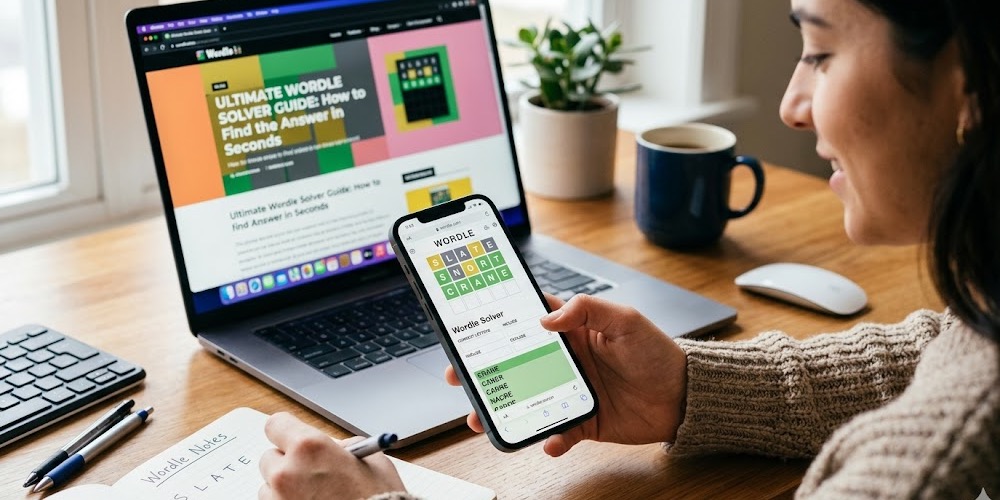
If you spend any time online, chances are you’ve seen those iconic grids of green, yellow, and gray squares floating across your social media feeds. What started as a simple love gift has blossomed into a global daily ritual for millions of players. Wordle is the ultimate test of vocabulary and deduction, but even the most seasoned wordsmiths can occasionally find themselves staring blankly at the screen as their remaining guesses dwindle.
With thousands of five-letter words in the English dictionary and only six attempts to guess the correct one, keeping your daily win streak intact can be incredibly challenging. This is where a Wordle solver comes in. Whether you’re stuck on guess number five or just looking to improve your overall strategy, this comprehensive guide will teach you everything you need to know about Wordle solvers, the best starting words, and advanced tactics to beat the game every single day.
The Origins of Wordle: A Global Phenomenon
Before diving into solvers and strategies, it’s worth understanding the game’s wholesome origins. Wordle was created in 2020 by Josh Wardle, a Brooklyn-based software engineer. He built the game during the COVID-19 pandemic as a private project for his partner, Palak Shah, who is a massive fan of word games. The name “Wordle” itself is a clever play on his surname.
After playing it privately for months, the couple introduced the game to their family’s WhatsApp group, where it became an instant hit. Encouraged by this, Wardle released the game to the global public in late 2021. The growth was nothing short of explosive. The game jumped from a mere 90 daily players in November 2021 to over two million daily players by January 2022.
The secret weapon to its virality? The brilliantly designed “Share” button. This feature allowed players to post their colored grids to platforms like Twitter without spoiling the actual answer, creating massive curiosity and Fear Of Missing Out (FOMO). Due to its undeniable success, The New York Times acquired Wordle in January 2022 for a reported “low seven figures,” cementing its place in the world-class NYT Games portfolio alongside the Crossword and Spelling Bee.
What is a Wordle Solver and How Does It Work?
A Wordle solver is a digital word-finding tool designed specifically to help players narrow down their options based on the feedback the game provides. Instead of racking your brain to remember every five-letter word that fits a highly specific pattern, a solver cross-references your game’s constraints against the complete Wordle dictionary almost instantly.
When you use a Wordle solver, you typically interact with three main input fields:
- Green Letters (Correct Position): These are letters you know are in the word and in the exact right spot. You enter them into the exact position (1 through 5) in the solver.
- Yellow Letters (Misplaced Letters): These are letters that exist in the target word but are currently in the wrong position. The best solvers allow you to specify which position the yellow letter was played in, ensuring the tool doesn’t suggest words where that letter occupies the known incorrect spot.
- Gray/Black Letters (Excluded Letters): These are the letters that have been completely eliminated. Typing these into the solver ensures that no suggested words will contain them.
Once you input this data, the solver filters the original list of 2,309 accepted Wordle answers (and the broader list of over 10,000 valid guesses) to give you a curated list of remaining candidates. Many advanced solvers even rank these remaining words by probability or linguistic frequency, helping you pick the most logical next guess. Other tools, like PerThirtySix’s visual solver, provide a heat-mapped representation of letter frequencies based on your constraints.
Best Starting Words: Setting Yourself Up for Success
Your first guess is undoubtedly the most consequential move in the game. You have a blank slate, and your goal is to extract as much information as possible. A common mistake beginners make is guessing a word with double letters (like PUPPY) or heavily focusing on vowels at the expense of high-frequency consonants (like ADIEU or AUDIO).
While knowing the vowels is helpful, consonants actually narrow down the dictionary much faster. Letters like S, T, R, N, L, and C are mathematical goldmines. Here are the top mathematically optimized starting words:
- SLATE: The New York Times’ own analysis tool, WordleBot, highly recommends SLATE, rating it 99 out of 100 for skill.
- CRANE: Historically considered one of the absolute best openers, boasting an incredibly low average solve rate of 3.42 guesses.
- TRACE: A fantastic alternative that tests highly common letters and has an average solve rate of 3.46.
- CRATE & STARE: Both provide excellent coverage of the most frequently used letters in the English language.
If you are playing on Hard Mode, the word CLASP is often recommended as it sets up a slightly narrower but incredibly efficient path to solving the daily puzzle while avoiding certain trap scenarios.
Advanced Strategies: Winning Like a Pro
If you want to reduce your guess average and hit that “Genius” (2 guesses) or “Splendid” (3 guesses) rating more consistently, you need to employ advanced tactics.
The Two-Word Opener Technique
If you are playing on Normal Mode, you aren’t forced to use the hints you uncover immediately. This opens up the “Two-Word Opener” strategy. The goal is to use two pre-selected words that cover 10 unique, high-frequency letters, guaranteeing you eliminate or confirm a massive chunk of the alphabet right away.
Great combinations include:
- STARE + CLOUD (Covers S, T, A, R, E, C, L, O, U, D)
- CRANE + SPLIT (Covers C, R, A, N, E, S, P, L, I, T)
- SLATE + CRONY (Covers S, L, A, T, E, C, R, O, N, Y)
Escaping the Dreaded “Rhyme Trap”
Every Wordle player has been there. You have four green tiles. Your board reads: _ I G H T. You have four guesses left. You think it’s an easy win, but then you realize the missing letter could be M, N, L, T, F, W, or S (MIGHT, NIGHT, LIGHT, TIGHT, FIGHT, WIGHT, SIGHT).
- In Normal Mode: The easiest way out of this trap is to use an “elimination word.” Do not guess the rhymes one by one. Instead, guess a completely unrelated word that tests multiple missing letters at once. For example, guessing FLOWN will simultaneously test F, L, N, and W. Based on the result, you will likely know the exact answer for your next turn.
- In Hard Mode: Hard Mode forbids elimination words; you must use the known green and yellow letters in subsequent guesses. To survive here, you must act before the trap snaps shut. If you have _ I _ _ T, don’t rush to guess LIGHT. Use the open slots to test prefixes. Guessing FLINT tests F, L, N while obeying the rule to use I and T. If you are already trapped with four green letters, you must rely on letter frequency, guessing high-frequency words like LIGHT or NIGHT before obscure words like WIGHT.
Letter Frequency by Position: The Data Breakdown
If you are using a solver or just playing from your own brain, understanding where letters are most likely to appear is a massive advantage. Wordle data analysts have broken down the 2,309 solution words to find precise frequency statistics:
- Position 1 (First Letter): S is the undisputed king of the start, appearing first in over 15% of answers. C (11.3%) and B (8.5%) are also highly common.
- Position 3 (Middle Letter): The middle of the word is dominated by vowels. A (14.3%), I (10.2%), and O (9.4%) are your best bets for the center square.
- Position 5 (Last Letter): E is the most common ending letter by a landslide (14.9%), with Y (9.3%) and T (8.6%) following closely behind.
Overall, the most common letters in the game are E, A, R, O, T, L, I, and S. The least common are X, Z, Q, J, V, and W.
The Streak Breakers: Words That Ruin Games
Have you ever felt like Wordle is getting harder? Statistically, it isn’t. When the New York Times took over, they actually removed a handful of highly obscure or archaic words to make the game fairer. The illusion of difficulty comes from “Streak Breakers”—words that feature double letters or bizarre spellings that completely subvert our expectations.
Some of the most infamous words with massive failure rates (often pushing 30-48%) include:
- PARER: Obscure vocabulary combined with repeated letters.
- MUMMY: A triple letter! No one plans for three M’s.
- WATCH: A common word, but the W + TCH ending is brutal.
- FOYER: French origin with an unusual vowel/consonant mix.
- VIVID: Double V’s and double I’s will catch anyone off guard.
- SWILL: Double L combined with an uncommon term.
When faced with a board that isn’t making sense, always remember that Wordle allows duplicate letters! If the solver is outputting zero results, you might have forgotten to consider that a confirmed yellow or green letter might appear twice in the word.
Popular Wordle Spin-Offs to Test Your Skills
If one Wordle a day isn’t enough, the internet has birthed a massive ecosystem of spin-offs that cater to every niche and difficulty level. A good Wordle solver can actually help you with many of these variants as well.
- Quordle & Dordle: Why solve one word when you can solve four (Quordle) or two (Dordle) simultaneously? You guess words for multiple grids at the same time, making resource management incredibly tricky.
- Octordle: For the true masochist, Octordle tasks you with solving eight different puzzles simultaneously, giving you 13 attempts to figure them all out.
- Word Master / Wordle Unlimited: If you hate the once-a-day limit, these clones allow you to play endless standard Wordle puzzles to your heart’s content.
- Nerdle: A mathematical spin-off where you must deduce a hidden equation (e.g., 10+4=14) instead of a word.
- Worldle: A geography trivia game that provides the silhouette of a country and tells you the distance and direction of your guesses relative to the correct answer.
- Absurdle: An adversarial version of the game that actively changes the target word based on your guesses to keep you playing as long as possible.
Is Using a Wordle Solver Considered Cheating?
The debate over whether using a Wordle solver is “cheating” is as old as the game itself. Ultimately, Wordle is a single-player game, and how you choose to enjoy it is entirely up to you.
Many players use solvers not to instantly find the answer, but as an educational tool. Reviewing a solver’s output after a completed puzzle is one of the fastest ways to improve. Seeing which candidates remained after your guesses teaches pattern recognition. Furthermore, using a solver when you are genuinely stuck on guess five or six is a great way to save your streak and relieve frustration without fully giving up. It acts as an interactive hint system.
Conclusion
Wordle is a beautifully simple game that hides deep strategic complexity beneath its colorful grid. By understanding linguistic frequencies, mastering the Two-Word Opener, learning how to dodge the Rhyme Trap, and utilizing the power of a digital Wordle solver, you can transform from a casual guesser into a Wordle master.
Remember, there’s no shame in getting a little help when you need it. Whether you are consulting a list of past answers to avoid wasted guesses or plugging your gray and yellow tiles into a solver to see the remaining possibilities, these tools are here to enhance your experience. Start with a strong word like SLATE or CRANE, trust the data, and may your squares always turn green!
Leo Falsafi is a digital marketing veteran and senior journalist at Virlan.co, where he covers the intersection of digital marketing, gaming, and breaking US trending news. With nearly two decades of hands-on experience in SEO and digital strategy, Leo has consulted for and scaled hundreds of companies. His deep industry roots allow him to deliver sharp, fact-checked insights and analysis on the trends shaping today's digital landscape.