
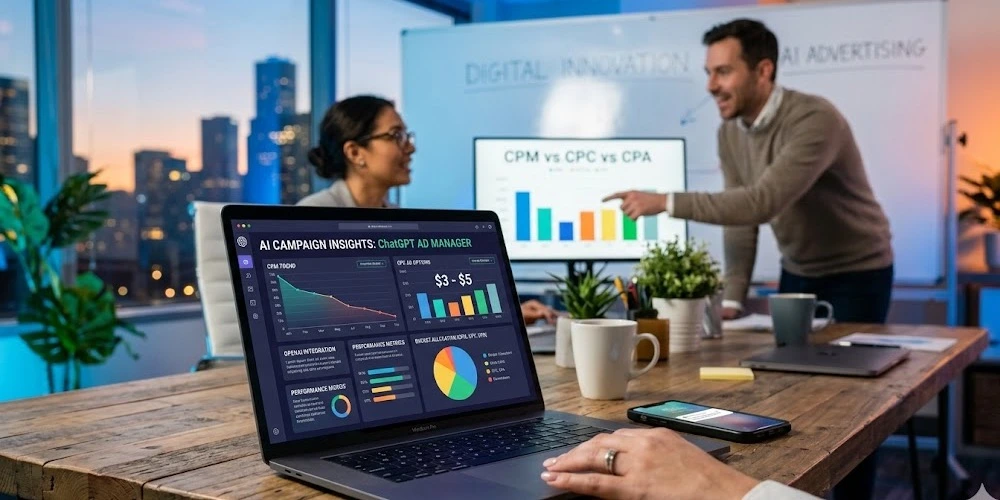
OpenAI has officially taken a major step toward maturing its budding advertising business. In a move to cater to performance marketers and stabilize its ad revenue models, the AI giant has turned on cost-per-click (CPC) advertising inside ChatGPT.
As AI platforms increasingly become primary search and discovery tools, advertisers are eager to understand how to best allocate their budgets. But what does this shift mean for marketers, and how does CPC compare to other standard digital ad metrics?
The News: ChatGPT Moves Beyond Impressions
When OpenAI initially launched its advertising capabilities a little over two months ago, it relied exclusively on a CPM (cost-per-mille) pricing model. While this was an easier initial lift that helped onboard brand advertisers without requiring complex click-tracking infrastructure, it had a limited ceiling.
According to a recent report by Digiday, OpenAI’s CPM rates have experienced a sharp decline, dropping from $60 at launch to as low as $25 for every thousand impressions. To maintain demand growth and build trust with performance advertisers—who account for the majority of online ad spend and prefer to pay for tangible engagement—OpenAI has rolled out CPC ads.
Advertisers testing the platform can now set bids between $3 and $5 per click. This puts ChatGPT in direct competition with Google Search, challenging OpenAI to prove that the intent built through back-and-forth chatbot prompts is just as valuable as a traditional search query. To back this up, OpenAI is currently on an urgent hunt to hire its first advertising marketing science leader to build robust measurement and attribution models from the ground up.
Ad Metrics Explained: CPM vs. CPC vs. CPA
For advertisers eyeing ChatGPT’s new ad manager, understanding how different pricing models align with campaign goals is crucial. Digital marketing experts at Pathlabs outline the fundamental differences between the three major ad metrics:
- CPM (Cost Per Mille): This metric measures the average amount an advertiser pays for every one thousand impressions (views) their ad receives. CPM is highly effective for top-of-funnel campaigns where the primary goal is mass brand awareness and reach. However, a user simply seeing an ad does not guarantee engagement.
- CPC (Cost Per Click): Under this model, advertisers only pay when a user actually clicks on their ad. CPC serves as both a pricing model and a key performance indicator (KPI). It is widely used in mid-funnel campaigns to drive consideration and direct traffic to a website. By shifting to CPC, OpenAI is allowing advertisers to pay strictly for active user interest rather than passive views.
- CPA (Cost Per Action / Acquisition): Taking it a step further down the sales funnel, CPA measures the price an advertiser pays for a specific user action—such as a purchase, a form fill, or a demo request. CPA is the ultimate metric for bottom-funnel performance marketing, helping brands calculate exact return on investment (ROI) by finding the “sweet spot” between ad spend and revenue generation.
What This Means for the Future of AI Advertising
OpenAI’s introduction of CPC advertising proves that the company is serious about capturing performance marketing budgets. While social media platforms like Meta offer cheaper CPCs due to the “browsing” nature of their users, Google has traditionally commanded a premium because of the high intent of search queries.
ChatGPT sits somewhere in a fascinating middle ground. As large language models (LLMs) bridge the gap between browsing and searching, conversational prompts can build deep, specific user intent. If OpenAI can prove that its $3 to $5 clicks lead to measurable actions (CPA), it could unlock a massive, entirely new category of digital advertising budgets.
Leo Falsafi is a digital marketing veteran and senior journalist at Virlan.co, where he covers the intersection of digital marketing, gaming, and breaking US trending news. With nearly two decades of hands-on experience in SEO and digital strategy, Leo has consulted for and scaled hundreds of companies. His deep industry roots allow him to deliver sharp, fact-checked insights and analysis on the trends shaping today's digital landscape.