
Sweeping NSW Gambling Reforms Target Pokies, Ads, and Mandate Facial Recognition by 2028
The Minns Labor Government is delivering on a key election commitment with the next and most comprehensive tranche of gaming reforms, giving people and families stronger protections against gambling harm and putting tougher rules around the way gambling is promoted and marketed.
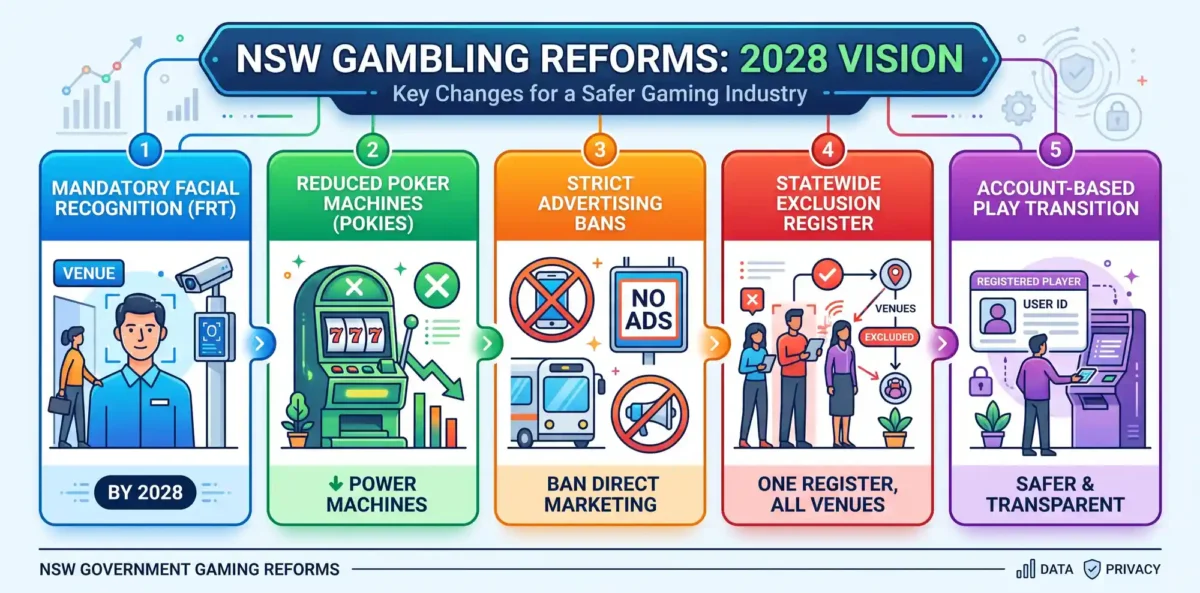
The tranche of reforms, NSW Gaming Reform package, being announced today are evidence-based and include a statewide exclusion register with mandatory facial recognition technology at the entry of gaming rooms, a third-party exclusion scheme in hotels and clubs, an increased forfeiture rate of 1 in 2, (from 1 in 3) and the end of VIP programs related to gaming.
Minister for Gaming and Racing David Harris said: The Minns Labor government is introducing wide-ranging reforms to help combat gambling harm across the state.
These are common sense reforms that have been developed alongside industry, harm minimisation groups, stakeholders and privacy experts to address gambling harm while supporting the industry and protecting the livelihoods of the many people it employs. By combining new technology, stronger exclusion tools, strengthened regulation and increased funding for harm reduction, we are building a safer system for the future.
Our government will continually explore and implement emerging technology to ensure NSW has the most up-to-date safety measures available built into our gambling industry.
The NSW Gaming Reform Package: Mandatory Facial Recognition NSW Clubs
NSW will bring in mandatory facial recognition technology (FRT) for hotels and clubs with gaming machines, tied to an exclusion register and expected to be ready by 2028, the state government announced. Over the next couple of years, a mandatory system is envisaged to cover every hotel and club with pokies and other gaming machines, backed by FRT that automatically flags excluded patrons at the door.
Since March 2026, venues that use FRT for self-exclusion have operated under a non-enforceable code of practice issued by Liquor & Gaming NSW, the first such formal guidance published by the state on the tech. Technical requirements for the current code include that data must be onshored in Australia, regardless of the FRT being cloud-hosted or on-premises. Furthermore, data must be encrypted with at least the 256-bit AES algorithm at rest, and use the at minimum Transport Layer Security (TLS) version 1.3 in transit, firewall protection and JSON as the format.
FRT installers need a Class 2 security licence, and systems are expected to have 99.9 per cent uptime during trading hours. The systems are expected to undergo penetration testing by independent third parties every 12 months.
As a privacy measure, the present code requires that biometric signatures and images of patrons, which should be in 1080p resolution or better, are discarded immediately, if not matched to excluded persons.
Currently installed FRT systems are expected to meet the United States National Institute of Standards and Technology (NIST) FRTE/FATE benchmarks on false negative and false positive identification rates across different demographic groups. The L&GNSW code also bars venues from linking their FRT systems to other software holding biographical data, including venue sign-in databases, scanned credentials or payment mechanisms.
Harm Minimisation and the Statewide Exclusion Register NSW
For the first time in NSW, people who choose to exclude themselves from gambling will be able to do so through a single statewide register covering every hotel and club with gaming machines.
Currently in NSW, people can enter into a voluntary self-exclusion agreement to ban themselves from the gaming areas of certain hotels and clubs or from the entire venue. However, the enforcement of this is largely left up to individual venues and staff to monitor compliance.
In a significant change, the new NSW Statewide Exclusion Register will replace this fragmented system with a single statewide framework backed by mandatory facial recognition technology at the entry of gaming rooms – meaning when someone makes the difficult decision to exclude themselves, that exclusion can follow them from venue to venue.
Mandatory Facial Recognition will be introduced at the same time as the NSW State Exclusion Register in 2028, helping venues identify people who have excluded themselves and ensure those exclusions are enforced.
Gambling harm doesn’t stop with the person sitting at the poker machine or online. It can mean bills going unpaid, savings disappearing and enormous pressure being placed on partners, children and families. According to the NSW Gambling Survey 2024, 3.1% of the adult population experience moderate risk gambling, while 0.9% experience high risk gambling – and for them, and their families it can ruin their lives.
These reforms put harm minimisation at the heart of our gaming system, making it easier for people to stop, giving families more options to intervene and putting stronger safeguards around gambling in NSW.
NSW Poker Machine Reduction and the New Sinking Cap
Currently, NSW has around 87,000 poker machines across some 2,100 clubs and hotels. While the number of gaming machine entitlements has steadily declined over the past three years, these reforms will help accelerate that reduction and ensure that when entitlements are removed from circulation, they are removed permanently.
Poker machine revenue in NSW is currently worth $1.6 billion and is expected to reach $2.2 billion by 2029, with the state housing half of Australia’s poker machines.
The NSW Government will increase the forfeiture rate when gaming machine entitlements are traded from one in three to one in two – meaning for every two entitlements traded, one will be permanently removed.
It will also introduce a new ‘sinking cap’ so the statewide cap falls as entitlements are removed from circulation and tighten existing exemptions that allowed entitlements to be transferred without forfeiture, while giving venues the option to voluntarily cancel their entitlements.
Account-Based Play NSW and Anti-Money Laundering Measures
As part of a staged approach, the Government will put in place the necessary infrastructure to facilitate future account-based play. Account-based play is a model that enables a person to use a registered account to play a poker machine, rather than gambling anonymously. However, a significant proportion of gaming machine infrastructure rely on legacy technology.
The Government will upgrade the Centralised Monitoring System (CMS) over the next two years to allow for a transition to this technology, which would better allow venues to enable account-based play at their discretion.
Rapid advancements in technology since the Cashless Gaming Trial have demonstrated there are many account-based play solutions that can be implemented to meet the anti-money laundering and harm minimisation benefits of cashless, while allowing players to continue using cash if they prefer.
It will also support NSW Police efforts to prevent gaming machines being used for money laundering and other criminal activity. FRT use for anti-money laundering has been parked for the current gambling reform package, and addressed in future reforms.
NSW Gambling Advertising Ban and Marketing Restrictions
The NSW Gaming Reform package will also strengthen protections against harmful gambling advertising and marketing, including banning VIP programs linked to gaming, prohibiting gambling advertising on NSW Government and council-owned assets, and addresses unwanted direct marketing by outlawing betting service providers to market directly to people via calls, email or text messages without receiving their express consent in advance.
Separately, it prohibits any commercial or marketing use of FRT data, which would rule out feeding it into loyalty programs. It also prohibits using the technology for any commercial or marketing purpose even with a patron’s consent, closing off the “VIP targeting” use case that drew criticism after three NSW clubs were reported in 2022 to have deployed FRT partly to identify high-value customers.
New transparency requirements will apply to gambling promotions by affiliates and social media influencers, alongside restrictions on commissions linked to higher-risk gambling products. The Government will commit to developing a NSW strategy to reduce online gambling harm and strengthen enforcement against betting providers and illegal gambling platforms, with new offences, tougher penalties and stronger regulatory powers.
The Minns Labor Government is investing $95.2 million over 4 years to fund this next tranche of e reforms, sourced by the money remaining in the $100 million gambling harm minimisation fund and an increase in licence fees for clubs and hotels with gaming machines. The reforms provide a $20 million boost to the Responsible Gambling Fund over the next two years to support delivery of its array of services and programs to prevent and address harm, including the GambleAware support services.
Critics and Reactions to the Chris Minns Gaming Reform
Promised in 2023 by current Labor premier Chris Minns, then in opposition, FRT remains a controversial tool to manage gambling harm, with privacy expert warnings about potential accuracy, bias and discrimination risk for the technology. The package will also ban VIP gambling programs, but stops short of mandatory account-based gambling and a major cut to the state’s 87,000 poker machines.
Critics say the government is still avoiding the strongest measures to reduce gambling harm. The reforms include new bans on marketing, advertising and VIP programs, but critics argue they fall short of evidence-based measures like account-based gaming and mandatory midnight shutdowns.
Wesley Mission CEO Reverend Stu Cameron says the changes are too little, too late. Whilst we welcome some of the initiatives in the announcement made today by minister Harris, in many ways it’s too little too late. It feels like we’re kicking the can down the road when it comes to real proportionate gambling reform and poker machine harm here in NSW.
Leo Falsafi is a digital marketing veteran and senior journalist at Virlan.co, where he covers the intersection of digital marketing, gaming, and breaking US trending news. With nearly two decades of hands-on experience in SEO and digital strategy, Leo has consulted for and scaled hundreds of companies. His deep industry roots allow him to deliver sharp, fact-checked insights and analysis on the trends shaping today's digital landscape.