
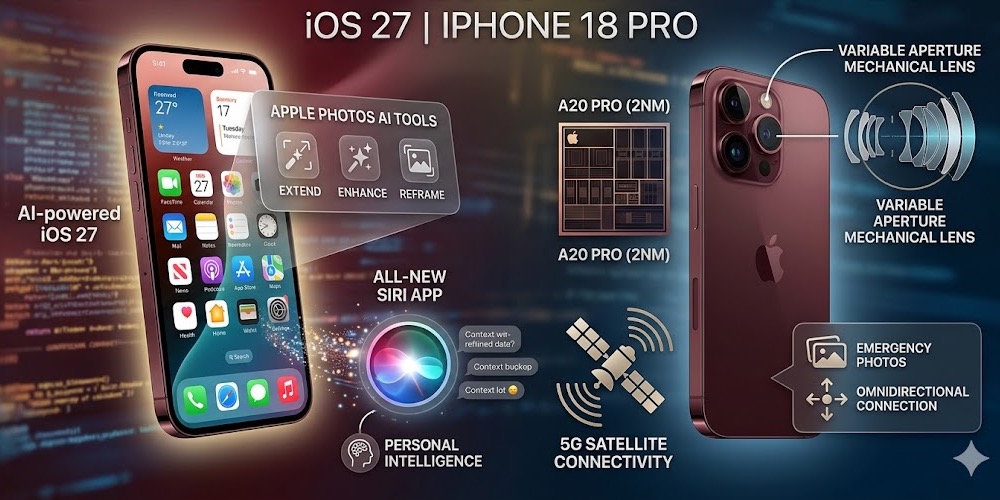
As the tech world barrels through 2026, the rumor mill surrounding Apple’s upcoming software and hardware releases has reached a fever pitch. With the Worldwide Developers Conference (WWDC) rapidly approaching on June 8, and the traditional September hardware event looming on the horizon, industry insiders, supply chain analysts, and prominent leakers have painted a vivid picture of what to expect. From a revolutionary “Snow Leopard” approach in iOS 27 to highly advanced artificial intelligence photo editing tools, and the head-turning “Dark Cherry” colorway of the iPhone 18 Pro, Apple is preparing a massive year of refinements and boundary-pushing innovations.
In this comprehensive roundup, we dive deep into the latest leaks and reports provided by top industry sources—including Bloomberg, MacRumors, 9to5Mac, Macworld, and PhoneArena—to bring you everything you need to know about Apple’s 2026 ecosystem.
iOS 27: The “Snow Leopard” Approach to Stability and Performance
For years, Apple users have clamored for a software update that prioritizes under-the-hood stability over flashy, experimental features. According to the latest leaks, Apple is finally delivering exactly that. iOS 27 is widely expected to be the “Mac OS X Snow Leopard” of the iPhone operating system. This means that Apple’s engineering teams have reportedly been laser-focused on crushing bugs, improving baseline stability, and enhancing underlying performance across the board.
However, just because the focus is on refinement doesn’t mean iOS 27 will lack visual flair. While major structural design changes are off the table, the update is expected to introduce a series of sophisticated “Liquid Glass” design enhancements. A standout feature within this aesthetic refresh is a rumored system-wide Liquid Glass slider, giving users the precise ability to adjust the opacity and translucency of the user interface—a feature that expands on the slider currently used for the Lock Screen’s clock.
Additionally, iOS 27 will bring much-needed quality-of-life improvements. The Home Screen customization menu will reportedly finally gain “Undo” and “Redo” options, saving users from the frustration of accidentally ruining their meticulously crafted app layouts. Apple has also tested an updated, grammar-focused iPhone keyboard. Similar to third-party services like Grammarly, this new keyboard will expand traditional autocorrect capabilities by actively offering alternative word choices and phrasing, aiming to fix the historically polarizing iPhone autocorrect experience.
Compatibility for iOS 27 is also looking generous; noted leaker Instant Digital claims the operating system will support the iPhone 12 series and newer, ensuring millions of older devices can take advantage of the stability upgrades.
A Massive Leap for Siri: The All-New Dedicated App and Visual Intelligence
Perhaps the most significant functional change in iOS 27 is the complete overhaul of Siri. Apple is reportedly preparing to launch an all-new, dedicated Siri app that will feature across iOS 27, iPadOS 27, and macOS 27. Armed with a so-called “Extensions” feature, this app will allow users to interact with Apple’s virtual assistant in both text and voice modes seamlessly.
Functioning similarly to industry-leading AI chatbots like ChatGPT, Gemini, and Claude, the Siri app will grant users access to their past conversational histories and context. This overhaul is visually represented by a new Siri interface within the Dynamic Island. Triggering Siri will now prompt a sleek “Search or Ask” display within the Dynamic Island, accompanied by a distinct “glowing cursor” that matches the aesthetic of Apple’s WWDC 2026 promotional graphics.
Furthermore, iOS 27 will finally deliver on the delayed personalized Siri capabilities first teased back in 2024. As Apple CEO Tim Cook recently highlighted in an earnings call, users can expect a highly customized assistant capable of cross-referencing on-device data. For example, you will be able to ask Siri about a family member’s upcoming flight or lunch reservation, and the AI will autonomously retrieve and synthesize the relevant information from your Mail and Messages apps.
Beyond conversational AI, Apple is heavily leaning into “Visual Intelligence.” iOS 27 will empower the camera and underlying operating system to instantly process the physical world around you. Users will be able to scan phone numbers and addresses printed on business cards and instantly port them into the Contacts app. The Wallet app will gain the ability to scan physical gym membership cards and event tickets to generate verified digital versions. Even the Safari app is getting an intelligence boost, gaining the ability to automatically generate contextual names for Tab Groups based on the actual contents of the web pages open within them.
Revolutionizing Apple Photos with “Apple Intelligence Tools”
Artificial Intelligence is the defining buzzword of the decade, and Apple is aggressively integrating it into one of its most used applications: Photos. According to a detailed report from Bloomberg, iOS 27 will refresh the editing interface within the Photos app to feature a dedicated “Apple Intelligence Tools” section. This suite aims to democratize complex photo manipulation, allowing users to make professional-grade alterations in a matter of seconds.
The suite is reportedly built around three core AI functions:
- Extend: Serving as Apple’s answer to generative fill, this tool will allow users to generate additional image content beyond the original boundaries of a photograph. If you take a tightly cropped picture of a famous landmark, the Extend tool will seamlessly fill in the surrounding scenery using generative AI. Users will be able to dictate how much environment is generated simply by dragging the edges of the photo outward with their fingers.
- Enhance: This feature acts as an algorithmic auto-tuner. It will automatically analyze and drastically improve a photograph’s overall quality, instantly correcting difficult lighting scenarios and balancing color profiles to make images pop.
- Reframe: Specifically tailored for Apple’s growing ecosystem of spatial media, Reframe will allow users to shift the perspective and depth of spatial photos after they have been taken.
Despite the exciting potential of these tools, their development hasn’t been without friction. Internal sources indicate that the “Extend” and “Reframe” features have not performed reliably during Apple’s rigorous internal testing. Because of these developmental roadblocks, there is a distinct possibility that Apple may delay or scale back these specific capabilities depending on how quickly they can improve the underlying AI models before the final release.
Next-Generation Connectivity: 5G via Satellite
Apple first introduced satellite connectivity with the iPhone 14, offering Emergency SOS to users off the grid. In 2026, Apple is taking this technology to entirely new heights. iOS 27 will reportedly support full 5G satellite internet connectivity for web browsing and rich media messaging.
This massive upgrade brings four major new satellite features to the ecosystem:
- Apple Maps via Satellite: Navigate and download map data even when hundreds of miles away from the nearest cell tower.
- Photos Support for Messages via Satellite: Sending emergency texts is no longer the limit; users will be able to send high-resolution photos over satellite connections.
- Third-Party App Integration: Developers will finally be granted access to an API that lets third-party App Store applications utilize Apple’s satellite network.
- Omnidirectional Connectivity: Users will reportedly be able to connect their iPhone to a passing satellite without having to manually point the device toward the sky, vastly improving usability in emergency situations.
It is important to note, however, that these advanced 5G satellite features will likely be hardware-restricted. Rumors point to this functionality being exclusive to the upcoming iPhone 18 Pro, iPhone 18 Pro Max, and the rumored foldable iPhone Ultra, as these devices will be equipped with Apple’s next-generation custom modems.
iPhone 18 Pro: The ‘Dark Cherry’ Sensation
While software defines the experience, hardware defines the aesthetic, and the iPhone 18 Pro is shaping up to be a true head-turner. According to exclusive renders and supply chain information obtained by Macworld, Apple is introducing a stunning new signature color for the iPhone 18 Pro lineup: Dark Cherry.
Described as a deep, classy hue that leans much closer to wine than a bright fruit punch, Dark Cherry is slated to replace the highly successful “Cosmic Orange” introduced with the iPhone 17 Pro. The shift back to a deeper, more sophisticated tone has already generated massive excitement. In a recent reader survey conducted by PhoneArena, a staggering 47% of respondents voted Dark Cherry as their favorite rumored color, positioning it to be just as popular as the iconic Midnight Green of the iPhone 11 Pro and Deep Purple of the iPhone 14 Pro.
Alongside Dark Cherry, Apple is actively developing three other colors for the Pro lineup. “Light Blue”—resembling the Mist Blue of the base iPhone 17—is currently the second most popular among fans, capturing nearly 18% of the vote. For traditionalists, a sleek “Dark Gray” will make its return, satisfying the 20% of users who prefer a classic, stealthy look. A “Silver” option is also in development, though with only 4% of user interest, it ranks as the least popular choice.
As is customary, last year’s Cosmic Orange and Deep Blue colors will be officially discontinued to make room for this fresh palette.
For those eyeing the highest echelon of Apple hardware—the highly rumored foldable “iPhone Fold” or “iPhone Ultra”—expect a more muted, professional color scheme. This revolutionary device, which reportedly unfurls to the size of an iPad mini and measures a remarkably thin 4.7mm when unfolded, will stick to neutral tones. Sources indicate it will launch in classic Silver, White, and a dark Indigo option.
Under the Hood: The Hardware Powering the iPhone 18 Pro
The aesthetic appeal of the Dark Cherry iPhone 18 Pro is only matched by the immense technological leaps happening inside the chassis. Apple is completely overhauling the silicon, camera systems, and display technology to justify the “Pro” moniker in 2026.
The A20 Pro Chip and 2nm Architecture:
At the heart of the iPhone 18 Pro and Pro Max will be the A20 Pro chip. Moving away from the 3nm process used in the A19, the A20 Pro will be manufactured using TSMC’s cutting-edge first-generation 2nm process. Featuring an entirely new packaging design, the 2nm architecture guarantees massive year-over-year gains in both raw processing performance and, more importantly, power efficiency.
LTPO+ Displays and a Smaller Dynamic Island:
That power efficiency will be further bolstered by new “LTPO+” display technology used for the 6.3-inch and 6.9-inch screens, contributing to significantly longer battery lifespans. Additionally, the displays will feature a notably smaller Dynamic Island. Apple has reportedly succeeded in moving the Face ID flood illuminator beneath the screen glass, reducing the footprint of the cutout and giving users more uninterrupted screen real estate when Live Activities aren’t actively being displayed.
Variable Aperture Photography:
For mobile photographers, the iPhone 18 Pro will introduce a groundbreaking mechanical upgrade. The main 48-megapixel Fusion camera will feature a variable aperture lens. This will allow users to physically control the amount of light that passes through the lens and reaches the sensor, granting unprecedented control over depth of field and natural bokeh. While smartphones generally have smaller image sensors than DSLR cameras, a true variable aperture represents a massive leap in mobile optical engineering.
Furthermore, the design of the device’s rear will feature a refined camera bump with reduced gaps between the lenses and the glass housing for a more seamless appearance. The dedicated Camera Control button will also see a simplification; Apple is reportedly removing the capacitive touch and haptic feedback mechanisms, returning to a purely pressure-sensitive mechanical button to improve reliability and prevent accidental triggers.
Next-Gen Modems and Connectivity:
To support the aforementioned 5G satellite features coming in iOS 27, the iPhone 18 Pro will utilize Apple’s custom third-generation C2 cellular modem. Following the C1 and C1X modems, the C2 is touted to be up to twice as fast and substantially more power-efficient. Working in tandem with the C2 is the new N2 chip, which will serve to dramatically enhance the stability and speed of Wi-Fi 7, Bluetooth 6, Thread, AirDrop, and Personal Hotspot connections.
Finally, the rear Ceramic Shield glass area that houses the MagSafe charging coils will be redesigned, featuring a beautifully frosted, seamless appearance that does away with the two-tone look of previous generations.
Conclusion
The 2026 Apple calendar is shaping up to be a monumental one. By combining a hyper-stable, bug-free iOS 27 update with deeply integrated, ChatGPT-rivaling AI features and revolutionary localized photo editing tools, Apple is laying the software foundation for the next decade. When paired with the aggressive internal upgrades of the A20 Pro chip, the mechanical advancements of a variable aperture camera, and the undeniably gorgeous Dark Cherry titanium finish of the iPhone 18 Pro, it is clear that September 2026 will be a historic milestone for smartphone technology. Whether you are an AI enthusiast, a mobile photographer, or just someone tired of their autocorrect making embarrassing mistakes, Apple’s upcoming lineup clearly has something incredible to offer.
 What is the difference between iPhone 13 and 13 pro + Video Review
 Which Powerbeats are the best? Are AirPods better than Beats?
 Does Apple iPhone 13 use Samsung Display? What is LTPO Tech?
 iPhone13 vs. Samsung Galaxy S21: Which one is better for you?
 Apple Watch 7 vs. Samsung Galaxy Watch 4: The Ultimate Guide
 Android 12 vs. iOS 15: Which one is better? + Detailed Comparison
 What is the Best free iPhone Games? Most Popular Free Game App?
 Huawei P40 Pro+ vs Apple iPhone 13 Pro Max: Which Smart Phone wins?
 Apple Watch Series 8 and Apple Watch Ultra
 iPhone 14 and 14 Plus + surprises with iPhone 14 Pro
 Apple AirPods Pro 2 Hands-On
 Rundown of Cyber Threats Mac Users Must be Aware of