
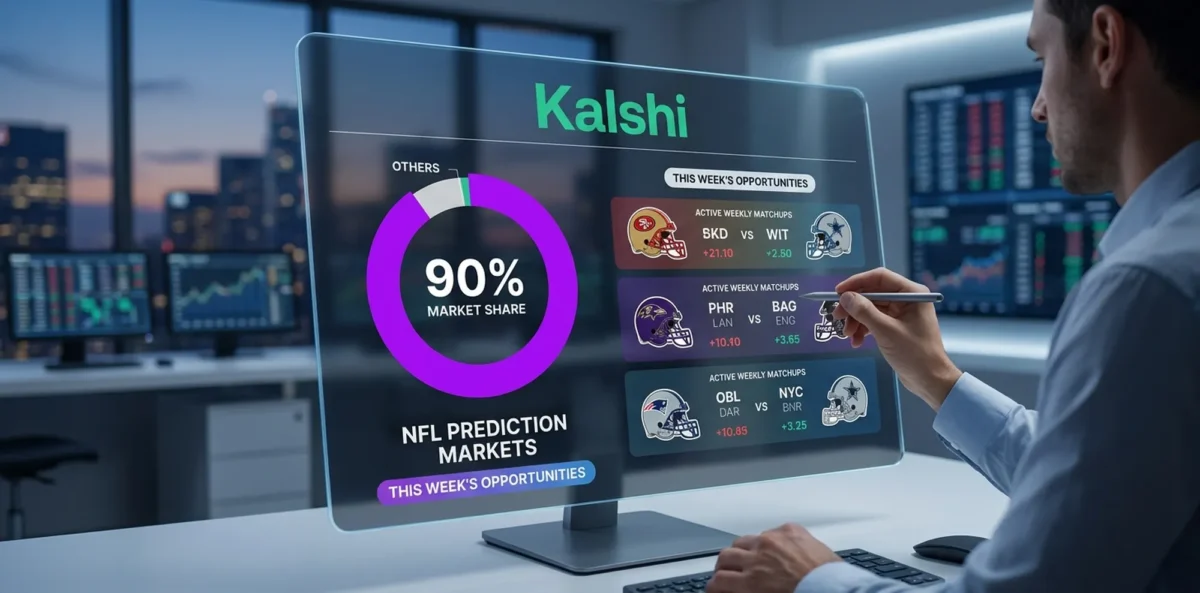
Kalshi cracked 90% of the sports prediction market this week, and the reason is sitting right in front of you if you’ve been watching the numbers. The NFL opening week just lit up the prediction markets like nothing else, and traders who understand the real landscape—not the hype, but the actual volume and pricing divergences—are already positioning for Week 2. This is the week where patterns from opening week start to matter, and where the smart money separates from the noise.
Is Prediction Market Income Taxable? What the IRS Says in 2026
Why Kalshi Won the Sports Prediction Market—And What It Means for You
The numbers tell a story. Kalshi hit $167.8M in NFL volume last week alone, up 324% week-over-week. That’s not a gradual climb—that’s an avalanche. And with 90.4% market share in sports prediction, Kalshi has become something close to a monopoly on outcomes-based trading.
Compare that to Polymarket, which still gets 39% of its overall volume from sports. But here’s the thing: Polymarket is spreading its liquidity across the whole platform. Sports represents 39% of Polymarket’s book, but sports represents 80% of Kalshi’s. That concentration matters. It means Kalshi has deeper liquidity in any single NFL market, tighter spreads, and faster execution. For traders who live in prediction markets, that gravitational pull is real.
Why did Kalshi pull so far ahead? Regulatory clarity. Kalshi is a licensed CFTC exchange, and when the NFL season opened with the league actively promoting prediction markets as part of fan engagement, the licensed venue won. Polymarket remains non-custodial, which suits certain traders and certain markets, but it doesn’t have Kalshi’s seal of approval from the regulators. For a new trader with a choice, or a trader with serious capital, Kalshi’s regulatory position is the default.
Kalshi’s UX is tighter now too. The mobile experience works. The API is faster. And the network effects are real—when 90% of traders are on Kalshi, liquidity begets liquidity.
What is Kalshi? How the Regulated Prediction Market Works in CA & TX
The Competitive Landscape: Kalshi vs. Polymarket on the Same Outcomes
Here’s where it gets interesting. Polymarket still exists, and for certain outcomes, Polymarket’s pricing doesn’t match Kalshi’s. That’s the arb opportunity traders miss.
On the same NFL outcomes—same games, same prop markets, same betting windows—Kalshi and Polymarket can diverge. Not by much, but enough. A 2–3 cent difference on a Yes/No outcome that’s trading at 50 cents is a 4–6% arb, and when the liquidity on Polymarket is decent, that’s a real trade. The catch is execution risk: you need enough size on Polymarket to close out a position taken on Kalshi, and the market can move against you while you’re waiting for a fill.
The bigger insight: Polymarket’s expansion into regulatory and political event markets is real. While Kalshi owns sports, Polymarket is winning on things like election outcomes, policy changes, and geopolitical events. So Polymarket’s product strategy isn’t to compete head-to-head with Kalshi on NFL Week 7 passing yards—it’s to own the non-sports category where Kalshi doesn’t operate. That means traders need both platforms, not one or the other.
Week 2’s Flagship Market: Cowboys vs. Giants, and What the Lines Tell You
When you look at Week 2 across all prediction markets, one game stands out by volume: Dallas Cowboys vs. New York Giants, and this is exactly the kind of matchup where you want to understand the pricing.
The Cowboys line has tightened from -3 to -2.5 across the week. In prediction markets, that line movement means something: it’s real money repositioning. The opening was Cowboys -3, and the line crawled down. That usually signals one of two things: sharp money came in on the Giants, or the initial market pricing had the spread off.
The moneyline is equally telling: Cowboys -162 / Giants +136. That’s not a blowout in the market’s eyes. It’s a 1-to-1.6 payout, which reflects something close to a 62% win-probability for Dallas. Compare that to the -2.5 spread, which would imply closer to a 55–56% win probability in traditional sports betting, and you see the market is pricing the Giants as closer to a coin-flip on the moneyline than the spread suggests.
The total sits at 48.5. That’s a moderately low total for these two teams, which tells you the market is pricing a slower, defense-first week. Or it’s pricing uncertainty around key players. Either way, the total is where sharp traders look first to find mispricings.
What to trade this week on Cowboys-Giants:
- The spread is tight, so the value is in props or the total
- If you think the Giants’ defense plays tighter than the line suggests, the under at 48.5 is the play
- The moneyline arbitrage exists if you can move fast between Kalshi and Polymarket when it opens there
NFL Week 2 Cowboys vs Giants Betting Preview: Why Sharp Money Is Flipping the Line in 2026
Beyond the NFL: Week 2 Events Traders Should Watch
The NFL owns 76.5% of all prediction market volume. That’s the gravity well. But Week 2 has other markets worth watching if you’ve got capital sitting in prediction markets.
Premier League (Sept 19–20): Tottenham vs. Aston Villa is the marquee fixture. Soccer prediction markets are growing, and the liquidity is picking up. This is not Kalshi’s main focus—it’s more of a Polymarket specialty—but the volume is real. European traders are active here.
UFC 331 (Sept 19): Combat sports prediction markets are a growth category. Kalshi has started listing UFC props, and the betting action on individual fights is solid. If you trade props more than straight outcomes, UFC is where you should be looking.
These markets are less liquid than NFL, but that’s where the edges are. Kalshi dominates in volume, but the less-populated markets are where you find mispricings.
How to Actually Use These Markets: Practical Trading Edges
Most new traders treat prediction markets like sports betting. That’s the first mistake. Here’s how traders who make money actually work these markets:
1. Treat Kalshi as your primary venue for NFL outcomes. The liquidity is too good to ignore. Use Polymarket as a hedge or for divergences, not as your first choice.
2. Understand the shape of the order book. Kalshi shows you the full book. Look at the bid-ask spread. When the spread is tight (1 cent or less on Yes/No), liquidity is real. When it’s wide (3+ cents), you’re looking at a market with thin order flow. Thin markets are where the trading takes place—the spread widens when uncertainty is high.
3. Arbitrage between Kalshi and Polymarket, but do it with size discipline. A 2-cent arb looks good at the micro level. But if you need to move 10,000 contracts across both venues, execution risk eats your edge. Use the arb for portfolio rebalancing, not as your main strategy.
4. Trade the aggregates. Kalshi and Polymarket both offer season-long markets and cumulative markets (Team A wins more games than Team B). These markets have less volume than single-game outcomes, but they’re where sophisticated traders build positions that mature over weeks, not days.
5. Use props to find edges in the straight markets. If a QB passing yards market is mispriced relative to the over/under on total points, that’s your signal. Props should be in conversation with the macro market, not isolated.
Is Kalshi Legit? The 2026 Prediction Market’s Battle Over CFTC Regulation and Legal Status
This Week’s Top Markets to Watch
1. Cowboys -2.5 vs. Giants (Kalshi)
- Status: Tight, active, good liquidity
- The spread tightened from -3, signal that smart money likes the Giants
- Trade: If you think the defense wins, go under 48.5
2. Dallas Cowboys Season Win Total (Polymarket / Kalshi)
- Status: Growing liquidity
- This is where you see if the market thinks Dallas’s win against the Giants is a one-off or the start of a streak
- Trade: Position before Sunday if you have a thesis on Dallas’s full season
3. Tottenham Moneyline vs. Aston Villa (Polymarket)
- Status: Moderate liquidity, European traders active
- Trade: If you know English football, this is a higher-edge market than the NFL
4. UFC 331 Main Event Outcomes (Kalshi)
- Status: New but growing
- Trade: Low volume means low competition; if you have expertise in combat sports, the edge is there
The Arb Opportunity: Reading Kalshi vs. Polymarket Pricing
Here’s the practical setup. Kalshi will price Cowboys-Giants this week. Polymarket may or may not have opened it yet (it depends on regulatory timing). If Polymarket opens the same market at a different line, you have an arb.
Example: Kalshi shows Cowboys -2.5. Polymarket opens at Cowboys -2.6. That difference is small, but multiply it by your position size and it adds up. The trade: buy Giants at -2.5 on Kalshi, sell Giants at -2.6 on Polymarket (or the equivalent in Yes/No odds), and you’ve locked in 1 cent per contract. Scale that to 1,000 contracts and you’ve made $10 on a completely neutral position.
The catch: slippage and fill risk. By the time you’ve bought on Kalshi and sold on Polymarket, the market may have moved against you. Use limit orders. And don’t try this with illiquid markets where the slippage will kill you.
The Verdict: Where to Trade This Week
Kalshi owns this market. Its 90.4% market share on sports is not a fluke—it’s regulatory advantage plus network effects plus better execution. If you’re trading NFL prediction markets in Week 2, start there.
But Polymarket is not dead. It’s repositioning toward regulatory and non-sports outcomes where Kalshi has less presence. If you’re a serious prediction market trader, you live on both platforms, but you use them for different purposes.
The three markets I’d watch closest this week:
- Cowboys vs. Giants spread (Kalshi) — Most liquid, real money moving, tight spreads. This is where you get the best execution and the most competition, which means efficiency but also less edge.
- Season-long Cowboys wins (Kalshi / Polymarket) — Lower volume, higher potential edge. The market priced a 17-game season; Cowboys’ Week 1 result gives you new information.
- Tottenham vs. Aston Villa moneyline (Polymarket) — Even lower volume. If you know soccer, this is where edge lives.
The meta-opportunity: Kalshi’s dominance is not going away. Regulatory approval is structural. But that concentration of liquidity means non-NFL prediction markets on Polymarket will have less competition and more opportunities for traders with expertise. Play to your edge, but play where the competition is weakest.
This article is for informational purposes only. Prediction market trading involves risk.
Leo Falsafi is a digital marketing veteran and senior journalist at Virlan.co, where he covers the intersection of digital marketing, gaming, and breaking US trending news. With nearly two decades of hands-on experience in SEO and digital strategy, Leo has consulted for and scaled hundreds of companies. His deep industry roots allow him to deliver sharp, fact-checked insights and analysis on the trends shaping today's digital landscape.