
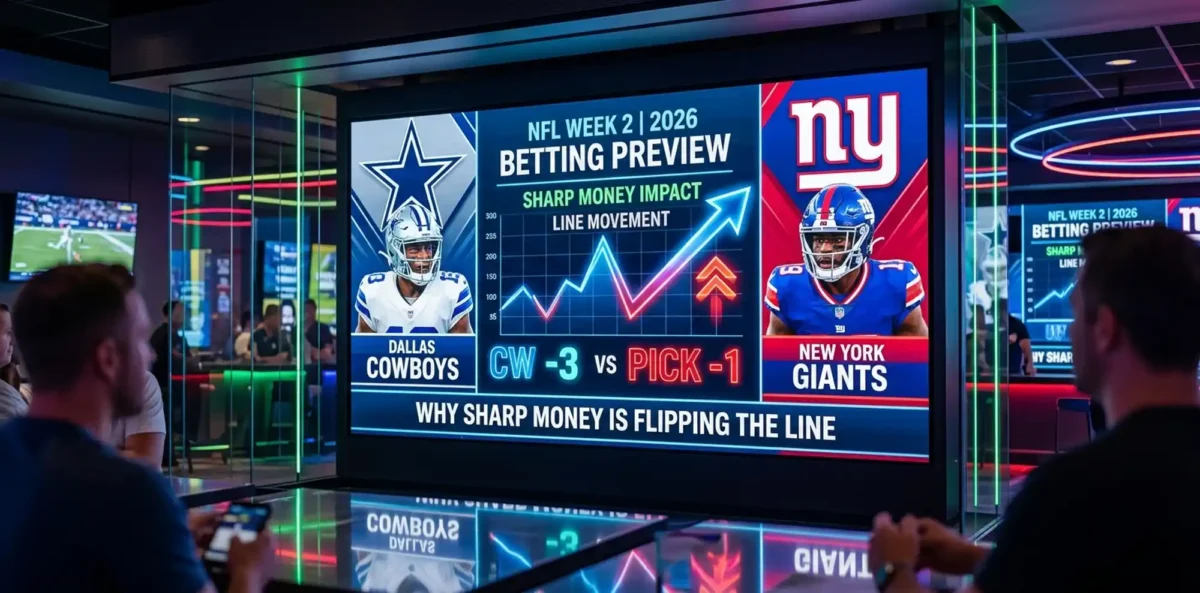
The opening kickoff has barely cooled and the smart money is already making a statement. The Dallas Cowboys came into Week 2 favored by 3 at home against the New York Giants, but somewhere between the first wager and now, the line has shifted to -2.5. In NFL betting, line movement of that magnitude isn’t noise—it’s a signal that professional bettors are reading something the casual public missed.
What’s driving the action? A combination of Week 1 results, sharp money confidence, and one of those market inefficiencies that prediction traders live for. Here’s what the data tells us about the most intriguing matchup of Week 2.
The Opening Narrative: Dallas Should Be Bigger Than -3
The Cowboys enter with every traditional edge. They’re at home. They’ve got the better roster on paper. The moneyline reflects this comfort: -162 for Dallas, +136 for New York. A straight bet on the Cowboys to win outright pays out just 38 cents on every dollar risked. The math suggests an easy Dallas win.
But line movement doesn’t work that way. When the opening line comes down from -3 to -2.5, it’s because sharp bettors are actively laying money on the Giants or backing away from Cowboys support at those higher prices. The question isn’t whether Dallas is better—it’s whether they’re 3 points better after one game’s worth of real evidence.
The Case for Dallas: Favored for Reason
Dallas dominated Week 1. The Cowboys’ offense executed cleanly, and their defense imposed their will on an opponent. That’s the baseline: at home, with momentum, against a team expected to struggle in this matchup. The total sits at 48.5 points, suggesting neither team is expected to put up a shootout, which aligns with a strong Dallas defensive show last week.
The Cowboys also benefit from a scheduling advantage—they’re facing the Giants in the early weeks of the season when consistency matters more than late-game desperation. Dallas’s personnel edge is real: a healthier roster, more offensive firepower, and secondary depth that should slow down whatever New York wants to attempt through the air.
The Case for Giants +2.5: Why Sharp Money Respects It
But here’s where the Week 2 data gets interesting. The Giants’ Week 1 result—a performance nobody expected to be competitive—has changed the conversation. They didn’t just show up; they found moments where the offense moved the ball, the defense generated pressure, and the team demonstrated it could hang with better competition for a full game.
That’s enough to shake confidence in a 3-point spread.
Prediction markets are pricing this accordingly. Last week, Kalshi NFL prediction market volume exploded to $167.8M, up 324% week-over-week, with the NFL season opener effect driving overall trading activity. That surge includes bets on Week 2 matchups, and the Giants contract prices suggest smart traders are seeing value in New York’s +2.5. When professional prediction traders—the ones who bet on market outcomes for a living—start backing a number, the public betting line eventually follows.
Kalshi holds 90.4% market share in sports prediction markets. These are bettors playing for real stakes, often with access to proprietary analysis and historical data most casual bettors never see. Their activity is a thermometer for where true value sits.
The Total: 48.5 and the Efficiency Play
The under at 48.5 points is worth examining. Both teams’ Week 1 performances suggest controlled offensive outputs. Dallas’s defense looked stout. New York didn’t fall apart early and give up garbage-time scoring that inflates totals. A grind-it-out game with field positions decided by defenses and special teams could easily settle well under 48 combined points.
If you’re a sharp bettor or prediction trader, the under and a Giants cover work in concert. You’re essentially betting on Giants discipline and Dallas not running away with the game early. That’s a coherent thesis, not two unrelated plays.
The Prediction Market Angle: Where the Edge Sits
Kalshi’s prediction markets price individual game outcomes separately from point-spread betting. On Kalshi, you’re betting on the binary outcome—Cowboys win or Giants win—not the point spread. That creates asymmetries. The platforms’ users might price a Cowboys moneyline at 60% implied probability, while traditional sportsbooks have the line priced to 62% (just as an example). That divergence is where traders find edge.
Last week’s volume spike shows these markets are heating up. More liquidity, more diverse participant opinions, and more real money testing the prices. The Giants at +2.5 with an implied probability lurking around 45–47% on prediction markets suggests the traditional betting line has overcorrected toward Dallas.
A bettor who finds a systematic gap between prediction market pricing and sportsbook spreads can build a repeatable edge over time.
Is Prediction Market Income Taxable? What the IRS Says in 2026
The Verdict
Back the Giants at +2.5. The play sits at the intersection of three confluent signals: sharp-money line movement, prediction-market discomfort with Cowboys overvaluation, and Week 1 evidence that New York can compete on neutral terms.
The Giants aren’t the better team. They’re just not three points worse in the second week of a season where one game’s data is still noisy and prediction markets are trading heavily. Dallas will likely win this matchup outright, but the spread is too tight for a Cowboys bet at -2.5 to offer value. The Giants, by contrast, have room to lose on the scoreboard and still cover.
For prediction traders specifically, the convergence of Kalshi volume, the binary-outcome odds on those platforms, and traditional betting-line movement all point to Giants value that won’t last long once more sharp money floods in. Get the line while it sits at +2.5.
This article is for informational purposes only. Please gamble responsibly.
Max Newman is Deputy Editor and Data Strategy at Virlan.