
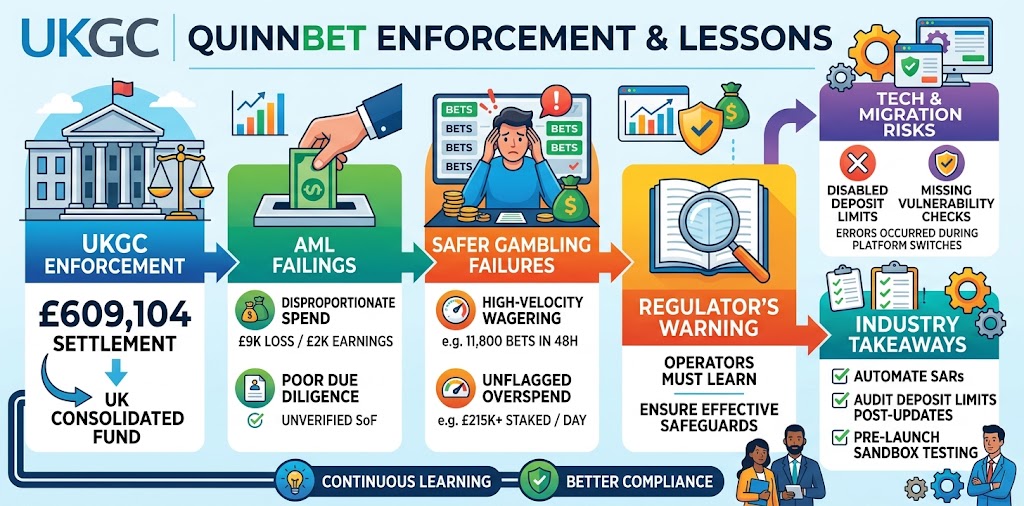
Overview of the £609,104 Regulatory Settlement
QuinnBet (Gibraltar) Limited—the remote gambling licensee behind the operation of quinnbet.com—has agreed to pay a £609,104 regulatory settlement following an extensive compliance investigation conducted by the UK Gambling Commission (UKGC). The Commission’s enforcement action addresses systemic anti-money laundering (AML) and social responsibility deficiencies covering an assessment period from March 2023 to August 2025.
QUINNBet REGULATORY SETTLEMENT BREAKDOWN
| Total Settlement Amount | £609,104 |
| Financial Disgorgement Component | £193,118 |
| Destination of Funds | UK Consolidated Fund |
| Compliance Investigation Period | March 2023 – August 2025 |
| Market Traffic Ranking (Blask) | 17th (Ireland) / 70th (UK) |
The £609,104 agreed sum is paid in lieu of a formal financial penalty following a non-contested regulatory settlement process. Included within the total figure is a direct disgorgement payment of £193,118—representing financial gains accrued during the period of non-compliance—alongside contributions toward the UKGC’s investigative costs. All settlement proceeds will be directed into the UK Government’s Consolidated Fund, which covers central public expenditure, day-to-day government operations, and national debt servicing.
Anti-Money Laundering (AML) Deficiencies and Due Diligence Breaches
The Gambling Commission’s investigation highlighted severe delays and shortcomings in QuinnBet’s identification and mitigation of money-laundering risks, specifically concerning customers exhibiting disproportionate spending relative to their verified income.
+-------------------------------------------------------------------------+
|                    KEY ANTI-MONEY LAUNDERING FAILINGS                   |
+-----------------------------------+-------------------------------------+
| Disproportionate Spend Case #1    | Monthly earnings of ~£2,000;        |
|                                   | deposited and lost £9,000 in 4 days |
+-----------------------------------+-------------------------------------+
| Disproportionate Spend Case #2    | Deposited ~£120,000, withdrew       |
|                                   | £111,000 in <3 months with no       |
|                                   | verified Source of Funds (SoF)      |
+-----------------------------------+-------------------------------------+
| Suspicious Activity Reports (SAR) | Failure to submit reports promptly  |
|                                   | once suspicion threshold was met    |
+-----------------------------------+-------------------------------------+
Ineffective Source of Funds (SoF) Verification
- Unverified Disproportionate Losses: Investigators identified an account where a customer provided payslips showing net monthly earnings of approximately £2,000, yet was permitted to deposit and lose £9,000 within a four-day timeframe without immediate intervention.
- Unsubstantiated Recycled Winnings: Another customer deposited approximately £120,000 and withdrew £111,000 across a span of under three months. QuinnBet assumed these transactions represented recycled winnings without obtaining corroborating evidence. Subsequent reviews confirmed that neither the customer’s bank statements nor tax returns reflected transactions with the operator.
- Delayed Suspicious Activity Reports: The operator displayed insufficient procedural controls to guarantee that Suspicious Activity Reports (SARs) were compiled and submitted to authorities as soon as practicable after the threshold of suspicion was established.
Social Responsibility Failures and Safer Gambling Control Breakdowns
The Commission’s published findings revealed operational and algorithmic shortcomings in QuinnBet’s customer interaction framework, customer monitoring triggers, and protection protocols for vulnerable customer demographics.
+-------------------------------------------------------------------------+
|                  SOCIAL RESPONSIBILITY & HARM MARKERS                   |
+-----------------------------------+-------------------------------------+
| High-Velocity Wagering Case #1    | 4,800 bets placed on day one;       |
|                                   | 7,000 bets placed on day two        |
+-----------------------------------+-------------------------------------+
| Escalated Staking Case #2         | £215,000+ staked in 24 hours;       |
|                                   | multiple wagers exceeding £5,000    |
+-----------------------------------+-------------------------------------+
| Vulnerable Demographic Protection | Manual delay allowed 18–24s to      |
|                                   | deposit 8x monthly limits           |
+-----------------------------------+-------------------------------------+
Flaws in Algorithmic Monitoring and Risk Detection
- High-Velocity Betting Sessions: Algorithmic monitoring failed to capture rapid, high-volume wagering. In one documented instance, a single customer placed approximately 4,800 bets in a single day and 7,000 bets the following day (totaling 11,800 wagers across a 48-hour window) without the activity triggering a manual safer-gambling review.
- Unflagged Escalated Staking: Following a substantial win, a customer escalated stakes to exceed £215,000 in a single day—including multiple individual wagers exceeding £5,000. This pattern was not identified in real time and was only picked up in retrospective reporting.
- Misconfigured Real-Time Alerts: The operator’s real-time loss-limit alert was configured to execute only when a customer attempted a further deposit after exceeding their limit, allowing pre-existing balances above the limit to be gambled through unhindered.
- Ineffective Harm Evaluations: Account reviews focused predominantly on customer financial means rather than behavioral markers of harm, and staff did not systematically verify if prior customer interventions had successfully curbed problem behavior.
Technical Platform Migration and Financial Vulnerability Check Errors
A substantial portion of QuinnBet’s compliance failures originated during an operational migration to a new technical architecture, which disabled automated compliance checks and exposed structural software bugs.
+-------------------------------------------------------------------------+
|                 PLATFORM MIGRATION IMPACT ON COMPLIANCE                 |
+-----------------------------------+-------------------------------------+
| Deposit Limit Override            | 194 customers exceeded intended     |
|                                   | limits due to disabled controls     |
+-----------------------------------+-------------------------------------+
| Omitted Vulnerability Checks      | 177 accounts missed required        |
|                                   | threshold reviews during migration  |
+-----------------------------------+-------------------------------------+
| Retrospective Vulnerability Fail  | 41 outright fails;                  |
|                                   | 136 requiring account restrictions  |
+-----------------------------------+-------------------------------------+
Deposit-Limit Controls Disabled
- Bypassed Young-Adult Thresholds: QuinnBet implemented lower deposit limits for young adults aged 18 to 24, recognising increased vulnerability to gambling harms. However, the limit was applied via a manual procedure that took several hours to activate. One young adult successfully deposited eight times their intended monthly limit prior to control activation, losing the entirety of the funds within 24 hours.
- Software and Human Errors: Software and manual integration errors during the platform switch disabled two deposit-limit controls, permitting 194 customers to deposit sums above designated thresholds.
- Backlog of Financial Vulnerability Checks: Customers meeting financial vulnerability thresholds were not checked at required operational intervals during the migration. When QuinnBet self-reported the fault and subsequently executed the backlog of checks, 41 customers failed outright and 136 accounts required immediate betting restrictions.
Official Statements: UK Gambling Commission and QuinnBet Leadership
UKGC Enforcement Directorate Response
John Pierce, Commission Director of Enforcement, stated:
“This case highlights the serious consequences of relying on systems and controls that are unable to identify and respond to indicators of harm and financial crime quickly enough. We expect operators to ensure their safeguards are effective in practice to protect consumers and keep crime out of gambling.
“In this case, the operator recognised the issues and took immediate action to make significant improvements to its systems and controls. This included strengthening their AML policies and procedures and improving how they identify and respond to indicators of harm.
“We expect operators to learn from this case and read the public statement to ensure that they do not make the same mistakes. Our key focus is on ensuring that operators meet the standards we expect and, where they fall short, we will take regulatory action where necessary.”
QuinnBet Executive Response
Brenda Quinn, Chief Executive Officer of QuinnBet, stated:
“We took action to address the matters identified, strengthening our policies, procedures and controls and making significant investment in our people and technology. These improvements were subsequently reviewed by the Commission, and the issues identified were resolved to its satisfaction.
“We have agreed a regulatory settlement with the Commission and consider the matter fully resolved. We remain committed to protecting our customers, maintaining robust compliance standards and continuing to strengthen our systems and controls.”
Sources Quoted
- UK Gambling Commission (gamblingcommission.gov.uk): Official regulatory enforcement notice and public statement by John Pierce, Director of Enforcement.
- SBC News (sbcnews.co.uk): Reporting by Viktor Kayed featuring executive statements from Brenda Quinn, CEO of QuinnBet.
- Gaming.net & iGaming Business (igamingbusiness.com): Technical reporting on platform migration data, financial breakdown, and Consolidated Fund allocation.
Leo Falsafi is a digital marketing veteran and senior journalist at Virlan.co, where he covers the intersection of digital marketing, gaming, and breaking US trending news. With nearly two decades of hands-on experience in SEO and digital strategy, Leo has consulted for and scaled hundreds of companies. His deep industry roots allow him to deliver sharp, fact-checked insights and analysis on the trends shaping today's digital landscape.