
The Core of the Ninth Circuit Dispute
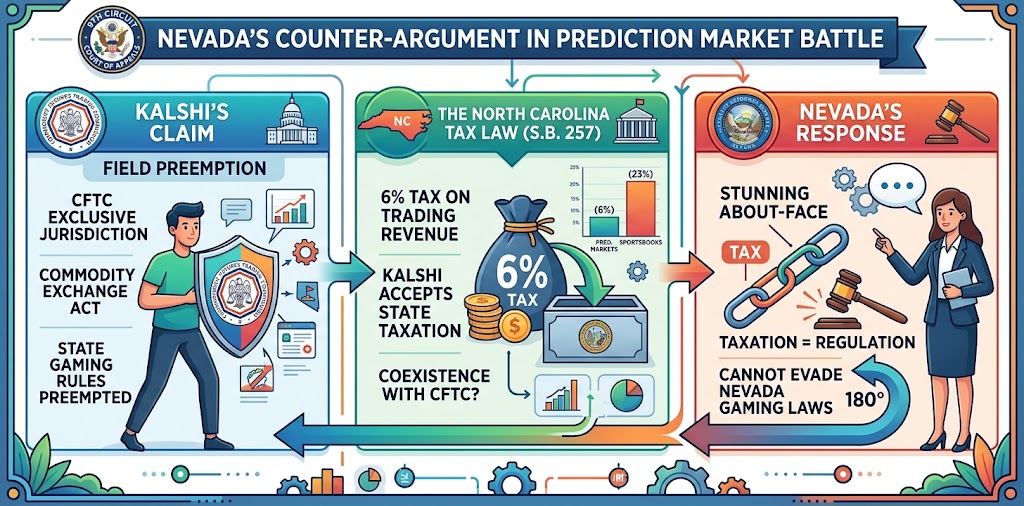
Nevada is using Kalshi’s own argument over North Carolina’s prediction market tax against it in the Ninth Circuit. The Nevada attorney general’s office has told a federal appeals court that by embracing a tax on their trading revenue in North Carolina, Kalshi is admitting that a state has the power to regulate its operations in the state. The state says the operator’s reliance on the law undercuts its broader federal preemption case.
In a filing, Nevada responded to an Aug. 11 letter in which Kalshi cited North Carolina Senate Bill 257 (S.B. 257) to support its preemption arguments. According to Kalshi, states remain free to regulate transactions outside Designated Contract Markets (DCMs) and exercise other powers that do not directly affect trading on or the operation of a federally regulated exchange. The operator also used the North Carolina law to counter Nevada’s argument that unlicensed prediction markets threaten state revenue by avoiding gambling taxes.
The CFTC’s exclusive jurisdiction prevents states from regulating on-DCM trading, but it does not preclude states from imposing lawful taxes on revenues from trading on DCMs, Kalshi told the court.
A Stunning About-Face
Nevada rejected Kalshi’s distinction between taxing prediction markets and regulating their underlying contracts.
A stunning about-face, which would mean that (at a minimum) Kalshi cannot evade Nevada’s taxing provisions, Nevada Deputy Attorney General Abigail Pace wrote in papers filed with the Ninth Circuit Court of Appeals in San Francisco.
The (North Carolina) law confirms the central holding … that states have the authority to regulate (Kalshi’s) sports, election, and entertainment-related event contracts, Pace wrote. Kalshi’s embrace of S.B. 257 undermines its (own) arguments at every turn.
Pace added: By embracing S.B. 257, Kalshi is admitting that a state has the power to regulate its operations in the state. The state said that would mean, at a minimum, Kalshi cannot avoid Nevada’s own taxing provisions.
North Carolina’s Senate Bill 257 Explained
Under North Carolina’s roughly $34 billion state budget, signed by Democrat Governor Josh Stein, prediction market operators like Kalshi face a 6% tax on trading fee revenue attributable to state residents. The tax takes effect on January 1, 2027.
North Carolina became the first state to codify federal Commodity Futures Trading Commission (CFTC) oversight into law in Senate Bill 257—formally known as Session Law 2026-41—allowing federally regulated exchanges to operate legally. It allows prediction markets registered with the CFTC to operate in the state, provided they are federally registered and comply with the Commodity Exchange Act (CEA). If a prediction market is registered with the CFTC, it has fulfilled all of the requirements imposed upon it by the state and does not need to ask for any special license, cannot be required to register separately, and does not face any special gaming rules.
The Tax Gap and Sweetheart Deal Allegations
The tax rate on prediction markets contrasts heavily with sports-betting operators. Beginning January 1, 2027, prediction market operators will owe the government 6% of the net revenue earned on transactions involving residents of North Carolina. By comparison, sports betting operators will be taxed at 23% on gross betting revenue in the same budget, which is an increase from 18% and applies immediately. Furthermore, licensed sportsbooks also pay $1 million to the government for the license to operate, a cost prediction markets avoid entirely.
Because prediction markets and sportsbooks offer functionally similar products to consumers, opponents argue the 17-percentage-point tax gap amounts to a sweetheart deal that disadvantages licensed, state-regulated operators. Wagering on sporting events makes up as much as 80% of the trading value on the platforms by some estimates, prompting states to view them essentially as sports books.
Mick Mulvaney, who used to be the acting chief of staff at the White House and is currently running the organization Gambling Is Not Investing, argued this favors platforms that avoid the state’s licensing and gambling rules. He was quite frank: Prediction markets are unlicensed sports gambling apps — full stop.
However, according to gaming analyst Dustin Gouker, writing in his Next Event Horizon newsletter, the measure appears to mark the first time a state has sought to explicitly recognize CFTC-registered prediction markets as lawful under federal authority while declining to impose its own licensing, registration, or other regulatory obligations. Gouker described it as affirming legislation with a relatively low tax rate that prediction markets would likely want other states to copy.
The Taxation vs. Regulation Argument
Despite North Carolina’s explicit deference to the federal government, Nevada argued that North Carolina’s tax still amounts to state regulation in a field Kalshi says is reserved to the federal government.
Pace noted that on field preemption, Kalshi argued that the Community Exchange Act creates a regime (that) leaves no room for states to supplement it.
Yet S.B. 257 acts directly in the very field Kalshi claims is preempted – on DCM transactions, she wrote. Kalshi attempts to draw a distinction between regulating its contracts and taxing its revenue from these contracts, but that is purely a formalism. Both are forms of regulation by the state.
Pace wrote that on conflict preemption, Kalshi argued that the application of Nevada’s gaming laws would frustrate a supposed federal policy of uniform federal regulation of derivative markets.
Yet S.B. 257 imposes exactly that type of state specific regulation by requiring Kalshi to identify its gaming activity attributable to North Carolina and pay taxes on that activity, Pace wrote.
Kalshi notes that S.B. 257 purports to recognize the CFTC’s exclusive federal regulatory over sports-contracts offered by CFTC-regulated DCMs, Pace added. However, Pace emphasized that the North Carolina Legislature’s view of the meaning of federal statute is not binding on this court and the legislature’s statement is factually suspect in light of the fact it plainly believes there is room for states to act in regulating prediction markets.
The Broader Ripple Effect on Prediction Markets
The rest of the states have implemented stricter measures, leaving federal courts split across the United States.
Illinois, Kentucky, and A Fragmented Regulatory Landscape
Effective July 1, Illinois imposed a tiered transaction tax on sports-related exchange wagers placed on prediction markets. Enacted under Senate Bill 3019, the law taxes the first five million exchange wagers at 1.75% and subsequent wagers at 3.5%, while requiring operators to get a state sports-betting license. A four-year license would cost $15 million. Kalshi has sued Illinois to overturn the tax.
Elsewhere, Kentucky enacted a 14.25% excise tax in April and paired it with enforcement actions, drawing a lawsuit from the CFTC.
The legal angle is sharply contested across the country. In New Jersey and Tennessee, Kalshi obtained preliminary injunctions which in April were upheld by the Third Circuit Court of Appeals. However, the platform has suffered losses in other states, including Maryland, Nevada, Arizona, Ohio, and recently, in the Southern District Court of New York.
In New York, Judge Analisa Torres did not agree to grant an injunction against the state’s activities, arguing that Kalshi had not shown a likelihood of winning the argument based on federal preemption law. The company filed an appeal with the Second Circuit Court of Appeals. Daniel Wallach, a Sports Law attorney, agreed that the decision may have a negative impact on Kalshi’s other fights.
A spokesperson of Polymarket noted that the company follows the CFTC rules and that state-level efforts to regulate prediction markets will likely face significant federal preemption challenges.
Leo Falsafi is a digital marketing veteran and senior journalist at Virlan.co, where he covers the intersection of digital marketing, gaming, and breaking US trending news. With nearly two decades of hands-on experience in SEO and digital strategy, Leo has consulted for and scaled hundreds of companies. His deep industry roots allow him to deliver sharp, fact-checked insights and analysis on the trends shaping today's digital landscape.