
Maine is now officially online casino country. When Governor Janet Mills allowed LD 1164 to become law on January 8, 2026 — declining to veto it after the legislature reconvened the day before — the Pine Tree State joined a small but fast-growing club of U.S. states where residents can legally play real-money slots, poker, and live dealer games from their phones.
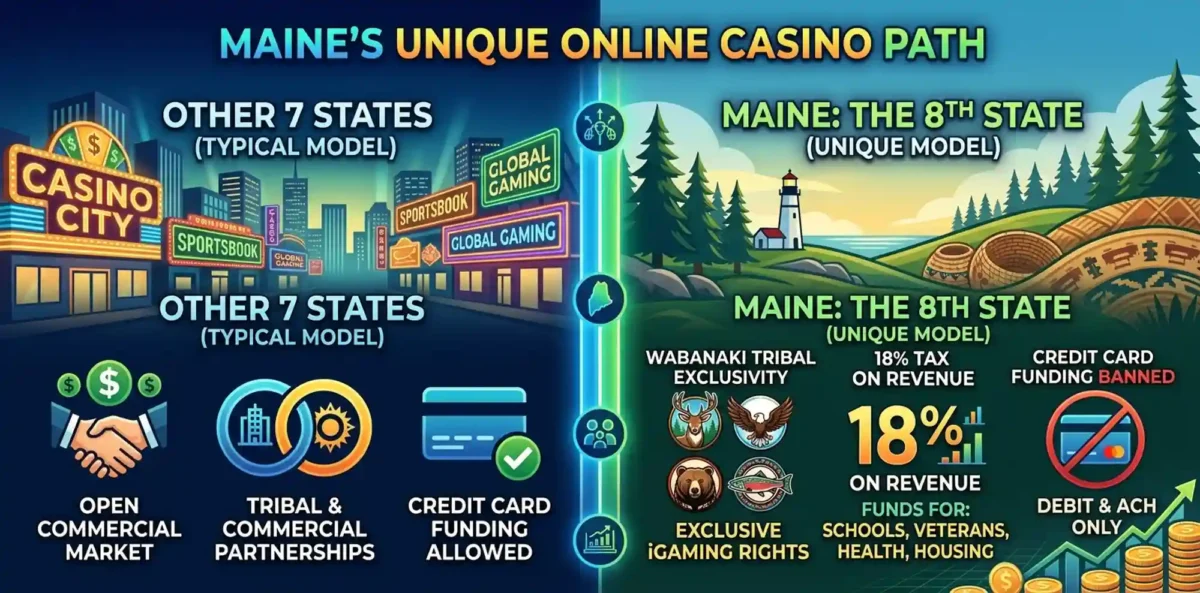
But Maine didn’t just copy the blueprint from New Jersey or Pennsylvania. It built something new: a framework rooted entirely in tribal sovereignty, structured to funnel the economic windfall of online gambling directly to the state’s four federally recognized Wabanaki Nations. It’s the first model of its kind in U.S. iGaming history — and it’s already drawing attention from operators, tribes, and lawmakers across the country.
How LD 1164 Became Law
The bill was introduced to the Maine House on March 20, 2025, by Rep. Ambureen Rana (D), co-sponsored by Rep. Aaron Dana, with the central argument that online gaming revenue could deliver genuine economic sovereignty to the Wabanaki Nations — communities that have been systematically excluded from the tribal gaming boom that enriched Native nations across most of the U.S.
That exclusion has a legal root: the 1980 Maine Indian Claims Settlement Act placed Maine’s tribes under state jurisdiction rather than the federal framework that normally governs tribal gaming. As a result, the Wabanaki Nations cannot operate traditional tribal casinos under federal law the way tribes in Connecticut, Michigan, or California can. LD 1164 was designed to correct that imbalance — not perfectly, but meaningfully.
Governor Mills, who allowed the bill to become law without signing it, acknowledged the nuance in a statement: “This fall, I met with the five elected Chiefs of the Wabanaki Nations, who each spoke passionately about the importance of this bill in offering life-changing revenue for Tribal communities, as well as providing a form of economic sovereignty for their Nations.”
The message was clear: this wasn’t a conventional gambling expansion bill. It was a matter of economic justice.
The Tribal-Exclusive Model: How It Works
Under LD 1164, only Maine’s four Wabanaki Nations can hold online casino operator licenses:
- Penobscot Nation
- Passamaquoddy Tribe
- Houlton Band of Maliseet Indians
- Mi’kmaq Nation
The tribes don’t build the technology themselves — they partner with established national platforms that provide the games, software, and infrastructure. The tribal nation holds the license; the operator powers the platform.
The licensing deals broke down like this:
- DraftKings partnered with the Passamaquoddy Tribe and was first to market, launching in March 2026
- FanDuel followed in April 2026, holding its own tribal partnership license
- Caesars Entertainment partnered with three nations — the Penobscot Nation, the Houlton Band of Maliseet Indians, and the Mi’kmaq Nation — establishing the broadest tribal footprint of any operator in the state
The tax rate on gross gaming receipts sits at 16-18%, a fraction of Pennsylvania’s punishing 54% slot tax. That competitive rate was deliberate: lawmakers wanted to attract serious operators who would invest in the market long-term, not just file a license and run a minimal product.
The Numbers: What Maine Is Worth
Maine is not New Jersey. Its population of roughly 1.4 million makes it one of the smaller iCasino markets in the U.S. The state’s own fiscal projections are modest: $3.6 million in state tax revenue by fiscal year 2026-27, based on conservative handle estimates.
But the industry’s own numbers are more optimistic. With all three major operators active in a lightly competitive environment, analysts project Maine could reach $57.9 million in annual gross gaming revenue, generating approximately $10.4 million in annual taxes. More bullishly, the tribal online casino launch is projected to hit $180 million in annual gross gaming revenue within three years — a figure that would put it solidly in the middle tier of U.S. iCasino markets.
That’s meaningful money for the Wabanaki Nations, whose communities have limited economic infrastructure compared to tribal nations in states where federal gaming law applies.
What Already Existed Before the Law
Maine wasn’t a gambling desert before LD 1164. The state had two commercial casinos — Oxford Casino in Oxford (approved by statewide referendum in 2010) and Hollywood Casino in Bangor (opened in 2005 as Maine’s first casino-style property). Both offer slots and table games. The state lottery has operated for decades, and parimutuel horse racing wagering is also legal.
More relevantly for this story: Maine’s four Wabanaki Nations have held exclusive mobile sports betting rights since 2022, already making them the only entities in the state that can take a legal sports wager from a Maine resident’s phone. LD 1164 extended that exclusivity model to the far larger category of online casino gaming.
The tribes knew this market. They’d been building relationships with national operators for years. When the law passed, the launch timeline was genuinely fast — DraftKings was live within three months.
Maine Is Now the 8th — Who Came Before, and Who’s Next?
Maine’s legalization makes the U.S. iCasino map look like this:
| State | Year Launched | Key Operators |
|---|---|---|
| Delaware | 2013 | State lottery monopoly |
| New Jersey | 2013 | DraftKings, FanDuel, BetMGM, Caesars |
| Nevada | 2013 | Poker-only |
| Pennsylvania | 2019 | DraftKings, FanDuel, BetMGM, Barstool |
| Michigan | 2021 | DraftKings, FanDuel, BetMGM, PokerStars |
| West Virginia | 2020 | DraftKings, FanDuel, BetMGM |
| Rhode Island | 2024 | IGT (state monopoly) |
| Maine | 2026 | DraftKings, FanDuel, Caesars |
Every U.S. iCasino State Ranked: The Definitive 2026 Breakdown
Together, these eight states represent a market that analysts estimate will generate over $8 billion in annual gross gaming revenue in 2026 — with New Jersey, Pennsylvania, and Michigan accounting for roughly 90% of that. Pennsylvania alone has collected over $4 billion in cumulative iGaming revenue since launching in 2019, with a record $1.1 billion in its 2024-25 fiscal year.
Who’s Next?
Virginia came close. Senate Bill 118 passed both chambers of the Virginia legislature in early 2026, only to fail in conference on March 14, 2026. Both chambers’ versions included a reenactment clause requiring the bill to pass again in the 2027 session — meaning the earliest Virginia goes live with iCasinos is 2028. Given Virginia’s population of 8.7 million and a robust existing sports betting market, it remains one of the most valuable untapped prizes in U.S. iGaming.
New York is the bigger conversation. State Sen. Joseph Addabbo Jr. introduced Senate Bill 2614 in January 2026 to authorize online casinos and online lottery sales. As of mid-September 2026, the bill remains in committee — a familiar holding pattern for New York gaming legislation. But with the state finalizing licenses for three major downstate retail casinos (Bally’s Bronx, Resorts World NYC, and Metropolitan Park at Citi Field), the political dynamics are shifting. Operators who invested billions in retail licenses want online access. That pressure tends to eventually move legislation.
A legal New York iCasino market would immediately become the largest in the United States.
Why Maine’s Model Matters Beyond Maine
The tribal-exclusive structure that LD 1164 created is being studied by operators and tribes in neighboring states. Vermont and New Hampshire — both of which share Maine’s New England geography and similar tribal political dynamics — are watching closely.
If the Maine model works as advertised — operators generating strong revenue, tribal nations building genuine economic infrastructure, state tax revenue meeting projections — it becomes a template that could accelerate iGaming adoption in states where non-tribal casino expansion would face steeper political resistance.
Conversely, if operators find the tribal licensing structure limiting, or if competitive friction emerges between the four Wabanaki Nation partners and their respective operators, the model’s advocates will have a harder case to make elsewhere.
Either way, Maine has carved out a distinct lane in U.S. iGaming history. It is the only state where the entire online casino industry is built on — and controlled by — the tribes whose lands the state sits on. That’s a first worth watching.
Leo Falsafi is a digital marketing veteran and senior journalist at Virlan.co, where he covers the intersection of digital marketing, gaming, and breaking US trending news. With nearly two decades of hands-on experience in SEO and digital strategy, Leo has consulted for and scaled hundreds of companies. His deep industry roots allow him to deliver sharp, fact-checked insights and analysis on the trends shaping today's digital landscape.