
Picking an online bingo site used to be a short conversation. A few household names, a television advert, whichever welcome bonus looked biggest. Done. It doesn’t work like that any more. Hundreds of licensed bingo sites now compete for British players, plenty of them the same platform wearing different outfits, and choosing between them has turned into a genuine job.
The market itself is enormous. The Gambling Commission’s Gambling Survey for Great Britain found 48 per cent of adults had gambled in the previous four weeks, and once you strip out the lottery-only crowd, online play comfortably beats trips to a physical venue. Remote casino, betting and bingo brought in £2.1 billion in a single quarter, by the Commission’s latest count. Bingo is a small slice of that. A busy slice, though, with new sites arriving every month.
Somewhere in all that noise, something shifted. UK bingo players stopped choosing sites the way operators wanted them to and started treating the decision like any other purchase worth researching properly.
Why bonuses stopped being the deciding factor
For years, the industry’s marketing playbook was built on one number. Whichever site could put the biggest figure in its welcome offer headline — £50 free, £120 in bonuses, 500 per cent on your first deposit — tended to win the click. It worked because most new players had no other basis for comparison.
It stopped working because players learned to read the small print. Take a £100 bingo bonus carrying 65x wagering, a seven-day expiry and a cap on what can ever be turned into cash. On paper it beats a £20 bonus at 4x with no ceiling. In your account it doesn’t, not even close. Players did that maths for themselves and passed it around the forums. The big headline number stopped landing.
The regulatory environment accelerated the shift. The Gambling Commission and the Advertising Standards Authority have both tightened expectations around how offers are presented, pushing significant terms out of the footnotes and into the open. The result is a market where bonus value is still relevant, but it has become table stakes rather than the deciding factor. The questions that decide where experienced players actually deposit are different ones. Who runs this site? How fast does it pay? What happens when something goes wrong?
The trust signals players now check first
Ask a few seasoned UK players what they check before joining a new site. You’ll hear the same list back, near enough word for word.
The licence comes first. Any site legally serving British customers must hold a Gambling Commission licence, and the Commission’s public register lets you check one in about thirty seconds. Sites that put their licence number where you can find it are telling you something. So are the ones that bury it.
Then there’s ownership, the detail the industry would rather you didn’t dwell on. An awful lot of UK bingo brands are white-labels sitting on the same few shared networks. Two sites with completely different branding can turn out to share their games, their promotions, their support desk, even their withdrawal queue. Have a poke around behind the mascot and you will learn more about the experience waiting for you than the homepage will ever admit.
Then come the practical questions. How long do withdrawals genuinely take, as opposed to what the terms page promises? Are bonus terms written in plain English? Does the site offer meaningful safer gambling tools — deposit limits, time-outs, reality checks — and does it participate properly in GamStop, the national self-exclusion scheme that has now passed half a million registrations? Is there a named alternative dispute resolution provider for complaints the operator cannot resolve?
None of these checks is difficult on its own. The problem is scale. Running that checklist properly against even a shortlist of five sites takes hours, and against a market of several hundred sites it is simply not feasible for an individual. That is the gap independent comparison websites have grown into.
How independent comparison sites changed the equation
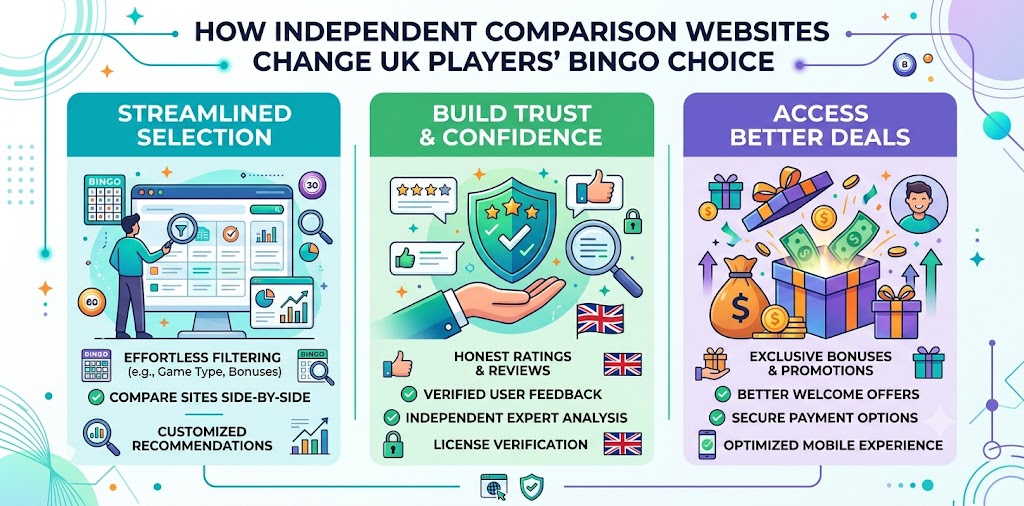
The good ones do the legwork no individual player reasonably can — registering accounts, depositing real money, timing how long withdrawals genuinely take. They read the full bonus terms, not the summary box, and they keep a record of which network and parent company sits behind each brand. Resources such as TheBingoOnline’s bingo comparison guide set licensed operators out side by side — networks, wagering terms, payment options and payout speeds included — so that a player can weigh ten sites in the time it once took to investigate one.
That aggregation has had a knock-on effect on the operators themselves. When withdrawal speeds and wagering requirements sit in a table next to nine competitors, fine print turns into a competitive feature. Several operators now lead their marketing with fast payouts and low wagering, which is a direct response to the criteria comparison sites made visible.
Not every comparison site deserves the word “independent”, mind. Most are affiliates, earning a commission when a reader signs up, and the weakest of them are little more than advertising dressed as advice. The credible ones give themselves away in specific habits: a published methodology, reviews with dates on them that actually move, plain disclosure of how the site earns its money. The strongest signal of all is a willingness to publish negative bingo site reviews and to name the operators they would tell readers to avoid. A comparison site that has never warned anyone off anything is not comparing. It is selling.
Car insurance went through this a generation ago. So did energy tariffs, and mortgages after them. Once comparison culture arrives, opacity stops paying, and the market has little choice but to compete on substance. Online bingo is well along the same path.
The informed player era
The regulator sets the floor for how UK bingo sites must behave. What comparison culture has done is push competition above that floor. Operators who pay quickly, write fair terms and treat complaints seriously now have somewhere for that record to show up. So do the ones relying on nobody reading the small print.
For players, the practical advice is short enough. Check the licence on the Commission’s register yourself rather than taking the site’s word for it. Find out whose network a site sits on before its branding wins you over. Read the bonus terms, not the bonus banner. Even a trusted comparison resource is the start of your homework, not the end of it. And set deposit limits before the first game, not after a bad month.
Online bingo remains entertainment with a cost attached, and no amount of research changes the underlying odds. But choosing where to play is no longer guesswork, and that is largely down to a corner of the industry that decided its job was to inform players rather than simply deliver them. The operators don’t always enjoy the scrutiny. Players are better off for it, full stop.
Leo Falsafi is a digital marketing veteran and senior journalist at Virlan.co, where he covers the intersection of digital marketing, gaming, and breaking US trending news. With nearly two decades of hands-on experience in SEO and digital strategy, Leo has consulted for and scaled hundreds of companies. His deep industry roots allow him to deliver sharp, fact-checked insights and analysis on the trends shaping today's digital landscape.