
The bond market spent late June bracing for a prolonged period of hawkish monetary policy. Then the mid-July Consumer Price Index (CPI) report landed.
Softer inflation data immediately triggered a disinflationary relief rally. Treasury yields compressed across the curve, the US Dollar Index (DXY) slipped, and capital aggressively rotated back into the foundational names of the market. The central tension between sticky inflation and growth has temporarily broken in favor of equities, setting up a distinct runway for specific mega-cap tech firms.
However, not all tech equities respond equally to macroeconomic shifts. Based on current institutional data, earnings projections, and structural business catalysts, three specific stocks are demonstrating the strongest technical and fundamental momentum in the post-CPI environment.
The Macro Shift: Why Soft CPI Data Ignites Tech Stocks
Direct Answer: A softer Consumer Price Index (CPI) indicates cooling inflation, which drives down bond yields and increases the probability of Federal Reserve rate cuts. Because technology company valuations rely heavily on discounted future cash flows, lower borrowing costs make their long-term earnings structurally more attractive to institutional investors, prompting immediate upward price momentum.
When the June 2026 inflation data hit the tape on July 14, the market rapidly began unwinding the rate-hike premium that had been building since the non-farm payroll shocks earlier in the summer. The US 10-year Treasury yield dropped to 4.55%, and the 2-year yield fell to 4.15%.
This exact macro configuration heavily favors companies with massive cash flow engines that do not require cheap debt to operate. Investors are pivoting away from speculative AI bets and reallocating into established tech firms boasting clear product supercycles and aggressive margin expansion strategies.
3 Tech Stocks Positioned for a Post-CPI Breakout
1. Apple Inc. (AAPL): Services Growth and Hardware Supercycles
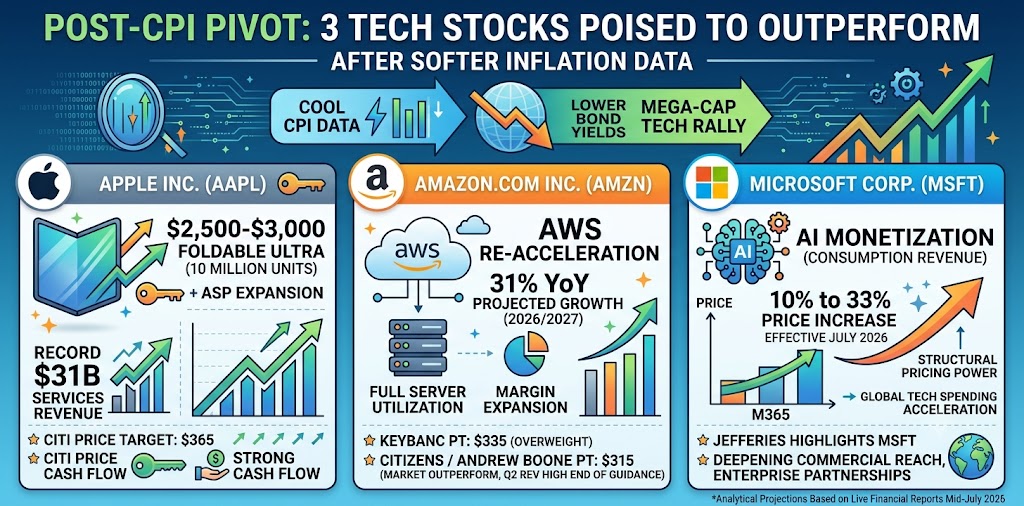
Direct Answer: Apple is structurally positioned to outperform due to a robust cash flow engine, a record $31 billion in Services revenue, and institutional anticipation of a new hardware supercycle driven by an upcoming premium foldable device.
Apple has quietly climbed roughly 16% since late June, pushing past the $325 mark by mid-July. The narrative driving this momentum extends far beyond broad tech strength. Investors are currently pricing in the company’s staggering $111.2 billion March quarter, which featured 22% year-over-year iPhone revenue growth and an all-time high in Services revenue.
Looking forward, institutional models are factoring in the highly anticipated “foldable iPhone Ultra”. Industry reports suggest production targets of 10 million units at a premium $2,500 to $3,000 price point. If executed, this hardware release will generate massive Average Selling Price (ASP) expansion. Citi analysts recently upgraded their price target on Apple to $365, pointing toward the July 30 earnings report as a critical catalyst to confirm the company’s margin narrative.
2. Amazon.com Inc. (AMZN): AWS Re-Acceleration and Margin Expansion
Direct Answer: Amazon’s forward momentum is anchored by expected upside in its Amazon Web Services (AWS) division, with institutional analysts projecting 31% year-over-year AWS growth in 2026 driven by full server utilization, capacity expansion, and aggressive retail margin improvements.
As the broad market digested the CPI data, Amazon shares pushed higher in tandem with the Magnificent Seven recovery. The foundational bull case for Amazon currently rests entirely on the re-acceleration of its cloud computing dominance.
On July 16, KeyBanc raised its price target on Amazon to $335, maintaining an Overweight rating. The firm explicitly cited higher AWS net sales, projecting 31% year-over-year growth for both 2026 and 2027, alongside upgraded operating income estimates. Citizens analyst Andrew Boone similarly reiterated a Market Outperform rating with a $315 target, forecasting that Amazon’s upcoming Q2 revenue will hit the high end of guidance. Boone highlights that AWS is currently benefiting from full utilization, newly online capacity, and elevated pricing power.
3. Microsoft Corp. (MSFT): AI Monetization Meets Structural Pricing Power
Direct Answer: Microsoft is positioned for continued outperformance by simultaneously compounding consumption-based AI revenue while executing a 10% to 33% price increase across its legacy commercial M365 software suite effective July 2026.
Microsoft is executing a structural financial maneuver that few other companies can attempt. Effective this month, the company is raising list prices across its commercial M365 suite by 10% to 33%.
This aggressive pricing strategy operates in parallel with massive enterprise cloud adoption. The company is effectively layering immense pricing power over its captive legacy seat base while opening an entirely new revenue ceiling through consumption-based AI tools. Financial firm Jefferies recently highlighted Microsoft as a standout in global tech spending, noting that broader cloud expenditure is expected to accelerate to 10.1% in 2026. With deepening commercial reach through expanded enterprise partnerships, Microsoft’s ability to extract more capital from existing clients makes it highly resilient to broader economic fluctuations.
Disclaimer: Forward-looking market projections are analytical in nature and subject to change based on macroeconomic conditions. The upcoming July 28–29 FOMC meeting and evolving Federal Reserve testimonies remain critical risk events that could alter bond yields and equity trajectories.
Sources Quoted
Specific data, pricing targets, and market metrics were extracted from live financial reports dated mid-July 2026, including institutional notes from Citi, KeyBanc, Citizens (Andrew Boone), Jefferies, and real-time market data aggregated via Investing.com and the Moomoo trading community.
Leo Falsafi is a digital marketing veteran and senior journalist at Virlan.co, where he covers the intersection of digital marketing, gaming, and breaking US trending news. With nearly two decades of hands-on experience in SEO and digital strategy, Leo has consulted for and scaled hundreds of companies. His deep industry roots allow him to deliver sharp, fact-checked insights and analysis on the trends shaping today's digital landscape.