
The cryptocurrency market has evolved dramatically over the past decade. Trading volumes have multiplied, security standards have hardened, and regulatory clarity has begun to reshape which platforms thrive. Choosing the right crypto exchange isn’t a casual decision — it determines your fees, the coins you can access, the speed of your trades, and ultimately how safe your assets are.
This guide cuts through the noise. We’ve ranked the top 10 cryptocurrency exchanges of 2026 based on 24-hour trading volume, regulatory standing, security practices, user experience, and fee structure. Whether you’re a seasoned trader or just getting started, you’ll find the best crypto trading platform for your needs here.
How We Ranked the Top 10 Crypto Exchanges
Any ranking lives or dies by its methodology. Ours is transparent and built on five pillars:
Trading Volume: We prioritized exchanges handling the highest daily volumes. Volume signals liquidity — the ability to enter and exit positions without moving the market against you. A $100B+ daily volume tells a different story than a $10B one.
Security & Regulation: We examined which exchanges hold meaningful licenses or registrations. This includes Money Transmitter licenses in the US, FCA authorization in the UK, and equivalent regulatory approvals globally. We also reviewed custody practices, insurance coverage, and historical security incidents.
Fee Structure: Maker and taker fees matter. We benchmarked standard trading pairs (BTC/USD, ETH/USD) and noted deposit/withdrawal fees where they apply. Lower isn’t always better — sometimes you’re paying for better execution or faster withdrawals.
User Experience: This covers platform interface, mobile app quality, customer support responsiveness, and educational resources. A confusing exchange might save you a few basis points until you accidentally place a market order you meant to limit.
Coin Selection: Access matters. We counted the number of supported cryptocurrencies and noted unique assets some exchanges offer. If you’re trading smaller altcoins, availability is critical.
1. Binance — The Global Powerhouse
| Metric | Details |
|---|---|
| Founded | 2017 |
| Headquarters | Singapore (compliance offices globally) |
| 24h Volume | ~$90 billion |
| Maker / Taker Fees | 0.10% / 0.10% (standard) |
| Supported Coins | 1,000+ |
| Regulated | Partial (varies by jurisdiction) |
| Best For | High-volume traders, altcoin access |
Binance remains the 800-pound gorilla of crypto exchanges. Its 24-hour trading volume dwarfs the competition, and its coin selection is unmatched — you’ll find obscure tokens here that exist nowhere else. For serious traders, that liquidity and breadth are game-changers.
The platform itself is powerful but steep. Binance’s advanced charting, derivatives markets, and staking products cater to experienced users. Newcomers often find the interface overwhelming, but that’s the price of sophistication. Mobile experience is solid, and customer support, while sometimes slow, is improving.
Fees are competitive across the board. Standard maker/taker fees are 0.10%, though high-volume VIP tiers drop significantly lower. Deposit and withdrawal are nearly free, which matters when you’re moving capital between exchanges.
Regulation remains Binance’s thorniest issue. The platform has faced scrutiny globally and operates under a patchwork of permissions. It’s not banned in most jurisdictions, but it operates in a gray zone in some. That’s not a deal-breaker if you understand the landscape, but it’s worth noting.
Verdict: Binance is the standard for professional traders and anyone who needs maximum coin selection and liquidity.
2. Coinbase — The Trusted American Exchange
| Metric | Details |
|---|---|
| Founded | 2012 |
| Headquarters | San Francisco, USA |
| 24h Volume | ~$35 billion |
| Maker / Taker Fees | 0.40% / 0.60% (Coinbase Advanced) |
| Supported Coins | 200+ |
| Regulated | Yes (BitLicense, SEC-registered) |
| Best For | US traders, compliance-focused users |
Coinbase is synonymous with institutional-grade crypto trading in the US. The platform holds a BitLicense from New York, is registered with the SEC as a broker-dealer, and passes every regulatory test you can name. If regulatory clarity matters to you — and it should — Coinbase is the gold standard.
The Coinbase experience is built on simplicity for beginners and power for advanced traders. Coinbase.com is the beginner-friendly portal; Coinbase Advanced is the serious trading interface with real-time charting and lower fees. This two-tier approach works.
Fees are higher than Binance’s, but that’s a deliberate trade-off. You’re paying for regulatory certainty, institutional-grade infrastructure, and insurance that covers customer assets up to $250K. For retail traders in the US, that peace of mind often justifies the premium.
Execution quality is excellent. Coinbase’s matching engine is one of the fastest in the industry, and slippage is minimal on major pairs. Deposit and withdrawal via bank transfer are fast for US customers — often same-day.
The coin selection is narrower than Binance’s. You’ll find the major coins (Bitcoin, Ethereum, Solana, etc.) and a solid roster of established altcoins, but obscure tokens are unlikely to be there. That’s intentional — Coinbase vets coins before listing them.
Verdict: Coinbase is the best crypto exchange for US-based traders who prioritize regulation and institutional trust over maximum altcoin access.
3. Kraken — The Serious Trading Platform
| Metric | Details |
|---|---|
| Founded | 2011 |
| Headquarters | San Francisco, USA |
| 24h Volume | ~$28 billion |
| Maker / Taker Fees | 0.16% / 0.26% (standard) |
| Supported Coins | 150+ |
| Regulated | Yes (Money Transmitter licenses in US states, EU authorization) |
| Best For | Margin traders, staking, serious retail traders |
Kraken occupies a sweet spot: serious trading credentials without the overload. Founded in 2011, it survived every crypto winter and regulatory crackdown. The platform holds Money Transmitter licenses across US states and regulatory approval in the EU.
The interface is clean and professional. Kraken’s charting is on par with Binance’s, and its order types are comprehensive. Margin trading is available (up to 5x leverage) for approved users. If you want to trade with more sophistication than Coinbase offers but prefer Kraken’s regulation over Binance’s gray-zone status, this is it.
Fees are favorable — better than Coinbase, worse than Binance unless you’re VIP. But Kraken’s standout feature is its staking program. The platform offers competitive staking rewards on Ethereum, Solana, Polkadot, and dozens of other coins. For long-term holders, Kraken’s staking can meaningfully boost returns.
Coin selection is solid (150+ supported) but not exhaustive. You’ll find all major coins and most established altcoins, but the long tail of tokens won’t be there.
Customer support is a strength. Kraken’s team responds to tickets within 15-30 minutes during business hours, which is faster than Binance and on par with Coinbase.
Verdict: Kraken is the best crypto trading platform for serious retail traders who want leverage, staking, and regulatory assurance without the complexity of Binance.
4. Bybit — The Derivatives Specialist
| Metric | Details |
|---|---|
| Founded | 2018 |
| Headquarters | Singapore |
| 24h Volume | ~$32 billion |
| Maker / Taker Fees | 0.10% / 0.10% (spot trading) |
| Supported Coins | 250+ |
| Regulated | Partial (operational in multiple jurisdictions) |
| Best For | Futures traders, high leverage, active traders |
Bybit is the king of derivatives trading. The platform specializes in perpetual futures, quarterly contracts, and other derivatives with leverage up to 125x. If you’re trading with leverage, Bybit’s liquidity and execution speed are hard to beat.
Spot trading is secondary to futures here, but it’s present and competitively priced. The interface is intuitive for derivatives work, with risk management tools built in. Bybit’s funding rate on perpetuals is usually tight, meaning fewer arbitrage opportunities but more consistent pricing.
Coin selection is impressive (250+), with good coverage across DeFi tokens and altcoins. This breadth is especially useful for derivatives traders targeting specific assets.
Bybit’s regulatory posture is like Binance’s — operational globally but not formally regulated in most jurisdictions. The platform is working toward regulation (particularly in Dubai and other hubs) but isn’t there yet.
Fee structure is very competitive. Spot trading at 0.10% maker/taker matches Binance, and futures makers actually pay negative fees (the exchange pays you to provide liquidity). High-volume traders get even steeper discounts.
Customer support is adequate but not exceptional. Response times run 24-48 hours, which is slower than Kraken but acceptable for the derivatives-focused user base.
Verdict: Bybit is the best crypto exchange for active derivatives and futures traders who want high leverage and tight funding rates.
5. OKX — The High-Volume Asian Exchange
| Metric | Details |
|---|---|
| Founded | 2017 |
| Headquarters | Seychelles (operations across Asia) |
| 24h Volume | ~$25 billion |
| Maker / Taker Fees | 0.10% / 0.15% (standard) |
| Supported Coins | 300+ |
| Regulated | Partial (operational in select jurisdictions) |
| Best For | Asian traders, derivatives trading, Web3 enthusiasts |
OKX is the second-largest exchange by volume and punches above its weight in derivatives. The platform launched as OKCoin and rebranded to OKX in 2021. It’s especially popular in Asia but increasingly used globally.
Spot trading fees are competitive, and derivatives fees are excellent. Perpetual futures have funding rates on par with Bybit, and options trading is a standout feature. If you want to hedge or take sophisticated derivative positions, OKX’s depth is valuable.
Coin selection is excellent (300+) and leans toward tokens that matter in Asia and DeFi. If you’re trading altcoins, OKX will have them.
Platform usability is strong. The interface handles both beginners and advanced traders well, with good charting and order management. Mobile app performance is smooth.
Regulation is improving. OKX operates in Hong Kong with various compliance initiatives underway globally. It’s not at Coinbase’s level but more regulated than Binance or Bybit.
OKX’s unique advantage is Web3 integration. The platform offers crypto wallet features and even a self-custody option. If decentralization matters to your philosophy, OKX edges toward that space.
Verdict: OKX is the best crypto exchange for traders seeking strong derivatives markets, excellent altcoin selection, and emerging Web3 integration.
6. Crypto.com — The Mainstream Onramp
| Metric | Details |
|---|---|
| Founded | 2016 |
| Headquarters | Singapore |
| 24h Volume | ~$20 billion |
| Maker / Taker Fees | 0.40% / 0.40% (standard) |
| Supported Coins | 250+ |
| Regulated | Yes (various MSB licenses, working toward full regulation) |
| Best For | Newcomers, fiat onramps, rewards programs |
Crypto.com is betting big on mainstream adoption. The company’s high-profile advertising (NFL naming rights, celebrity endorsements) makes it a household name in crypto. That brand strength translates to solid onboarding and a massive user base.
Trading fees are higher than most competitors (0.40% standard), but Crypto.com’s real value is elsewhere. The platform offers excellent fiat on-ramps (credit card, bank transfer) in most countries, with faster processing than many rivals. You can fund your account and start trading within hours.
The mobile app is excellent — intuitive and visually polished. For retail users who want to download one app and buy Bitcoin without thinking, Crypto.com delivers that experience.
Crypto.com’s rewards ecosystem is aggressive. The platform offers staking, cash-back on card purchases (with a staked CRO balance), and other incentives. Over time, these rewards can offset the higher trading fees.
Coin selection is solid (250+) but not exceptional. You’ll find major coins and popular altcoins, but obscure tokens will be missing.
Security is a strong suit. Crypto.com holds insurance and has passed regular audits. The platform’s regulatory approach is cautious, which appeals to conservative traders.
Verdict: Crypto.com is the best crypto exchange for newcomers and casual traders who value ease of use, fiat on-ramps, and rewards over trading fees.
7. KuCoin — The Altcoin Paradise
| Metric | Details |
|---|---|
| Founded | 2017 |
| Headquarters | Seychelles (major operations in Asia) |
| 24h Volume | ~$18 billion |
| Maker / Taker Fees | 0.10% / 0.10% (standard) |
| Supported Coins | 600+ |
| Regulated | Operational in select jurisdictions; regulatory status evolving |
| Best For | Altcoin traders, small-cap projects, DeFi enthusiasts |
KuCoin is the go-to platform for altcoin traders hunting moonshots. The exchange lists tokens that haven’t made it to Binance yet, including new DeFi projects and layer-2 tokens. If you want breadth of coin selection, KuCoin’s 600+ supported coins are unmatched.
This breadth comes with risk. KuCoin lists lower-quality and riskier projects than more conservative exchanges. The platform’s trading community is especially active in speculative trading, and rug pulls on smaller coins aren’t uncommon.
Fees are competitive (0.10% maker/taker), and the referral program is generous. If you bring friends to KuCoin, you earn rebates on their trades.
Platform usability is good. KuCoin’s interface works well for both beginners (simple mode) and traders (pro mode with advanced charting). The mobile app is solid.
Margin trading is available, with leverage up to 10x on selected pairs. This appeals to active traders but also increases risk of catastrophic losses.
Regulation is KuCoin’s weak point. The platform doesn’t hold major regulatory licenses, though it operates globally and is working toward compliance in several jurisdictions. For US traders, the regulatory clarity isn’t there.
Verdict: KuCoin is the best crypto exchange for altcoin hunters and DeFi traders who can stomach higher risk in exchange for maximum token selection.
8. Gemini — The Compliance Leader
| Metric | Details |
|---|---|
| Founded | 2014 |
| Headquarters | New York, USA |
| 24h Volume | ~$8 billion |
| Maker / Taker Fees | 0.50% / 0.50% (standard) |
| Supported Coins | 80+ |
| Regulated | Yes (BitLicense, heavily regulated) |
| Best For | Conservative US investors, compliance-focused traders |
Gemini is Coinbase’s main rival in the US regulated exchange space. Founded by the Winklevoss twins in 2014, Gemini holds a BitLicense and is regulated at every level. If regulatory paranoia (healthy paranoia) defines your approach, Gemini is worth considering.
The platform deliberately limits coin selection to 80+ assets. This conservatism is intentional — Gemini vets every coin before listing. Expect Bitcoin, Ethereum, and established altcoins; don’t expect experimental DeFi tokens.
Fees are high (0.50% maker/taker standard), but you’re paying for institutional-grade infrastructure and compliance. Gemini’s custody and insurance are among the best in the industry.
Platform experience is clean and professional. Gemini’s interface works well for both beginners and traders, though advanced features are limited compared to Kraken or Binance.
Unique advantage: Gemini Staking. The platform offers industry-leading staking rewards on select assets with no lock-up period. For passive income, Gemini’s staking is worth considering.
Volume is lower than Coinbase’s, which can mean wider spreads on large orders. This is the trade-off of Gemini’s conservative approach.
Verdict: Gemini is the best crypto exchange for US-based investors who demand maximum regulatory compliance and are willing to pay for it.
9. Bitfinex — The Professional’s Exchange
| Metric | Details |
|---|---|
| Founded | 2012 |
| Headquarters | Hong Kong |
| 24h Volume | ~$12 billion |
| Maker / Taker Fees | 0.10% / 0.20% (standard) |
| Supported Coins | 100+ |
| Regulated | Partial (operational globally; regulatory status varies) |
| Best For | Margin traders, professional traders, cryptocurrency veterans |
Bitfinex is the old guard of crypto exchanges. Founded in 2012, it has weathered every market cycle and regulatory storm. The platform attracts serious traders and has a reputation for no-nonsense execution.
Margin trading is Bitfinex’s signature. The exchange offers up to 5x leverage with a sophisticated margin system designed for professionals. If you’re trading on margin, Bitfinex’s liquidity and derivative products are exceptional.
Spot trading is available but secondary. Fees on spot are competitive (0.10% maker, 0.20% taker), but the real activity is in derivatives.
Coin selection is more limited than Binance or KuCoin, but broader than Coinbase. You’ll find major coins and established altcoins; the long tail is missing.
Platform experience is robust but outdated. Bitfinex’s interface is powerful for traders but uninviting for beginners. The learning curve is steep.
Regulatory status is uncertain. Bitfinex doesn’t hold major licenses in the US or EU and has faced compliance challenges. The platform is operationally available globally, but regulatory clarity is lacking.
Security history is a concern. Bitfinex suffered a major hack in 2016, and while it compensated users and has improved security since, the incident lingers in the community.
Verdict: Bitfinex is the best crypto exchange for experienced margin traders who prioritize leverage and execution speed over regulatory certainty.
10. MEXC — The Rising Challenger
| Metric | Details |
|---|---|
| Founded | 2018 |
| Headquarters | Singapore |
| 24h Volume | ~$10 billion |
| Maker / Taker Fees | 0.10% / 0.10% (standard) |
| Supported Coins | 500+ |
| Regulated | Operational globally; regulatory status evolving |
| Best For | Altcoin traders, high-volume traders, Asian traders |
MEXC is KuCoin’s younger sibling, equally focused on altcoins but with an even more aggressive listing approach. The platform lists tokens that others won’t touch — some legitimate projects, some questionable. If you want exposure to the absolute frontier of crypto projects, MEXC will have them.
Coin selection is exceptional (500+) and heavily skewed toward DeFi and layer-2 tokens. This breadth is MEXC’s selling point.
Fees are aggressive for a high-altcoin platform: 0.10% maker/taker standard. High-volume traders get rebates, and the referral program is generous.
Platform usability is solid, though less polished than KuCoin. The interface is functional and works on mobile and desktop.
Leverage trading is available with up to 10x leverage on select pairs. This appeals to active traders but increases risk.
Regulation is MEXC’s underdeveloped side. The exchange is operational globally but holds no major regulatory licenses. For US traders, regulatory clarity is minimal.
MEXC is less well-known than KuCoin or Binance, which means lower volume on some pairs and less robust community resources. That also means lower fees and better spreads for patient traders.
Verdict: MEXC is the best crypto exchange for aggressive altcoin traders who prioritize maximum token selection and competitive fees over brand recognition.
Crypto Exchange Fees Compared
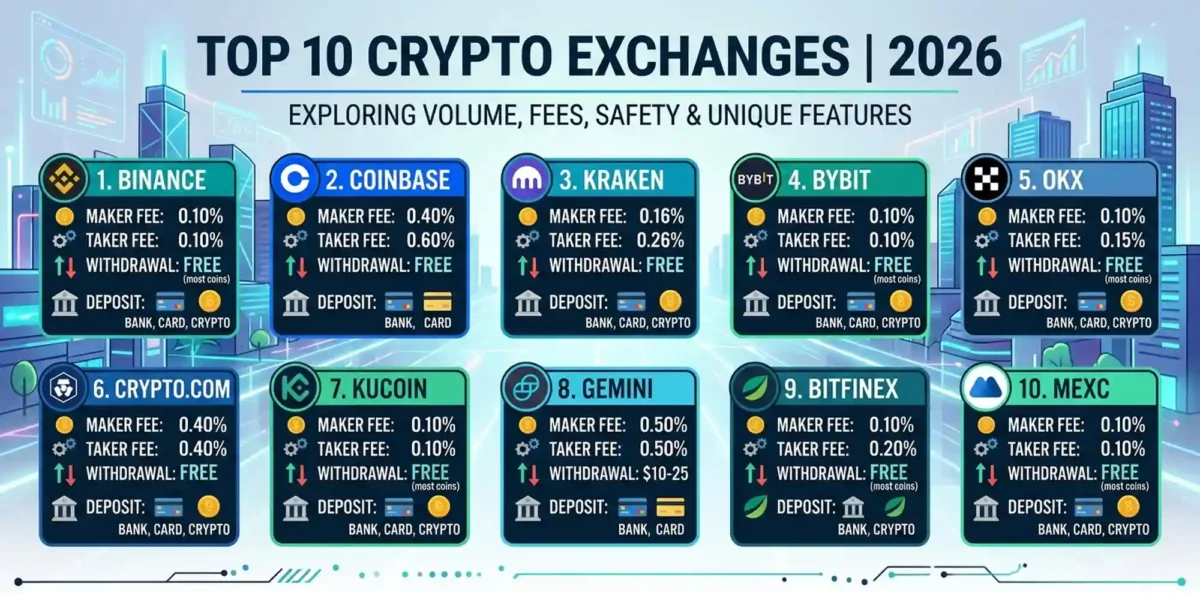
Fee structures vary wildly across exchanges. Here’s a direct comparison of the top 10 on standard trading pairs (buy/sell on BTC/USD):
| Exchange | Maker Fee | Taker Fee | Withdrawal Fee | Deposit Methods |
|---|---|---|---|---|
| Binance | 0.10% | 0.10% | Free (most coins) | Bank, card, crypto |
| Coinbase | 0.40% | 0.60% | Free | Bank, card |
| Kraken | 0.16% | 0.26% | Free | Bank, card, crypto |
| Bybit | 0.10% | 0.10% | Free (most coins) | Bank, card, crypto |
| OKX | 0.10% | 0.15% | Free (most coins) | Bank, card, crypto |
| Crypto.com | 0.40% | 0.40% | Free | Bank, card, crypto |
| KuCoin | 0.10% | 0.10% | Free (most coins) | Bank, card, crypto |
| Gemini | 0.50% | 0.50% | $10-25 | Bank, card |
| Bitfinex | 0.10% | 0.20% | Free (most coins) | Bank, crypto |
| MEXC | 0.10% | 0.10% | Free (most coins) | Bank, card, crypto |
Key takeaway: If fees are your primary concern, Binance, Bybit, OKX, KuCoin, and MEXC are competitive. Coinbase and Gemini charge a premium for regulation and brand.
What to Look for in a Crypto Exchange
Choosing an exchange isn’t just about fees or volume. Here are the critical criteria:
Fees: This is obvious but bears repeating. Trading fees, withdrawal fees, and deposit fees compound over time. A 0.30% difference on fees compounds dramatically if you’re an active trader.
Security: Does the exchange hold regulatory licenses? Insurance? Do they practice cold storage for customer assets? A breach isn’t a matter of if but when — you want an exchange that’s prepared.
Liquidity: Liquidity (measured by trading volume and order-book depth) determines your ability to enter and exit positions at reasonable prices. Thin-book exchanges lead to slippage and unexpected costs.
Coin Selection: Do they have the specific coins you want to trade? If you’re speculating on emerging tokens, you need an exchange with broad listings. If you’re buying Bitcoin, anywhere works.
KYC Requirements: Know-Your-Customer (KYC) standards vary. Most US exchanges require extensive verification. Some offshore exchanges have minimal KYC. Choose based on your jurisdiction and comfort level.
Withdrawal Limits: Some exchanges cap how much you can withdraw per day or month, especially in early account stages. If you need to move large amounts quickly, check withdrawal limits first.
Fiat Integration: How easy is it to deposit dollars, euros, or your local currency? Credit card, bank transfer, or wire? Speed and fees vary dramatically by method.
Customer Support: Is support responsive when you’re in a jam? Live chat, email, or community forum only? A slow support team is a real liability.
User Experience: Does the platform work on mobile and desktop? Are the charts useful? Can you set complex order types? Usability matters more than traders often admit.
Is It Safe to Use a Crypto Exchange?
Crypto exchanges have a troubled security history. Binance was hacked in 2019. KuCoin was hacked in 2020. FTX imploded in 2022. These events raise the legitimate question: is it safe?
Yes, with caveats.
Use an exchange that’s regulated. Regulated exchanges in the US (Coinbase, Kraken, Gemini) are subject to strict security and custody standards. They hold insurance and are audited regularly. This isn’t a guarantee, but it’s meaningful protection.
Check insurance coverage. Many exchanges offer insurance for customer assets held at the exchange. Coinbase covers up to $250K per customer. Crypto.com and others offer similar protection. This is your first line of defense.
Verify cold storage practices. Does the exchange store customer assets in cold storage (offline vaults)? This is the gold standard. Hot wallets (online) are more convenient for fast withdrawals but carry more risk.
Enable all security features. Two-factor authentication (2FA) is non-negotiable. Whitelist withdrawal addresses. Use a strong password. Don’t reuse credentials across exchanges.
Don’t keep large balances on exchanges. If you’re hodling long-term, keep your crypto in self-custody (your own wallet). Exchanges are for trading, not storage. This is the biggest risk most traders overlook.
Avoid using margin or leverage if you’re new. Leverage amplifies gains and losses. A 20% move against your position at 5x leverage wipes you out. Master spot trading first.
Research regulatory status. An exchange operating in a regulatory gray zone (like Binance in some jurisdictions) carries more risk than a fully licensed alternative. Is that risk worth the lower fees or better altcoin access? That’s your decision.
Frequently Asked Questions
Binance, Bybit, OKX, KuCoin, and MEXC all tie at 0.10% maker / 0.10% taker for standard spot trading. All five are highly competitive. Coinbase and Gemini charge 0.40-0.50%, which is significantly higher.
Binance is safe in terms of security infrastructure and insurance coverage. The risk is regulatory. Binance operates in jurisdictions with varying levels of legal clarity. If regulatory certainty is critical, Coinbase or Kraken are safer bets. If you can accept regulatory ambiguity, Binance’s security track record is solid (no customer-asset breaches since its 2019 hack, which it fully compensated).
Yes, all 10 exchanges support day trading. However, US traders face Pattern Day Trader (PDT) rules that require a minimum $25,000 account balance to day-trade equities. Crypto is less regulated, and these rules don’t formally apply to most crypto exchanges. Check your specific exchange and jurisdiction.
Coinbase or Crypto.com. Both prioritize user experience, offer simple interfaces, and provide extensive educational resources. Fees are higher, but the ease of use is worth it for newcomers.
Yes. Unlike stock exchanges, crypto exchanges never close. You can trade Bitcoin at 3 AM on Sunday. Liquidity is lower during off-peak hours, but trading is always available.
Yes. In most jurisdictions (including the US, EU, and UK), crypto gains are taxable events. You owe taxes on realized gains, staking rewards, and sometimes even airdrops. Many exchanges provide tax reporting tools. Consult a tax professional in your jurisdiction.
Spot trading is buying and holding the actual cryptocurrency. Futures trading involves contracts on the price of crypto, often with leverage. Spot trading is simpler and safer for beginners. Futures can amplify gains but also losses.
Final Verdict
The best crypto exchange depends on your priorities.
For regulatory certainty and American traders: Coinbase is unmatched. The platform’s BitLicense, SEC registration, and insurance are the gold standard. Fees are high, but you’re paying for institutional-grade protection.
For trading professionals and active traders: Binance remains the standard. Its volume, liquidity, coin selection, and low fees make it the de facto choice for serious traders globally. Regulatory ambiguity is the trade-off.
For margin traders and derivatives: Bybit and Bitfinex lead. Bybit is easier to use; Bitfinex offers more leverage but has a steeper learning curve. Kraken is the middle ground if you want leverage with regulation.
For altcoin speculation: KuCoin or MEXC. Both list tokens others won’t touch. Risk is higher, but so is potential upside. This isn’t for cautious money.
For European traders: Kraken holds strong regulatory approval and offers a good balance of compliance and features. OKX is also operational in the EU with improving compliance.
For staking and long-term holding: Kraken’s staking rewards are industry-leading, and Gemini’s Staking program is solid. Both platforms make passive income easy.
The optimal approach: Use multiple exchanges. Keep spot holdings on a regulated exchange (Coinbase, Kraken, Gemini) for security. Trade actively on Binance or Bybit for better fees and liquidity. Keep an altcoin account on KuCoin for speculation. Diversification isn’t just about assets — it’s about platforms.
Start with one exchange, master it, and expand from there. Crypto trading is a marathon, not a sprint. Choose a platform you trust, understand its rules, and execute disciplined trades. The right exchange won’t make you rich, but the wrong one can cost you dearly.
Max Newman is Deputy Editor and Data Strategy at Virlan.