
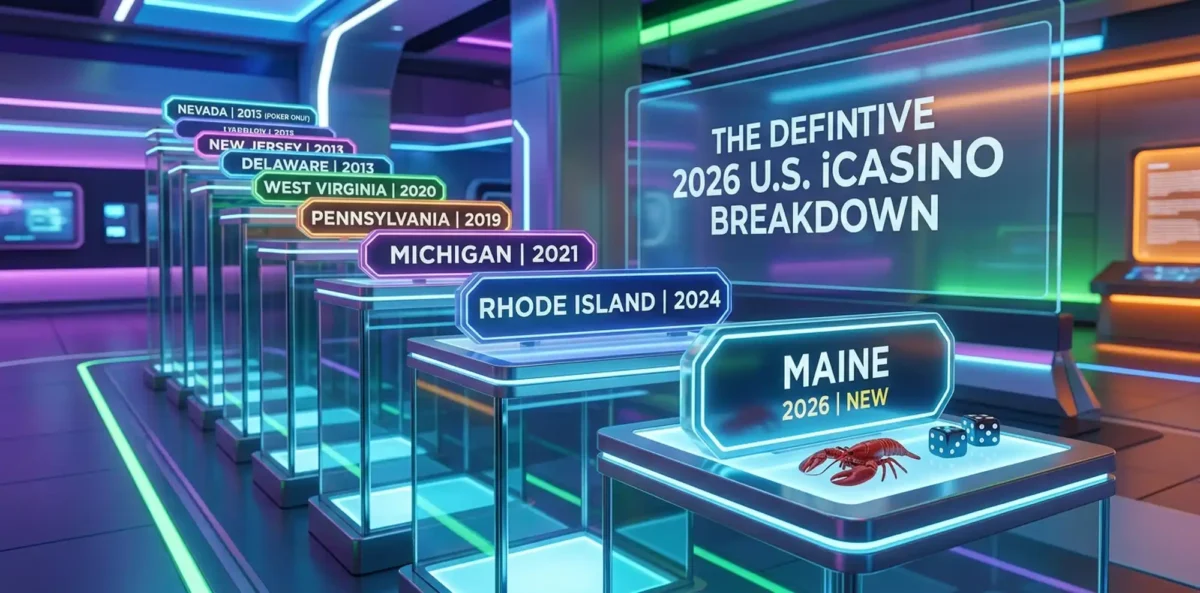
Eight U.S. states have legalized real-money online casino gambling. They look nothing alike. One is generating $3 billion a year. One hasn’t launched yet. One only allows poker. The tax rates swing from 15% to 54%. Some have fifteen licensed operators; one has exactly one.
Here is every state, ranked by 2025 gross gaming revenue — with the numbers, the operators, the tax structures, and the strategic read that separates a mature market from a missed opportunity.
🥇 #1 — Michigan: The Biggest Market Nobody Expected
| Launched | January 2021 |
| 2025 GGR | $3.09 billion |
| Growth (YoY) | +22.3% |
| Tax Rate | 18–20% |
| Active Operators | 15 |
| Population | 10.1M |
| Per-Capita GGR | ~$305/year |
Michigan is the story of U.S. iGaming. Nobody predicted that a Great Lakes state of 10 million people would become the largest online casino market in the country, overtaking the industry’s founding giants in New Jersey and Pennsylvania. But here we are.
The numbers speak for themselves: $3.09 billion in 2025 GGR, with projections of $3.6-3.8 billion for 2026. The market grew 22% year-over-year and shows no sign of plateauing. Hard Rock Bet underscored the market’s appetite when it set a debut record of $35.7 million in its very first month of operation.
What made Michigan explode? A combination of tribal gaming infrastructure (which accelerated early launch), a competitive 18–20% tax rate that attracts serious operators, and a wide-open licensing regime that now hosts 15 operators — more than any other iCasino state. BetMGM (28% share), DraftKings (22%), and FanDuel (18%) lead the market, but the long tail of competitors keeps the product sharp and the promotions aggressive.
The strategic read: Michigan proved that market size is not just a function of population. It’s a function of regulatory design. Competitive tax rates and open licensing = a thriving market.
🥈 #2 — New Jersey: The Pioneer That Still Prints Money
| Launched | November 2013 |
| 2025 GGR | $2.91 billion |
| Growth (YoY) | +22% |
| Tax Rate | 19.75% |
| Active Operators | 9+ |
| Population | 9.6M |
| Per-Capita GGR | ~$303/year |
| Cumulative Revenue | ~$21 billion |
New Jersey invented U.S. online casino gambling. The state went live in November 2013 — more than seven years before Michigan — and spent a decade as the undisputed market leader. It has now been narrowly overtaken by Michigan in raw revenue, but the per-capita number tells the real story: $303 per resident per year, essentially matching Michigan in player engagement.
The cumulative figure is staggering: ~$21 billion in gross gaming revenue since launch. New Jersey has generated more online casino revenue than the next several states combined. It operates 9+ licensed operators (BetMGM, DraftKings, FanDuel, Caesars, Golden Nugget, and more) under a 19.75% tax rate that has proven sustainable for operators while delivering consistent returns to the state.
The strategic read: New Jersey is the market that proved the model. Every state that came after it borrowed from the Garden State’s playbook — and the ones that ignored it (see: Delaware, Rhode Island) built smaller, more limited markets as a result.
🥉 #3 — Pennsylvania: The Tax Paradox
| Launched | July 2019 |
| 2025 GGR | $2.78 billion |
| Growth (YoY) | +27% |
| Tax Rate | 15% (table/poker) / 54% (slots) |
| Active Operators | 7+ |
| Population | 13.1M |
| Per-Capita GGR | ~$213/year |
| Cumulative Revenue | $4B+ since 2019 |
Pennsylvania has the largest population of any iCasino state and the fastest growth rate in the top three — +27% year-over-year in 2025. It has also achieved something no other state has: online casino revenue that outpaces land-based casino revenue. iGaming has become Pennsylvania’s primary gambling category.
The paradox is the tax structure. Pennsylvania charges a 54% tax on online slot revenue — the highest slot tax of any iCasino state in the world, far above anything in New Jersey or Michigan. The table games and poker rate (15%) is comparatively fair, but slots are where the money is, and operators absorb a brutal hit on every spin. BetMGM leads the market at $1.13B in annual revenue.
The remarkable thing is that despite the punitive slot tax, Pennsylvania’s market continues to grow at speed. That says something profound about the underlying demand — players are there regardless. But the tax structure explains why Pennsylvania’s per-capita GGR ($213) trails both Michigan and New Jersey despite having a larger population: operators invest less aggressively in a market where the state takes more than half of slot revenue.
The strategic read: Pennsylvania’s market succeeds despite its tax structure, not because of it. A rational reform of the slot tax could unlock the biggest iGaming market in the U.S.
#4 — West Virginia: The Fastest Grower Nobody’s Watching
| Launched | July 2020 |
| FY2025-26 GGR | $439.2 million |
| Growth (YoY) | +42.7% |
| Active Operators | 10 |
| Population | 1.7M |
| Per-Capita GGR | ~$258/year |
West Virginia is the most underrated iCasino story in the U.S. right now.
The state has 1.7 million people — smaller than most mid-sized American cities. Yet it hosts 10 licensed online casino operators, generated $439 million in FY2025-26, and grew at a staggering 42.7% — the fastest growth rate of any established iCasino market in the country. Per-capita GGR of ~$258 puts it solidly in the top half of all iCasino states by player engagement.
Hollywood Casino leads the market at $145.9 million, but the competitive landscape is broad. Ten operators fighting for 1.7 million residents creates intense promotional activity and product development — which ultimately serves players well.
The strategic read: West Virginia is proving that a small population is not a ceiling. With the right regulatory framework and enough operator competition, even a small state can build a genuinely significant iGaming market. Virginia should be watching closely.
#5 — Rhode Island: The Cautionary Tale
| Launched | March 2024 |
| 2025 GGR (online) | ~$70M (estimated) |
| Operator | Bally’s only |
| Population | 1.1M |
| Market Structure | State monopoly |
Rhode Island launched in March 2024 with a framework that makes New Jersey’s market look chaotic: one operator, Bally’s, holds an exclusive license. No DraftKings. No FanDuel. No BetMGM. Just one platform, running as a de facto state monopoly.
The numbers reflect the limitation. Online-only revenue in February 2026 was $5.84 million for the month — slots accounting for 90% of the mix. Annualized, that’s roughly $70 million, a fraction of what markets of similar size (Delaware is actually smaller) generate under competitive regimes. Delaware, with fewer people and a three-operator structure, consistently outperforms Rhode Island’s online category.
The exclusive operator model was likely a concession to Bally’s, which holds the state’s land-based casino licenses. But it has produced a stunted online market that serves Rhode Island residents poorly compared to neighboring states.
The strategic read: Rhode Island is what happens when online casino regulation is shaped by incumbent operator protection rather than consumer interest. The state left hundreds of millions in tax revenue on the table — and will likely revisit the framework within the next few years.
#6 — Delaware: Small but Growing Fast
| Launched | November 2013 |
| 2025 GGR | $85.5 million |
| 2026 YTD Growth | +52.5% |
| Operators | 3 (unified BetRivers system) |
| Population | 990,000 |
| Per-Capita GGR | ~$86/year |
Delaware shares New Jersey’s 2013 launch date but has followed a very different trajectory. The state operates three racino-linked platforms running on a unified BetRivers system — a limited structure that kept the market small for years.
The surprise storyline in 2026 is Delaware’s 52.5% year-over-year growth — the fastest raw growth rate of any state with an established market. The driver: online poker returned in June 2025 after an 18-month hiatus, reactivating a dormant player base and injecting fresh energy into a sleepy market.
At $85.5 million annually and a per-capita GGR of just $86/year, Delaware remains the smallest active iCasino market in the U.S. by revenue. But the growth trajectory is worth noting: a market that’s been stagnant for years can wake up quickly when the right product is restored.
The strategic read: Delaware’s growth proves that poker is a genuine traffic driver. For states considering iGaming, poker-first launches deserve more credit as an acquisition tool than they typically receive.
#7 — Nevada: Online Gambling Without a Casino
| Launched | April 2013 (poker only) |
| Games Allowed | Poker only — no slots, no table games |
| Current Operator | WSOP.com (1 operator) |
| Population | 3.2M |
Nevada is the ultimate asterisk entry on this list. The gambling capital of America launched online gambling in 2013 — but only for poker, and only poker to this day. No online slots. No online blackjack. No live dealer roulette. Just cards.
The market has contracted rather than grown. DraftKings and FanDuel both exited Nevada’s online poker market in November 2025, leaving WSOP.com as the sole remaining operator. PokerStars has reportedly been evaluating a return pending a new software rollout, but nothing has materialized in 2026.
Nevada’s land-based casino industry has historically resisted online casino expansion as a threat to its core product. With a Republican-dominated legislature similarly skeptical, full iCasino legalization in Nevada — despite its gambling culture — remains a political non-starter for the foreseeable future.
The strategic read: Nevada is the most counterintuitive market in U.S. iGaming. The state that defined gambling refuses to fully participate in its online evolution. Until that changes, Nevada is a minor poker market dressed up in a famous name.
#8 — Maine: The Newest Member (Still Warming Up)
| Law Passed | January 8, 2026 |
| Status | Launched 2026 (DraftKings March, FanDuel April) |
| Tax Rate | 16–18% |
| Operators | DraftKings, FanDuel, Caesars (tribal-licensed) |
| Population | 1.3M |
| Projected Revenue (Year 3) | $180 million |
Maine is ranked last because it’s the newest — not because it’s the least promising. LD 1164 became law in January 2026 under a first-of-its-kind tribal-exclusive licensing model, with the state’s four Wabanaki Nations holding all operator licenses and partnering with national platforms.
DraftKings (via the Passamaquoddy Tribe) launched in March. FanDuel followed in April. Caesars partnered with three of the four nations. At a 16–18% tax rate — competitive with Michigan’s and far below Pennsylvania’s — Maine has structured a framework designed to attract serious operator investment.
Industry projections put Maine’s market at $180 million in annual gross gaming revenue within three years, which would make it a West Virginia-scale market: meaningful, profitable, and a genuine economic asset for the Wabanaki Nations that the state’s 1980 federal settlement otherwise left behind.
The strategic read: Maine is a market to watch rather than write off. The tribal framework is genuinely novel, the operators are serious, and the growth runway is real. Check back in 18 months.
The Full Comparison at a Glance
| Rank | State | 2025 GGR | Tax Rate | Operators | Launch |
|---|---|---|---|---|---|
| 1 | Michigan | $3.09B | 18–20% | 15 | 2021 |
| 2 | New Jersey | $2.91B | 19.75% | 9+ | 2013 |
| 3 | Pennsylvania | $2.78B | 15–54% | 7+ | 2019 |
| 4 | West Virginia | $439M | N/A | 10 | 2020 |
| 5 | Rhode Island | ~$70M | Monopoly | 1 | 2024 |
| 6 | Delaware | $85.5M | N/A | 3 | 2013 |
| 7 | Nevada | N/A | N/A | 1 | 2013 |
| 8 | Maine | Launching | 16–18% | 3 | 2026 |
What This Map Tells Us
Three lessons jump out of this data:
1. Tax rate and operator count predict market size. Michigan, New Jersey, and West Virginia — the best-performing markets relative to their size — all have competitive tax rates and multiple licensed operators. Rhode Island and Nevada — the worst-performing — have monopoly or near-monopoly structures. The correlation is not coincidental.
2. The combined market is already massive. The seven active states generated more than $10 billion in annual GGR in 2025. That number will grow materially when Virginia and New York eventually legalize — New York alone could add $4–5 billion annually.
3. The ceiling is nowhere in sight. Every active market except Nevada grew in 2025. West Virginia grew 42.7%. Delaware grew 52.5%. Michigan — a $3 billion market — still grew 22%. The U.S. iCasino industry is not mature. It is accelerating.
The states still on the sidelines — New York, Virginia, Illinois, Georgia — are leaving billions in tax revenue uncollected every year. Maine figured that out. The rest will eventually follow.
Leo Falsafi is a digital marketing veteran and senior journalist at Virlan.co, where he covers the intersection of digital marketing, gaming, and breaking US trending news. With nearly two decades of hands-on experience in SEO and digital strategy, Leo has consulted for and scaled hundreds of companies. His deep industry roots allow him to deliver sharp, fact-checked insights and analysis on the trends shaping today's digital landscape.