
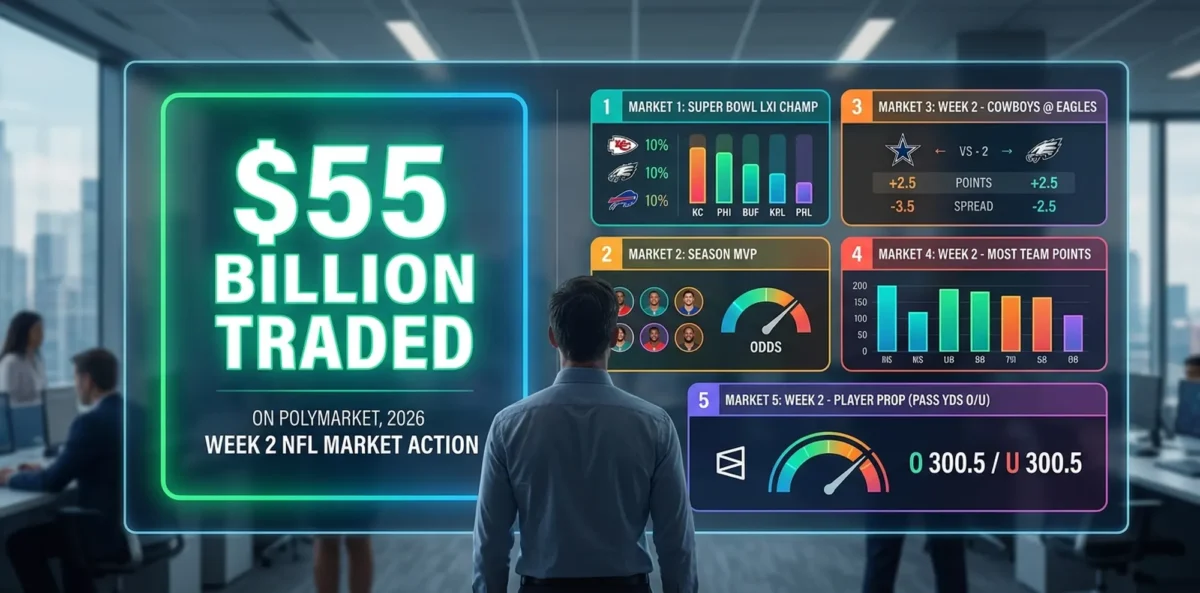
If you’ve been trading prediction markets since Polymarket went mainstream, you already know what September feels like: the entire market tilts toward one thing. Right now, it’s NFL. And not just any NFL—Week 2 games are where the real liquidity pools this week, and if you’re trying to move size or find an edge without moving the market yourself, you need to know which five markets matter.
Let’s be direct about the numbers. Polymarket has done $55.61 billion in total volume year-to-date in 2026. NFL sits at $2.39 billion of that—nearly 4,400% spike in weekly volume compared to Week 1. That’s not hype. That’s capital seeking signal. When four percent of an entire platform’s annual volume concentrates into one week of one sport, it’s time to pay attention to where it’s going.
This is what the smart money is actually trading right now in Week 2, and why the edges matter.
Why NFL Dominates Every September (And Why This Week Is Different)
September in prediction markets has a rhythm. The NFL season kicks off, casual bettors flood in, sharp traders deploy capital, and the whole ecosystem gets loud. But Week 2 is different from Week 1 in one specific way: data.
By Week 2, you have one full game on each team. That’s real film. Real injury reports. Real trends. The sharp money that was defensive in Week 1—waiting to see how the books moved lines—is now confident enough to take positions. That’s why liquidity jumped nearly 44x week-over-week.
Seventy-six point five percent of ALL prediction market volume right now is sports. That’s the entire ecosystem saying: this is where volatility lives, this is where edge exists, and this is where capital moves fastest.
The difference between Polymarket and Kalshi is about to matter to your trading decision. Same game. Different prices. Different liquidity. Same opportunity if you know how to read it.
Kalshi Just Hit 90% Market Share: The NFL Prediction Markets Every Trader Should Know This Week
The 5 Markets Worth Your Attention This Week
These rankings are by volume and liquidity—where you can actually move size without getting sandwiched by the spread. But volume alone doesn’t mean edge. Read the reasoning. It’s where the sharp trades are happening.
1. Buffalo Bills vs. Detroit Lions (Thursday Night Football)
Volume on Kalshi: $4.5M+ (and climbing)
Current spread: Bills -3 | Total 53.5
This is the liquidity leader for the week, and it’s not because the game is close. It’s because Thursday night games pull money from traders who specifically hunt the “light volume window.” You get Thursday and Friday action from West Coast traders, but the full volume comes Thursday night before the game. The Bills-Lions spread is deep enough that you can layer in a multi-leg play without fear of being identified.
The sharp move here: the line opened Bills -3 and Kalshi is showing it stable. Polymarket might have pricing differences if you look at win probability, totals break, and player-specific props. Run the arbitrage. The Thursday-night liquidity tends to move early, so if you’re in, you’re in before Wednesday night West Coast closes up shop.
Why this matters to you: Deepest liquidity, fastest price discovery, most responsive to news. If you want to test a model or move size, this is your market. The volume supports it.
2. San Francisco 49ers vs. Los Angeles Rams
Trend: Large volume, LA favored
Divisional games carry their own weight in prediction markets. Traders who focus on NFC West dynamics concentrate here. The Rams are favored—but divisional underdogs move fast. One injury report on a Rams starter, and the market swings.
This is a traders’ market because it sits right between “obvious” and “data-driven.” Week 1 told us something about each team. Week 2 tests whether that signal holds.
The sharp play: divisional lines move differently than spreads on neutral opponents. If you have a model that weights divisional history, this is where you find edge against casual traders.
Why this matters to you: Divisional psychology. The money here isn’t just on the game—it’s on “did Week 1 mean anything?” Test your model here.
3. Dallas Cowboys vs. New York Giants
Line movement: -3 → -2.5 (sharp money on Giants cover)
This is the play of the week in terms of sharp signal. The line opened with the Cowboys favored by 3. It’s moved to -2.5. That half-point move is not random—it’s a tell. Sharps are building Giants exposure.
When a line moves toward the underdog in the middle of the market’s volume, it’s not the public chasing. It’s the professional money saying: “We disagree with where this opened.”
Why does this matter? Because the Cowboys look worse after Week 1 than their season projection suggested. The Giants, despite being a losing team, executed better last week. The market knew Week 0 (preseason narratives). Now it’s processing Week 1 (actual performance).
Why this matters to you: Read the move, not the level. This is a market where your edge lives if you have a better model than “who’s better.” The sharps already moved off the opener.
4. Arizona Cardinals vs. Chicago Bears
Headline: Kyler Murray concussion creating pricing uncertainty
Health questions drive prediction markets. When a star player’s status is unclear, especially a QB who controls so much variance, the market reprices in real time. The Bears-Cardinals game has outsized volume because of this uncertainty.
This is a news-dependent market. The line moves when Murray’s status updates. Traders are arbing the uncertainty—some assuming he plays (which they bet), others assuming he doesn’t (which they hedge).
The sharp edge here is information speed. How fast can you process a Murray status update vs. the broader market? If you have a direct feed, this is where you monetize it.
Why this matters to you: Volatility = edge. When healthy assumptions break, sharp traders make. This market will reprice hard on news.
5. Baltimore Ravens vs. New Orleans Saints
Spread: Ravens -8.5 | Large spread generating interest
The Ravens are heavily favored, which means the market is confident on one side. But when a line opens this wide, it attracts specific traders: those who specialize in “is the favorite that much better?” and those hunting Saints value.
Large spreads create opportunities for bettors who think markets misprice tail risk. An 8.5-point spread says the Ravens have maybe a 75% implied win probability. Sharps are asking: is that too high? Too low?
The volume here isn’t about uncertainty—it’s about disagreement on what the spread should be. Ravens look strong after Week 1. Saints didn’t. But is that Week 1 performance fully priced into an -8.5 line?
Why this matters to you: Large spreads hide sharp disagreement. This is where you find the contrarian edge if your model disagrees with the market consensus.
Same Game, Different Prices: The Kalshi vs. Polymarket Edge
Here’s the practical reality. Kalshi is running $11.26B in weekly contracts. Kalshi owns 90.4% of sports prediction market share—a record high. But that doesn’t mean Kalshi is the only platform, and it doesn’t mean prices are identical.
Polymarket and Kalshi price the same games differently. Not wildly differently—the arb is usually a few percentage points. But a few percentage points at scale is real money.
Here’s the play:
- If you’re trading on Polymarket and the Bills win probability is 65%, check Kalshi.
- If Kalshi shows 62%, you’ve found a 3-point difference.
- If you’re moving size, you can lay it at 65% on Poly and lay it at 62% on Kalshi, capturing the spread.
This is how sophisticated traders use the multi-platform environment. Same game. Same odds. Different markets. Different liquidity. Different counterparties.
Kalshi’s weekly structure (contracts that settle every week) means traders who want a definitive weekly outcome come there first. Polymarket’s perpetual markets mean longer-term position traders and researchers use Poly. That creates a subtle but real pricing difference.
The edge: Identify which platform has the outlier price and trade the difference.
One Non-Sports Market Worth Watching: Politics as Volatility Hedge
Before you leave this analysis, note one thing: 76.5% of prediction market volume is sports. That means 23.5% is everything else. And in that 23.5%, there’s a specific market moving volume this week.
Scott Jennings, the CNN contributor, is trading at 32% probability to replace Karoline Leavitt as press secretary, with $1.3M in volume.
Why mention this? Because sophisticated traders use non-sports markets as volatility hedges or as sentiment indicators about political risk. If that Scott Jennings market moves to 40%+, it signals something in the broader information environment has shifted. Smart traders watch non-sports markets for signal, not for the sports betting itself.
The Verdict: Which Market to Enter First (And Why)
If you’re looking at these five markets and wondering where to start, here’s the priority:
1. Start with Bills-Lions if you have size to move. $4.5M weekly volume means you can enter and exit without moving the line 5%. The liquidity is real. Thursday-night timing means you have a discrete window to act.
2. Trade Cowboys-Giants if you’re hunting sharp signal. The line movement tells you the sharps disagreed with the opener. Follow that. If you have a model that disagreed with -3 on the Cowboys, this market is pricing your thesis right now.
3. Use Bears-Cardinals for news-dependent edge. If you have a health/injury model or a direct information feed, this is where you monetize it. The Kyler Murray status is a real variable that markets will reprice.
4. Arb Kalshi vs. Polymarket on all five. Don’t assume prices are identical. Spend 10 minutes checking if any of these games show a 2-3 point spread between platforms. At scale, that’s your actual trading edge.
5. Watch Ravens-Saints if you want to test contrarian positioning. The 8.5 spread looks wide, which means the market is saying something confident. If your model disagrees, this is the place to find out if you’re right.
Liquidity Notes for Traders
- Bills-Lions: Closes Thursday night. If you move size, do it Wednesday.
- 49ers-Rams, Cowboys-Giants, Bears-Cardinals, Ravens-Saints: Each has $500K-$2M weekly volumes. Reasonable for position-taking, not great for massive trades. Layer your entry.
- Cross-platform arb: Kalshi’s weekly structure means the settlement dynamics are cleaner. Polymarket’s volume is deeper overall. Check both before committing capital.
The prediction market ecosystem is 44x more active for NFL in Week 2 than it was in Week 1. That capital is flowing into these five games. The difference between a sharp trader and a casual one isn’t whether they see the games—it’s whether they see the money. You’re looking at it right now.
This article is for informational purposes only. Prediction market trading involves financial risk.
Leo Falsafi is a digital marketing veteran and senior journalist at Virlan.co, where he covers the intersection of digital marketing, gaming, and breaking US trending news. With nearly two decades of hands-on experience in SEO and digital strategy, Leo has consulted for and scaled hundreds of companies. His deep industry roots allow him to deliver sharp, fact-checked insights and analysis on the trends shaping today's digital landscape.