
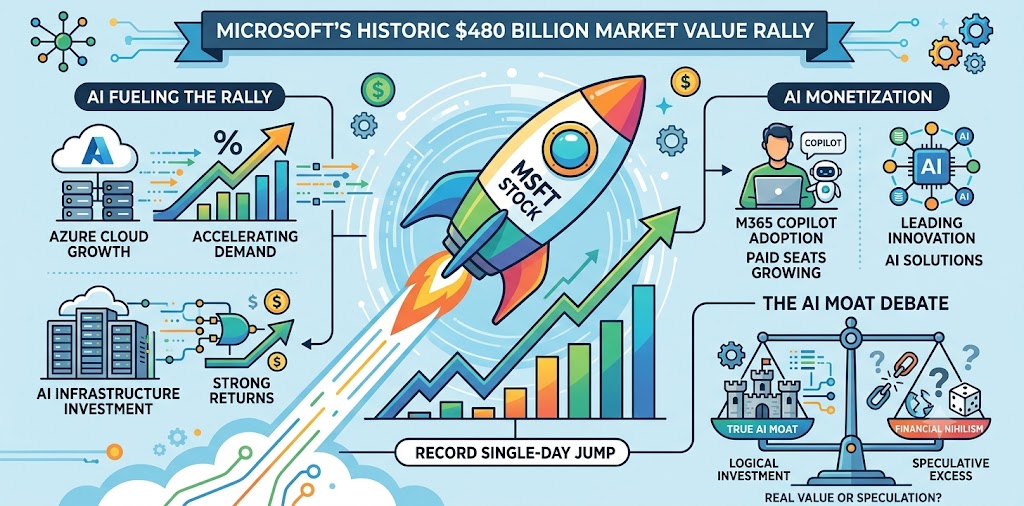
The Historic Rally: Microsoft’s Biggest Daily Gain
Wall Street ended sharply higher on July 30, with Microsoft logging its biggest daily percentage gain in 18 years. Shares are up 14.6% shortly after Thursday’s open and heading for their best single-day performance since Oct. 13, 2008, when they rose 18.6%. Microsoft jumped over 15 per cent, boosting its stock market value by US$450 billion, the greatest-ever single-day increase for a company on Wall Street. The stock is also on pace for its best post-earnings performance on record, according to Dow Jones Market Data.
By The Numbers: 43% Azure Growth Proves the AI Moat
Microsoft has finally started to convince Wall Street that it’s striking the right balance on artificial intelligence. The technology giant gave a stellar forecast that eased fears about massive spending on AI infrastructure. Microsoft reported $90 billion in fiscal fourth quarter revenue, beating analyst estimates, as Azure cloud revenue grew 43% and lifted adjusted earnings to $4.74 per share. Azure and other cloud-services revenue grew 43% in the fiscal fourth quarter, the fastest reported pace in roughly four years.
This year, Azure revenue surpassed $100 billion for the first time, and Microsoft 365 Copilot reached over 30 million paid seats, reflecting the confidence customers are placing in us to power their AI transformation, Nadella, in the earnings release. More importantly, Microsoft guided to approximately 45% Azure growth in constant currency for the September quarter.
The Capex Bill Behind the AI Boom
Capital spending hit $115.9 billion in fiscal 2026, testing AI payback patience. Microsoft added $35.8 billion in property and equipment during the quarter, more than double the $17.1 billion a year earlier. At the same time, management offered some reassurance that heavy AI spending isn’t expected to push the company into negative free-cash-flow territory this fiscal year. Operating cash flow of $55.4 billion covered that outlay comfortably.
The AI Moat vs. The Rise of Financial Nihilism
A key infecting agent is artificial intelligence. Companies are trying to figure out what the effect of these heavy investments in AI will be on their businesses. The podcaster Demetri Kofinas coined the term financial nihilism, a pandemic-like disorder he claims is distressing rising generations across the globe.
What is ‘financial nihilism’? The phrase describes the sense that the economic system no longer rewards prudence or long-term planning. ‘Financial Nihilism’ is a term used to describe an attitude where people believe financial decisions are meaningless because the system is rigged. The idea behind this line is that young people, facing what feels like a bleak financial future, are throwing caution aside to gamble with crypto, options, and meme stocks to build wealth fast, rather than creating lasting wealth. After three years of unprecedented market gains in every asset class, from stocks to cryptocurrencies to precious metals, Financial Nihilism has resurfaced to rationalize speculative excess and justify abandoning long-term investment strategies.
Sources: The Straits Times, MarketWatch (Morningstar), BeInCrypto, Business Finance News, The Times Gazette, World Economic Forum, and Investing.com.
Leo Falsafi is a digital marketing veteran and senior journalist at Virlan.co, where he covers the intersection of digital marketing, gaming, and breaking US trending news. With nearly two decades of hands-on experience in SEO and digital strategy, Leo has consulted for and scaled hundreds of companies. His deep industry roots allow him to deliver sharp, fact-checked insights and analysis on the trends shaping today's digital landscape.