
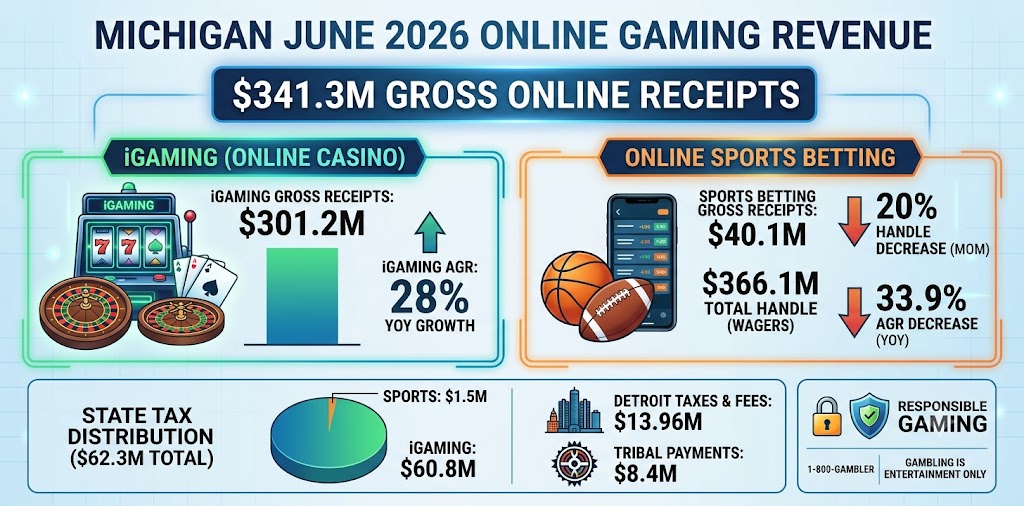
Michigan’s commercial and tribal gaming operators posted a combined $341.3 million in online gross receipts for June 2026, according to the latest regulatory data. The headline number masks a deepening divergence within the state’s gambling ecosystem: digital casinos are surging, while sportsbooks face steep seasonal and year-over-year headwinds.
The Michigan Gaming Control Board (MGCB) report highlights a market that is increasingly relying on the digital casino floor to balance the cyclical, volatile nature of the sporting calendar.
Digital Casinos Counteract Seasonal Slumps
iGaming generated an overwhelming $301.2 million of the state’s total online pie in June. Despite a nominal 1.5% month-over-month contraction—standard for the beginning of the summer season—the sector’s underlying strength is apparent. Digital casino adjusted gross receipts (AGR) rocketed 28% compared to June 2025.
That kind of sustained yield suggests player behavior in the online casino space operates largely immune to the seasonal drop-offs that define sports wagering. Players are engaging consistently with virtual table games and slots, pushing lifetime state iGaming revenue past the $11.9 billion mark.
Sports Betting Handle Contracts by 20%
The sports betting ledger tells a vastly different story. June saw online sports betting handle plummet to $366.1 million, a sharp 20% drop from May. Gross receipts settled at $40.1 million.
While summer months traditionally thin the betting board as the NBA and NHL playoffs conclude, the year-over-year metrics reflect a deeper softening. MGCB data shows sports betting AGR plunged 33.9% from exactly a year prior.
At the operator level, FanDuel (partnered with MotorCity Casino) maintained its operational chokehold. It processed $111.8 million in June handle and extracted $14 million in revenue, comfortably pacing ahead of DraftKings (Bay Mills), which took in $105.7 million in wagers for $10.9 million in revenue.
Tax Distributions Heavily Skew Toward iGaming
Tax distributions expose just how heavily Michigan relies on digital slots versus the sportsbook. Of the $62.3 million operators remitted to state coffers in June, $60.8 million originated directly from iGaming. Online sports betting contributed a mere $1.5 million.
Detroit’s three commercial casinos received a similar tax distribution. They collected $13.96 million in municipal taxes and fees, with digital casino gaming supplying $13.5 million of that total. Tribal operators also reported $8.4 million in payments to their respective governing bodies.
Detroit’s Retail Sector Holds Steady
Brick-and-mortar operations in Detroit generated $102.68 million in aggregate revenue for the month. MGM Grand Detroit secured 47% of the market share, followed by MotorCity at 31% and Hollywood Casino at Greektown at 22%. Yet even on property, sports wagering proved to be a fraction of the business, producing just $836,063 in qualified adjusted gross receipts from a $6.38 million retail handle.
Regulatory Focus and Responsible Gaming
The MGCB continues to anchor these massive financial milestones with strict regulatory oversight. Authorities explicitly reiterate in their official communications that gambling is designed solely as entertainment, not a vehicle for financial gain. The state maintains active consumer protection frameworks, requiring operators to prominently integrate responsible gaming tools. Officials urge anyone who may have a gambling problem to utilize free, confidential resources, such as the 1-800-GAMBLER helpline, to ensure the market remains a safe environment for all participants.
Sources Quoted
Data and financial metrics were extracted directly from the official July 2026 press releases and financial reports published by the Michigan Gaming Control Board (MGCB), supplemented by historical market tracking data from PlayMichigan and Sports Betting Dime.
Leo Falsafi is a digital marketing veteran and senior journalist at Virlan.co, where he covers the intersection of digital marketing, gaming, and breaking US trending news. With nearly two decades of hands-on experience in SEO and digital strategy, Leo has consulted for and scaled hundreds of companies. His deep industry roots allow him to deliver sharp, fact-checked insights and analysis on the trends shaping today's digital landscape.