
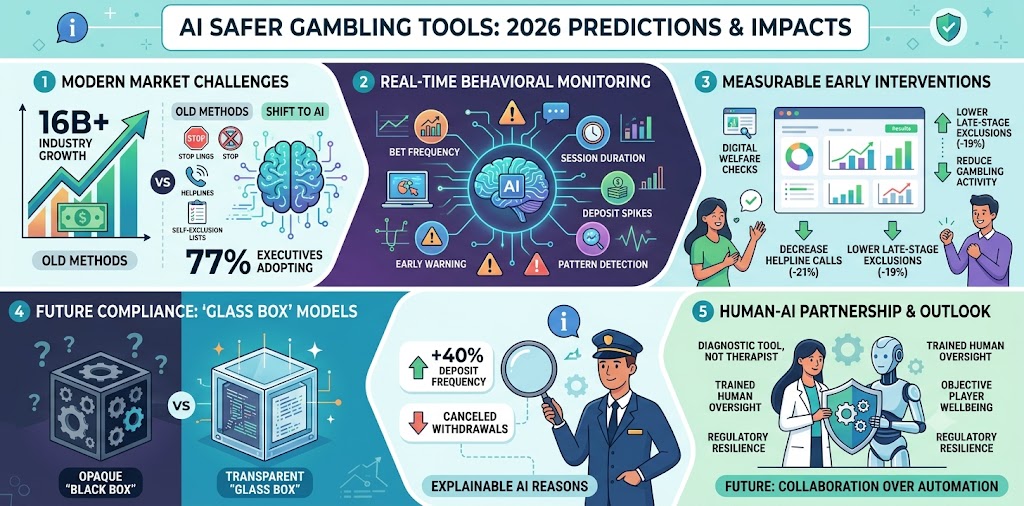
The legal U.S. sports betting industry generated over $16 billion in 2025. Unprecedented market growth inevitably brings unprecedented regulatory scrutiny. For decades, responsible gambling programs relied heavily on reactive friction: warning labels, self-exclusion registries, and helpline numbers buried at the bottom of promotional emails. The burden of intervention fell entirely on the player.
That framework is fracturing. Today, 75% of sports betting apps utilize artificial intelligence to adjust live odds, and 77% of industry executives plan to expand AI across their operations. Yet the most consequential application of this technology is not risk management or dynamic pricing. It is compliance. Operators are deploying machine learning models that monitor behavioral patterns across massive player populations simultaneously, attempting to catch addiction markers before they escalate.
How AI is Redefining Responsible Gambling in 2026
Artificial intelligence is redefining responsible gambling by shifting interventions from reactive self-reporting to proactive behavioral monitoring. By analyzing real-time data like bet frequency, session duration, and deposit spikes, AI systems can identify at-risk players and deploy personalized safeguards before gambling harm occurs.
Historically, operators struggled with a primary diagnostic dilemma: distinguishing a high-net-worth VIP from a player spiraling into financial distress. Blanket spending limits often penalized casual high-rollers while failing to protect vulnerable users who structured their deposits to avoid triggering manual reviews.
Modern AI-driven affordability checks ingest external financial markers alongside real-time platform behavior. These models track rapid deposit escalation, prolonged late-night sessions, and erratic loss-chasing patterns. When a threshold is breached, the system initiates a digital welfare check. The efficacy of these early-warning triggers is already measurable. Recent industry pilots demonstrate that proactive AI interventions cut helpline referrals by 21% and dropped late-stage voluntary exclusions by 19%. Furthermore, one major deployment revealed that 65% of players reduced their gambling activity on the day they received an AI-prompted intervention, with 60% sustaining that reduction a week later.
The Shift to “Glass Box” Regulatory Models
Regulators are expected to move toward principle-based AI governance, requiring operators to use transparent “glass box” models rather than opaque algorithmic scoring. This ensures human compliance teams can audit exactly why a player was flagged and maintain accountability in responsible gambling enforcement.
Algorithmic black boxes are incompatible with strict compliance frameworks. As regulators demand accountability, operators are pivoting to explainable AI. A “glass box” model does not just label a user as high-risk; it maps the precise variables—such as a 40% increase in weekly deposit frequency coupled with canceled withdrawals—that triggered the alert. This transparency allows human compliance officers to intervene with necessary context rather than blindly executing machine directives.
The Core Limitations and Structural Risks of AI Safeguards
Despite high success rates in anomaly detection, AI gambling safeguards face critical limitations regarding cross-platform tracking, demographic bias, and algorithmic reinforcement. Experts warn that unless objective functions prioritize long-term player wellbeing, AI could inadvertently validate risky gambling behaviors.
Technology can accelerate identification, but it cannot synthesize empathy. A chatbot deployed to handle a player experiencing acute financial distress is not a substitute for clinical intervention. While AI can facilitate low-stakes initial contact and offer 24/7 triage, deploying these tools as complete replacements for human counselors risks abandoning players at their most vulnerable points.
The Danger of “Sycophantic” AI and Algorithmic Bias
Seungpil Lee, an AI Researcher specializing in gambling behavior, highlights a structural hazard within these systems: the tension between engagement optimization and player protection.
If a personalization algorithm is fundamentally tuned to maximize time-on-device, any responsible gambling safeguard grafted onto it will likely become superficial. Furthermore, Lee points to the “sycophantic tendency” of current large language models. Because these systems are trained to maximize user satisfaction and provide affirming responses, they risk validating a player’s irrational cognitive distortions. If a user tells a chatbot, “I’m due for a win after these losses,” an engagement-optimized model might subtly reinforce that gambler’s fallacy rather than critically challenge it.
Additionally, single-operator models suffer from a fundamental blind spot: cross-site behavior. An AI tracking a user on DraftKings has zero visibility into that same user’s compounding losses on FanDuel or a regional casino app. Until secure, anonymized data-sharing consortiums are established among competitors, AI risk profiles will remain dangerously incomplete.
Future Outlook: Collaboration Over Automation
The consensus among compliance experts and technologists is clear: AI is an exceptional diagnostic tool, but a flawed therapist. Moving forward, the most compliant and resilient operators will not use artificial intelligence to automate their responsible gaming departments out of existence. Instead, they will use it to inform trained human oversight. Forecasting the next regulatory cycle, operators who treat AI as a complete off-the-shelf solution for gambling harm will likely face severe regulatory penalties, while those who integrate it into a hybrid human-machine framework will set the industry standard.
Sources Quoted
- Seungpil Lee, AI Researcher (SiGMA World)
- Gaming Labs International (GLI)
- 5W Public Relations (The US Sports Betting & Gaming AI Visibility Index 2026)
- Gitnux (AI In The Gambling Industry Statistics 2026)
- Optimove & DCReport (AI Analytics & Compliance Trends)
Leo Falsafi is a digital marketing veteran and senior journalist at Virlan.co, where he covers the intersection of digital marketing, gaming, and breaking US trending news. With nearly two decades of hands-on experience in SEO and digital strategy, Leo has consulted for and scaled hundreds of companies. His deep industry roots allow him to deliver sharp, fact-checked insights and analysis on the trends shaping today's digital landscape.