
Germany’s regulated online gambling sector has reached a critical inflection point. Operating strictly under the parameters of the 2021 Interstate Treaty on Gambling (Glücksspielstaatsvertrag), the national market is yielding mixed financial results as regulators clash with a persistent offshore footprint.
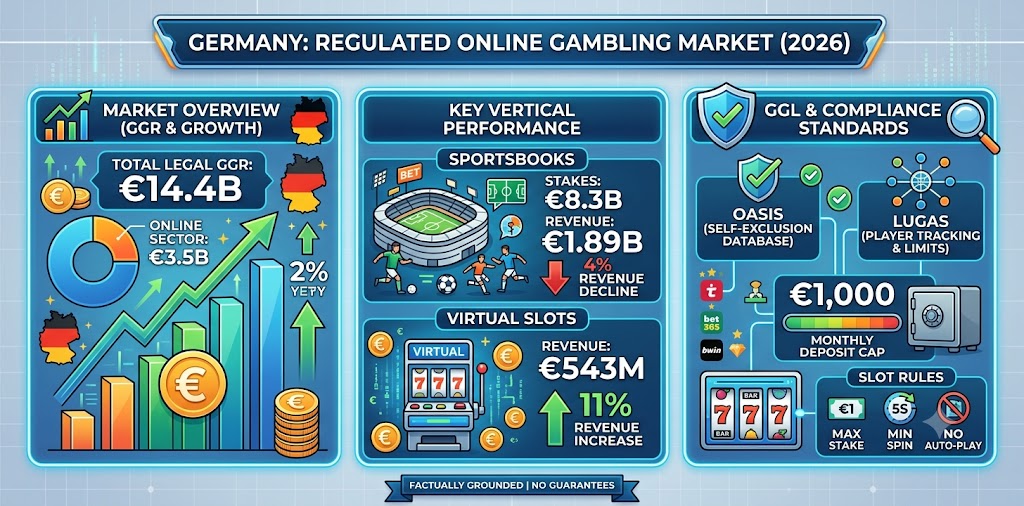
Recent data paints a complex picture of channelization. Germany’s legal gaming industry generated a stable €14.4 billion in Gross Gaming Revenue (GGR) over the past year, with the online sector accounting for €3.5 billion of that total—a modest 2% year-over-year increase. Yet, beneath these top-line figures, individual verticals like virtual slots and sports betting are moving in drastically different directions, forcing the Gemeinsame Glücksspielbehörde der Länder (GGL) to double down on strict enforcement.
For industry stakeholders analyzing the top licensed operators in Germany, understanding the tension between rigid consumer protection laws and market growth is essential.
Germany Online Casinos: Virtual Slots Drive Market Growth
Despite facing some of the strictest operational caps in Europe, regulated virtual slot machines delivered one of the strongest performances in the German market. Total stakes wagered on virtual slots climbed to €4.6 billion, pushing online slot GGR to €543 million—an 11% increase compared to the previous year.
This double-digit growth occurred despite heavy structural guardrails designed to prioritize responsible gaming. Licensed online casinos operating on the GGL’s official whitelist must enforce rigid gameplay mechanics, including:
- A strict €1 maximum stake per spin.
- A mandatory five-second minimum duration per spin.
- The complete prohibition of auto-play functions.
- A ban on simultaneous gameplay across different virtual slot domains.
The fact that the virtual slot vertical continues to expand under these heavy constraints suggests that players are gradually migrating toward the domestic, regulated ecosystem—or at least adapting to the mandated pace of play.
Sportsbooks Market Share: High Volume, Contracting Revenue
Conversely, the sports betting vertical is experiencing friction. While operators handled a massive €8.3 billion in stakes over the last year, sportsbook GGR actually declined by 4%, settling at €1.89 billion.
Football continues to dominate the landscape, accounting for 77% of all sports betting activity, with live betting driving 53% of total wagers. The discrepancy between high wagering volume and shrinking gross revenue highlights the competitive pricing and tight margins operators face within the regulated market. Furthermore, strict advertising protocols—including a ban on broadcasting sportsbook ads by active athletes and sports officials—have fundamentally altered how top sportsbooks acquire and retain users in Germany.
GGL Regulations and LUGAS Enforcement
The backbone of Germany’s regulated framework is LUGAS, the centralized IT system that monitors player activity across all licensed platforms. This infrastructure is non-negotiable for the top online casinos and sportsbooks operating legally within the country.
LUGAS enforces a mandatory €1,000 monthly cross-operator deposit limit to mitigate severe financial risk and prevent problem gambling. By tracking deposits and concurrent logins across all whitelisted operators, the system structurally prevents the financial ruin associated with unrestricted, high-velocity betting.
For the GGL, consumer protection remains the primary metric of success. Tax and levy revenues from gambling generated approximately €7 billion recently, funds that state governments increasingly rely upon. However, the agency’s leadership maintains that keeping the industry safe supersedes raw revenue generation.
The Offshore Threat: Analyzing Channelization Rates
The central debate in 2026 revolves around the true size of Germany’s black market. The GGL asserts that the illegal market volume accounts for roughly 3% to 4% of the total legal market, and about 25% of the online sector.
Ronald Benter, Chief Executive of the GGL, remains confident in the agency’s regulatory tightening. “Our measures are having an impact,” Benter stated recently. “Our stated goal is to make the business model of illegal providers unattractive through a comprehensive package of measures”.
However, third-party analytics firms and industry associations paint a starkly different reality. Independent research indicates there are roughly 382 German-language illegal gambling sites targeting citizens, vastly outnumbering the highly regulated, licensed platforms. Furthermore, data analytics firm H2 Gambling Capital estimated that only 36% of online gambling in Germany would be generated via legal, onshore sites by the end of 2025.
As Benter acknowledges, “Combating illegal offerings remains a long-term process that requires strategic action, decisive action, and close interagency cooperation”. Moving forward, the success of Germany’s Top 20 licensed platforms will depend entirely on the GGL’s ability to sever offshore operators’ access to German consumers while keeping the legal market viable.
Top 20 Regulated Online Casinos & Sportsbooks in Germany (2026)
Following strict compliance with the 2021 Interstate Treaty on Gambling (Glücksspielstaatsvertrag), only platforms officially listed on the Gemeinsame Glücksspielbehörde der Länder (GGL) whitelist can legally offer real-money gaming to German citizens. The regulatory baseline is rigid. Every legal operator must integrate with the OASIS self-exclusion database and connect to the LUGAS IT system, which enforces a non-negotiable €1,000 monthly cross-platform deposit cap to mitigate financial ruin.
Below is the definitive, data-backed list of the top 20 licensed entities dominating the German market in 2026, categorized by their operational focus.
The Hybrid Leaders: Sports Betting & Virtual Slots
1. Bet365
Operating under full GGL authorization, this global powerhouse successfully balances a high-volume sportsbook with a legal virtual slot library. Market analysis reveals that Bet365 absorbs the 5.3% German sports betting tax on behalf of users for specific markets, while maintaining a low 1x turnover requirement on promotional credits.
2. Bwin
A foundational pillar of the domestic market. Independent monitoring indicates Bwin maintains an average sportsbook payout rate of 97.34%. The operator successfully offsets tight profit margins by leveraging cross-vertical compliance, keeping both sports bettors and slot players entirely within the regulated LUGAS tracking ecosystem.
3. Tipico
Dominating both the retail betting shop sector and the digital landscape, Tipico remains a primary driver of domestic sports wagering volume. The brand seamlessly links its digital slot and sports verticals under centralized OASIS tracking, making it a critical asset for state tax revenues.
4. Bet-at-home
Listed on the Frankfurt Stock Exchange and deeply entrenched in the local economy, Bet-at-home sustains an average payout rate of 96.75%. The platform prioritizes structural consumer protection tools alongside its regulated promotional tiers.
5. Interwetten
As an early adopter of the GGL’s stringent regulatory framework, Interwetten provides highly stable hybrid gaming. The operator strictly enforces the mandated €1 maximum stake per virtual slot spin while delivering competitive odds across top-flight European football.
6. AdmiralBet
Backed by the massive Novomatic conglomerate, this platform merges domestic virtual slots with a robust sportsbook. AdmiralBet requires only a 1x turnover on specific promotional refunds, though it adheres strictly to passing the 5.3% tax levy onto the consumer.
7. DAZNbet
Capitalizing on its massive sports broadcasting footprint, DAZNbet integrates live media viewing directly with regulated betting markets. The platform operates under an 8x turnover framework for new users and actively restricts in-play betting to final results and next-scorer markets, per GGL mandates.
8. LeoVegas
Consistently rated for its mobile-first infrastructure, LeoVegas successfully channels mobile slot players into the regulated market. The operator enforces the GGL’s unyielding five-second minimum spin duration constraint without sacrificing app performance.
The Sportsbook Specialists
9. Betano
Currently boasting one of the highest average payout rates in the German legal market at 97.54%. Betano is widely recognized for its top-tier mobile application, which integrates seamlessly with rigid national ID verification protocols to prevent underage access.
10. Neo.bet
Operating with a highly specific tax-free structure for combination bets, Neo.bet targets high-frequency sports bettors. The platform maintains a strict 10x turnover requirement and triggers mandatory responsible gaming prompts during extended sessions.
11. Winamax
Providing a largely tax-free betting structure for German consumers, Winamax yields an average payout rate of 96.06%. It remains a heavily utilized platform for live football wagering, fully compliant with national advertising restrictions.
12. VBet
With a 96.56% payout rate, VBet manages to offer highly competitive odds on international sports while operating strictly within the GGL’s real-time deposit monitoring boundaries.
13. Tipwin
A long-standing brand in both the German retail and digital sectors. Tipwin maintains a highly secure, LUGAS-compliant digital sportsbook, though it enforces a substantially higher 14x turnover condition on promotional credits compared to its peers.
Dedicated Virtual Slot Platforms (Online Casinos)
Under German law, the term “Online Casino” is heavily regulated. The GGL issues federal licenses exclusively for “virtual slot machines.” Traditional table games (Roulette, Blackjack) and progressive jackpots fall under fragmented state-level jurisdictions and are largely prohibited on the federal digital whitelist.
14. Jackpot50
Recently added to the GGL whitelist, Jackpot50 is exclusively calibrated for the German demographic. The platform offers a highly controlled virtual slot environment that strictly bans auto-play functions to reduce game velocity.
15. DrückGlück
A dedicated slot specialist. DrückGlück has adapted to the mandatory five-second spin rule by curating a portfolio of games that maintain visual engagement without violating state pacing laws.
16. Novoline
Leveraging its massive legacy in German land-based arcades, Novoline’s digital platform provides classic slot mechanics explicitly re-engineered to meet the strict €1 maximum stake limitation.
17. BingBong
A rising domestic brand focusing purely on GGL-approved virtual slots. BingBong prioritizes immediate consumer protection, emphasizing rapid ID verification and integrated “panic buttons” that allow players to self-exclude for 24 hours instantly.
18. JackpotPiraten
Operating as a sister site to BingBong, this platform utilizes domestic software providers. It adheres flawlessly to LUGAS cross-operator deposit limits to prevent users from spreading financial risk across multiple sites.
19. Slotmagie
Exclusively tailored for the German virtual slot market. Slotmagie integrates robust responsible gaming algorithms that track user session lengths to trigger mandatory cool-down periods.
20. bpremium
Entain’s premium virtual slot offering in Germany. Operating alongside its sportsbook sibling Bwin, bpremium is fully compliant with the stringent €5 million minimum security deposit required by the GGL to guarantee long-term operational solvency.
Sources Quoted:
Data and quotes were extracted from Legal 500 (2025 Gambling Law Guidelines), Mundo Video Entertainment (GGL market reports), ICLG (Gambling Laws and Regulations 2026), iGamingBusiness, and public statements from GGL Chief Executive Ronald Benter.
Data, payout rates, and regulatory mandates were extracted from BookiesBonuses (2026 German Market Data), iGamingBusiness (GGL Whitelist Updates), SOFTSWISS (Germany Gambling Regulation Map), and Altenar (Understanding Gambling Laws in Germany).
Leo Falsafi is a digital marketing veteran and senior journalist at Virlan.co, where he covers the intersection of digital marketing, gaming, and breaking US trending news. With nearly two decades of hands-on experience in SEO and digital strategy, Leo has consulted for and scaled hundreds of companies. His deep industry roots allow him to deliver sharp, fact-checked insights and analysis on the trends shaping today's digital landscape.