
The global sports betting ecosystem is accelerating toward a projected $187 billion valuation by 2030. In response, a massive cottage industry of algorithmic tools has flooded the consumer market. Search for the “top 20 AI betting bots,” and you will find endless lists of sleek applications promising effortless returns.
Differentiating a legitimate predictive model from a marketing gimmick requires understanding the hard math of variance, probability, and market structure. While artificial intelligence is fundamentally changing how sportsbooks set lines, the consumer tools attempting to beat those lines are wildly inconsistent. Most are simply ChatGPT wrappers bolted onto basic box-score data. A select few are mathematically calibrated models built to identify structural market inefficiencies.
The 2026 AI Sports Betting Market: Infrastructure vs. Consumer Tools
According to GMInsights, the broader market for AI in sports hit a $1.2 billion valuation in 2024 and is riding a 14.7% compound annual growth rate through 2034. Software development accounts for over 74% of this expansion.
Much of that capital flows directly into B2B risk-management infrastructure. Companies like GammaStack build the engines behind the house, having launched over 80 betting platforms globally. These enterprise systems ingest thousands of data points to adjust live odds in milliseconds, keeping the sportsbooks shielded from heavy exposure.
For the consumer, the arms race is about finding software that can outpace that infrastructure. The heavily marketed “top 20” lists usually lump together distinct categories: line-shopping bots, stat-aggregation dashboards, and predictive models. If you are evaluating predictive models in 2026, the industry standard has shifted entirely away from subjective “confidence scores” and toward strict, auditable ledgers.
Metrics That Expose the Pretenders: Brier Scores and Sample Sizes
The most common trap in the AI betting software market is the promotion of a high “hit rate” without context. A 70% win rate looks visually impressive on a landing page. But if those wins consistently occur on heavily juiced -300 odds, the bettor is actively losing money.
Serious evaluators in 2026 look at two distinct metrics: audited Return on Investment (ROI) and the Brier score.
Brier scores measure model calibration. They calculate how close an AI’s predicted probability is to the actual outcome over time. If a model assigns a 70% probability to a specific set of outcomes, and those outcomes happen exactly 70% of the time, the model is perfectly calibrated.
PropsBot.AI currently publishes some of the strongest auditable data in the consumer space. According to their 2026 ledger, their ensemble models have logged a 27.8% combined ROI across 218,826 graded picks. Crucially, they publish their Brier scores directly against sportsbook implied probabilities. In Major League Baseball, PropsBot recorded a Brier score of 0.1903, narrowly beating Vegas’s 0.1947. In the NHL, they logged 0.1846 against the sportsbook’s 0.1865.
When comparing premium tools across the landscape—such as PlayerProps.ai, Rithmm, or Leans.AI—the absence of a published Brier score is increasingly viewed as a red flag by sharp bettors.
Prediction Markets vs. Traditional Sportsbooks
The AI landscape is also fragmenting based on market type. While tools like PropsBot focus on traditional sportsbooks and player props, a new class of AI is targeting prediction markets like Kalshi and Polymarket. These are federally regulated (CFTC) exchanges where the crowd sets the price continuously, eliminating the traditional “house vig”.
Tools operating on these exchanges require entirely different architecture. PillarLab AI uses a 9-pillar analytical framework rather than a single predictive score. It weighs historical statistical baselines against live order book depth, liquidity shifts, and real-time news sentiment. Because prediction markets reprice based on aggregate crowd knowledge, an AI bot in this space must analyze information flow just as heavily as raw sports statistics.
The Reality of Risk: Why AI Cannot Guarantee Success
Despite these technological leaps, a fundamental truth remains: AI predicts outcomes probabilistically, not deterministically. No machine learning model, regardless of its sophistication or historical ROI, can guarantee a winning bet.
Variance is the silent killer of the casual bettor relying on algorithmic tools. Statistical smoothing requires massive sample sizes. Most consumer AI tools require a minimum of 1,000 graded picks just to clear the noise of standard variance. A model carrying a verified 27% long-run ROI will still experience brutal losing streaks over a 10- or 20-game stretch.
This means an AI betting bot is functionally useless without strict bankroll management. Subscribing to an algorithmic tool does not eliminate financial risk; it simply attempts to identify mispriced lines (expected value, or +EV) over a massive volume of wagers. Responsible gaming principles apply strictly to algorithmic betting. Bettors must wager within their means, avoid chasing losses during inevitable cold streaks, and remember that even the best-calibrated models in the world lose frequently.
The Top 20 AI Betting Bots of 2026
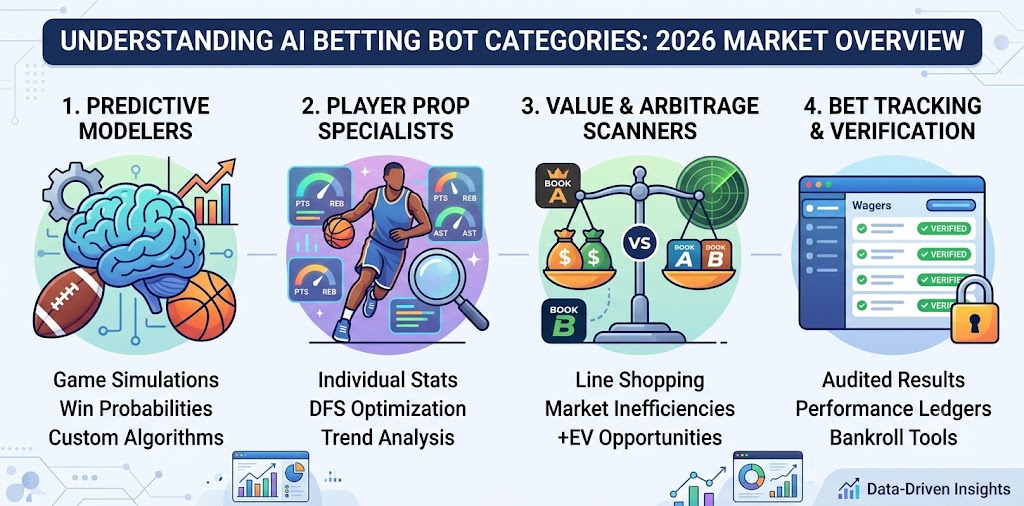
The consumer market for sports betting software is saturated with products claiming to utilize artificial intelligence. Distinguishing a mathematically sound analytical tool from a basic data aggregator requires evaluating the underlying architecture. The industry currently divides these platforms into four distinct functional categories: predictive modelers, player prop specialists, value scanners, and verification ledgers.
None of the platforms listed below guarantee financial profit. Algorithmic sports betting operates on the principle of long-term expected value (+EV), meaning users are subjected to standard market variance, inevitable losing streaks, and the strict necessity of disciplined bankroll management.
Best AI Betting Bot
Based on current 2026 market auditing, methodology transparency, and public pricing data, here is the definitive breakdown of the top 20 AI betting bots and software suites.
Predictive Modeling & Custom Simulation Engines
These platforms run proprietary machine-learning models on historical and contextual data to generate probability estimates for upcoming events.
1. Rithmm: Functioning as a no-code model builder, Rithmm allows bettors to construct, backtest, and refine their own predictive algorithms. The Core plan ($29.99/month) covers major U.S. sports alongside beta coverage for the 2026 FIFA World Cup, delivering baseline win probabilities and utilizing an AI Parlay Builder to flag mathematically weak legs.
2. BetQL: Backed by the Audacy sports network, BetQL operates on volume. Its proprietary AI simulates every supported matchup 10,000 times, factoring in weather, injuries, and historical performance to generate star-rated probability projections. Pricing typically ranges between $20 and $50 monthly.
3. Leans.AI: Powered by an AI engine named “Remi,” this platform caters to users seeking a steady stream of generated plays rather than a customizable model. Operating with paid tiers ranging from $49 to $329 per month, Leans.AI is designed strictly for daily pick delivery.
4. Sports-AI.dev: This prediction site runs machine learning models on historical data to publish raw probability estimates rather than just aggregate odds. By publishing transparent probabilistic outputs, users can measure the site’s data directly against sportsbook pricing.
5. Pyckio: Categorized alongside top global AI prediction sites, Pyckio generates distinct probability outputs built upon heavily guarded proprietary machine-learning frameworks, focusing on international sporting markets.
6. PredictZ: A legacy data site that has integrated AI sports prediction models to publish baseline win probabilities, specifically functioning as a high-volume statistical resource for global soccer.
Player Prop & Micro-Market Specialists
As player propositions dominate sportsbook handle, AI tools have adapted to parse micro-event data, fantasy sports context, and individual player trends.
7. PropsBot.AI: Built strictly for board-first research, this platform separates its product from the marketing hype by maintaining a public performance ledger detailing its methodology and grading. It is frequently utilized by bettors needing a singular interface for both traditional sportsbook odds shopping and Daily Fantasy Sports (DFS) optimization.
8. PlayerProps.ai: Positioned as an entry-level prop research application costing approximately $59.99 monthly, this tool provides visual context and historical trend instruction for bettors just entering the player prop market.
9. RotoBot AI: Bridging the gap between season-long fantasy sports and daily betting, RotoBot acts as a conversational research assistant. The AI connects directly to Sleeper, Yahoo, and ESPN league contexts, pulling live lines and injury reports to answer complex, multi-variable prompt questions.
10. PropGPT: Operating as the lightest, fastest workflow in the prop category, PropGPT delivers app-first AI grades and highly condensed statistical explanations for spreads, totals, and individual player markets.
11. BetAlytics: Operating in the sub-$30 monthly price tier, this platform focuses heavily on community-first projections, translating machine-learning outputs into easily digestible prop market predictions.
Value Betting, Arbitrage & Market Scanners
These bots do not predict who will win a game. Instead, they scan the global odds infrastructure to find mispriced lines and guaranteed arbitrage opportunities based on sharp market movement.
12. OddsJam: One of the most prominent value bet finders on the market, OddsJam’s algorithms constantly compare soft bookmaker odds to sharp global references, flagging mathematically positive-EV (expected value) opportunities in real time.
13. Outlier.bet: Priced between $19.99 and $79.99 per month, Outlier functions as an all-in-one analytical suite. Its defining feature is direct bet-slip integration; an AI-identified edge can be converted into a pre-filled ticket at DraftKings, FanDuel, or BetMGM with a single tap.
14. RebelBetting: Strictly a mathematical scanner, this software identifies guaranteed-profit arbitrage opportunities and value bets by instantly analyzing price discrepancies across global sportsbooks.
15. BetBurger: Operating similarly to RebelBetting, BetBurger is a professional-grade scanner utilized predominantly by high-volume bettors looking to exploit fleeting arbitrage windows before the sportsbook algorithms self-correct.
16. Unabated: Founded by professional bettors, Unabated offers odds intelligence and line-shopping tools that focus entirely on identifying market mispricings and visualizing line movement over time.
Workflow, Verification, & Niche AI Markets
The final category includes workflow optimizers and highly specialized bots trained on niche verticals or verified public ledgers.
17. Juice Reel (Microchip_Kelly.ai): Juice Reel addresses the industry’s lack of transparency by syncing billions of verified bets directly from users’ sportsbook accounts. Their flagship AI bot, Microchip_Kelly.ai, drops up to 8 picks daily, but crucially, every bet settles on a public record, allowing users to audit the bot’s true ROI before paying for a subscription.
18. Playbook by Action Network: A free workflow assistant designed for speed. While it does not offer custom model control, it excels at helping bettors compare lines across major U.S. sports (NFL, NBA, MLB, NHL) and cleanly execute wagers before the odds shift.
19. OddsTrader: Another free utility, OddsTrader is primarily an odds comparison engine that layers in basic “computer picks”. It is heavily utilized by bettors who prioritize finding the absolute best price on a number over deep analytical debate.
20. EquinEdge: Moving away from team sports, EquinEdge is a specialized third-party AI handicapping platform for horse racing. Analyzing North American tracks, its proprietary machine-learning models are highly calibrated; according to public metrics, their top win-probability horse wins 32.9% of tracked races.
Under the Hood: How AI Betting Algorithms Actually Work
Separating marketing fiction from mathematical reality requires understanding how these systems process information. Machine learning models function by analyzing massive volumes of historical data to identify patterns that human handicappers fundamentally cannot process at scale. The core methodology relies on continuous data ingestion. Modern algorithms instantly consume years of box scores, injury reports, weather conditions, and even social media sentiment to generate dynamic probability estimates.
Instead of relying on rigid, traditional statistical formulas, sophisticated platforms utilize a combination of specialized techniques. Regression models are deployed to predict specific numbers, such as game totals or player stats, while classification models forecast straightforward win or loss outcomes. To maximize accuracy, the most robust systems utilize ensemble methods, such as random forests. A random forest algorithm builds hundreds or thousands of distinct decision trees, each analyzing a random subset of data; by averaging the predictions of these individual trees, the system effectively cancels out isolated errors and produces a highly robust forecast.
Identifying Expected Value (+EV) and Model Calibration
The ultimate objective of an AI betting predictor is to transform raw statistical data into a clear, betting-decision-ready signal.
The software outputs a precise probability estimate for a specific outcome—for example, calculating that a basketball player has a 64% chance to exceed a certain point total. This prediction is then directly compared against the sportsbook’s implied probability for that exact same market. When the AI’s calculated probability is mathematically higher than the sportsbook’s pricing, the difference between the two numbers represents the bettor’s “edge”.
However, the entire concept of an algorithmic edge collapses without strict model calibration. If a platform assigns a 70% probability to a specific set of outcomes, those events must actually occur 70% of the time in the real world. Evaluators measure this accuracy using a Brier score, where a lower score indicates superior calibration.
How to Effectively Use AI Betting Tools
A subscription to a predictive model does not replace the necessity of disciplined bankroll management. Professional bettors utilize these AI platforms strictly as decision-support engines, governing how they interact with algorithmic outputs to mitigate the inherent variance of sports betting.
To utilize these tools effectively, bettors must adhere to a strict analytical workflow:
- Demand Audited Ledgers: Before trusting a model’s internal “confidence score,” users should verify its public ledger to ensure past predictions are accurately logged alongside final results.
- Contextualize the Edge: A high win-probability rating is mathematically useless without an explicitly quantified edge. Actionable bets only exist where the AI identifies a clear mathematical advantage in percentage points over the current sportsbook line.
- Execute a Line-Shopping Workflow: The recommended process requires confirming the market, ruthlessly comparing available prices across multiple sportsbooks to find the best odds, checking the model’s confidence, and logging the final result to maintain personal accountability.
- Leverage Responsible Gambling Integrations: Modern platforms are increasingly deploying AI to protect users, featuring behavioral pattern recognition that flags problematic betting frequencies and machine-learning models that suggest personalized deposit limits based on individual financial habits.
The Legal Landscape: Are AI Betting Bots Legal in the US?
The legal framework surrounding sports betting and algorithmic data processing in the United States remains highly localized and complex. In 2018, the U.S. Supreme Court issued a landmark ruling in Murphy v. National Collegiate Athletic Association, striking down the federal Professional and Amateur Sports Protection Act (PASPA) as unconstitutional. This decision erased the federal ban and returned authority to individual states, prompting over 38 states and the District of Columbia to pass laws legalizing sports wagering.
Because the Supreme Court opened the door to piecemeal, state-by-state legalization, no comprehensive national regulatory framework exists to govern the mobile sports gambling industry.
Federal Anti-Fraud Statutes and Algorithmic Scrutiny
While consumers are legally permitted to use machine learning software to research publicly available sports data, the surrounding infrastructure is heavily scrutinized. At the federal level, the ecosystem is governed by strict anti-fraud statutes. This includes the Wire Fraud Statute (18 U.S. Code § 1343), which penalizes fraudulent schemes utilizing wire communications, and the Wire Act (18 U.S. Code § 1084), which prohibits entities engaged in the business of betting from using interstate wire facilities to transmit wagers.
Furthermore, the rapid evolution of pricing algorithms is attracting intense regulatory attention. Legal analysts from the Yale School of Management note that highly sophisticated sports betting algorithms are currently pressing the limits of American antitrust laws, as these systems make tacit collusion increasingly possible without explicit human agreement. To operate legally within this environment, sportsbooks and data providers are mandated to implement clear internal policies ensuring the responsible use of AI and strictly preventing the misuse of predictive data.
Sources Quoted:
Data and industry metrics were sourced from GammaStack B2B reporting, GMInsights market analysis (via Idea Usher), PillarLab AI methodology reports, and PropsBot.AI’s 2026 public performance ledgers.
Pricing, features, and platform capabilities were verified via 2026 reporting from VegasInsider, Sports-AI.dev industry analyses, Horse.bet software audits, and direct app marketplace data from Google Play and Apple App Store for Rithmm, Juice Reel, and PropsBot.AI.
Information regarding machine learning methodologies, federal laws (PASPA, Wire Act), and AI calibration was sourced from the Yale School of Management’s Thurman Arnold Project, the National Council on Problem Gambling, legal analyses via New York Criminal Lawyer Blog, WSC Sports, Intellias, Playbook, Leans.ai, and PropsBot.AI methodology reports.
Leo Falsafi is a digital marketing veteran and senior journalist at Virlan.co, where he covers the intersection of digital marketing, gaming, and breaking US trending news. With nearly two decades of hands-on experience in SEO and digital strategy, Leo has consulted for and scaled hundreds of companies. His deep industry roots allow him to deliver sharp, fact-checked insights and analysis on the trends shaping today's digital landscape.