
The Master Chief is standing at a dangerous crossroads. It has been over a decade since Halo 5: Guardians fractured the franchise’s fiercely loyal community, and internally, the studio responsible for Xbox’s crown jewel is still feeling the aftershocks.
In a recent wave of quiet legal filings, leaked internal prototypes, and abrupt project cancellations, the future of Microsoft’s flagship sci-fi universe has been entirely rewritten. 343 Industries is dead, replaced by the newly rebranded Halo Studios. Yet the same developmental friction remains.
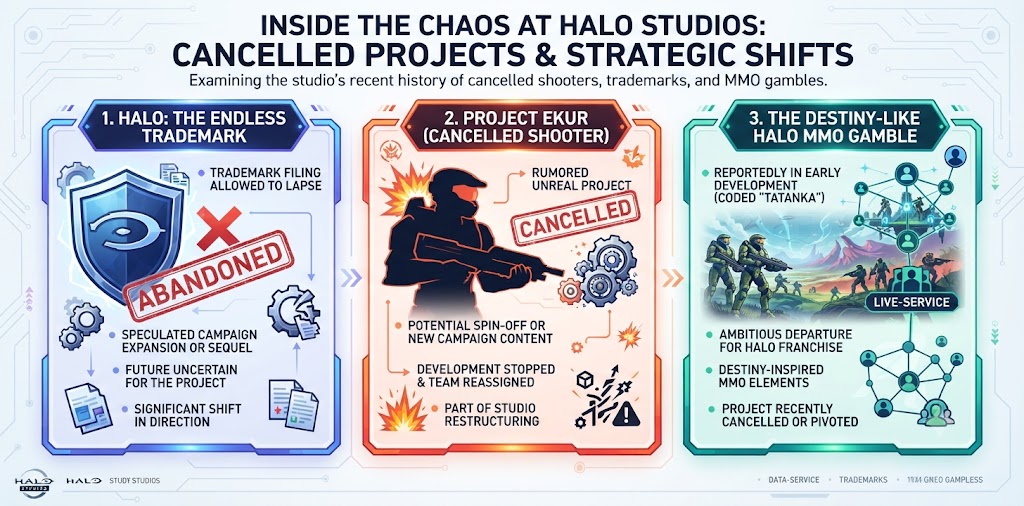
As the studio prepares to launch the Unreal Engine 5-powered remake Halo: Campaign Evolved later this month, behind-the-scenes reporting reveals a fractured pipeline. Microsoft has quietly killed off large-scale multiplayer prototypes, formally abandoned highly anticipated narrative expansions, and seemingly placed its chips on an ambitious, Destiny-like MMO.
Here is exactly what is happening behind closed doors.
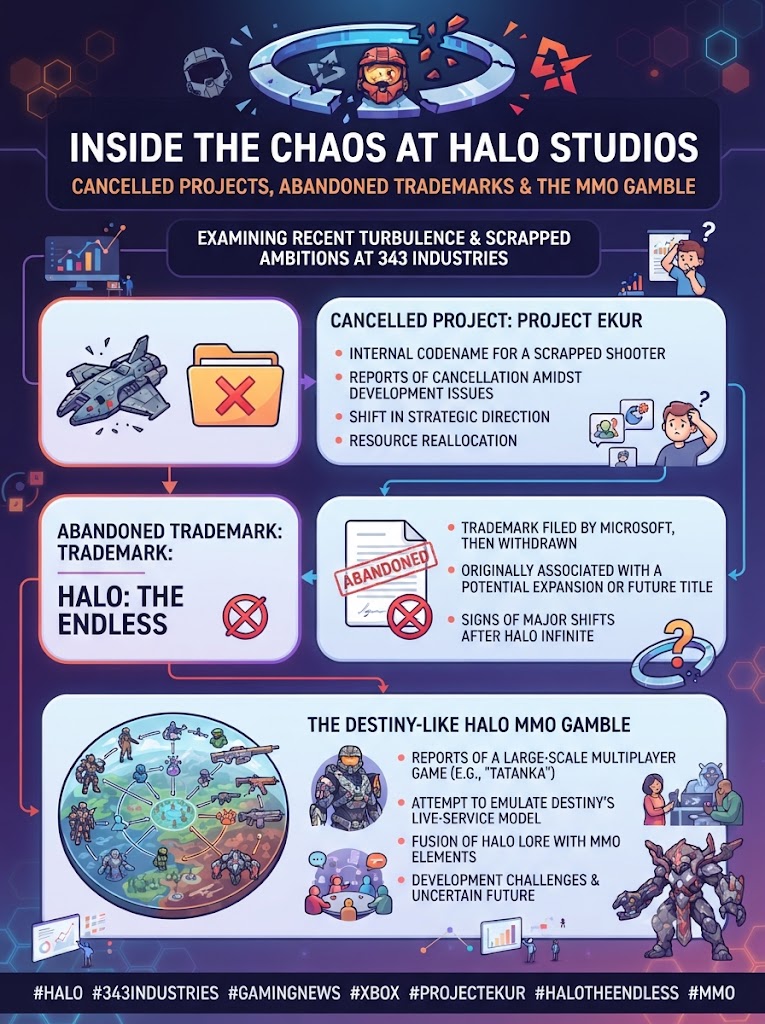
Microsoft Abandons Halo: The Endless
For years, lore enthusiasts have been chasing a ghost. Shortly after the launch of Halo Infinite, Microsoft filed a trademark for Halo: The Endless. Fans naturally assumed this was the title for an inevitable campaign expansion focusing on the mysterious, ancient species teased at the end of Infinite.
That expansion never materialized.
We now know why. Following a grueling legal battle over the name, Microsoft officially abandoned all trademarks related to “The Endless” in April 2026. According to content creator and noted Halo sleuth Sean Dubs TV, who uncovered the abandonment, this wasn’t just a simple renaming. It signaled a complete pivot away from the narrative threads established in recent entries.
The timing is far from coincidental. Just weeks after Microsoft dumped the trademark, reports surfaced that Halo Studios had completely axed another massive undertaking.
The Death of Project Ekur
Not long ago, fans were promised a sprawling multiplayer experience. Codenamed Project Ekur, this large-scale PvP shooter was originally handed off to Certain Affinity—the veteran support studio responsible for iconic Halo 2 maps and the rumored Tatanka battle royale prototype. Eventually, development was pulled back in-house to Halo Studios.
Then, the plug was pulled.
According to investigative reporting from Rebs Gaming, which was later verified as “100% true” by Windows Central’s Jez Corden, Project Ekur was terminated mid-development. Why? Studio leadership reportedly siphoned the multiplayer team’s resources directly into finishing Halo: Campaign Evolved.
Microsoft desperately needs a win. With massive corporate layoffs described internally as a “mass culling” and climbing Xbox Game Pass prices, the publisher cannot afford another misstep. And Halo Studios Head Pierre Hintze seems acutely aware of this, recently admitting in a resurfaced interview that the community backlash to Halo 5 was “imminent” due to developmental miscalculations.
But killing off traditional massive PvP raises a massive question: What is the long-term plan?
A Destiny-Like Halo MMO: The Next Frontier?
Enter “Team X.”
While traditional PvP projects get the axe, a massive, unannounced game is quietly spinning up in the background. According to credible franchise leakers HTD_Blog and Technical Halo, Microsoft has spent the last two years prototyping a Destiny-style MMO set in the Halo universe.
The leaks are incredibly specific. Initially pitched by Obsidian Entertainment and personally greenlit by Microsoft Gaming CEO Phil Spencer with a “give it a go,” the MMO casts players not as a monolithic Spartan, but as an ODST-style soldier. The gameplay loop reportedly revolves around traveling to different planets to complete quests, dive into dungeons, and execute large-scale raids.
“A trusted source of mine says the Halo MMOFPS prototype is real,” reported Technical Halo. “Started prototyping it a few years ago, and that this rumor sounds exactly like it. He says he’s seen video of it.”
For a while, this was easily dismissed as community vaporware. Microsoft actually attempted a sci-fi World of Warcraft competitor with Ensemble Studios between 2004 and 2007 before killing it. But recent comments from Pierre Hintze have poured gasoline on the rumor mill.
Speaking at the STEM Educational Institute earlier this month, Hintze subtly tipped his hand toward the studio’s shifting philosophy.
“Yes, it is incredibly rewarding if you go into a first-person shooter and play one versus one and win,” Hintze stated. “But it is also incredibly rewarding if you guys are completing an objective or completing a raid in an MMO and you see the solidarity and the help and support we can lend each other.”
The 2026 Reality Check
A Destiny-like Halo MMO makes perfect financial sense for a post-acquisition Microsoft. Live-service titles like Elder Scrolls Online and World of Warcraft are currently generating massive, consistent revenue for the company. With Bungie stepping back from Destiny 2 support, there is a massive vacuum in the sci-fi looter-shooter market just waiting to be filled.
But ideas are cheap in the gaming industry. Execution is what costs billions.
If Halo Studios can survive the internal turbulence, a sprawling, planet-hopping MMO could be the ultimate redemption arc. But right now? All eyes are on late July. If Halo: Campaign Evolved fails to stick the landing, the Master Chief’s next fight might not be against the Covenant—it might be against Microsoft’s own board of directors.
Sources Quoted:
Reporting in this article relies on data from Windows Central (Jez Corden, Adam Hales), Massively Overpowered, Wccftech (Alessio Palumbo), TechPowerUp, and statements extracted from industry leakers Rebs Gaming, Sean Dubs TV, Technical Halo, and HTD_Blog.
Leo Falsafi is a digital marketing veteran and senior journalist at Virlan.co, where he covers the intersection of digital marketing, gaming, and breaking US trending news. With nearly two decades of hands-on experience in SEO and digital strategy, Leo has consulted for and scaled hundreds of companies. His deep industry roots allow him to deliver sharp, fact-checked insights and analysis on the trends shaping today's digital landscape.