
Wall Street’s great artificial intelligence rotation has officially arrived.
For nearly a year, the AI revolution had a single, undisputed champion. Nvidia, the silicon heartbeat behind generative AI, soared to uncharted heights—even becoming the first company to ever eclipse a historic $5 trillion valuation last October. But on Friday, the tide turned. Apple has reclaimed the title of the world’s most valuable publicly traded company, dethroning Nvidia in a financial milestone that signals a massive shift in how investors are evaluating the future of artificial intelligence.
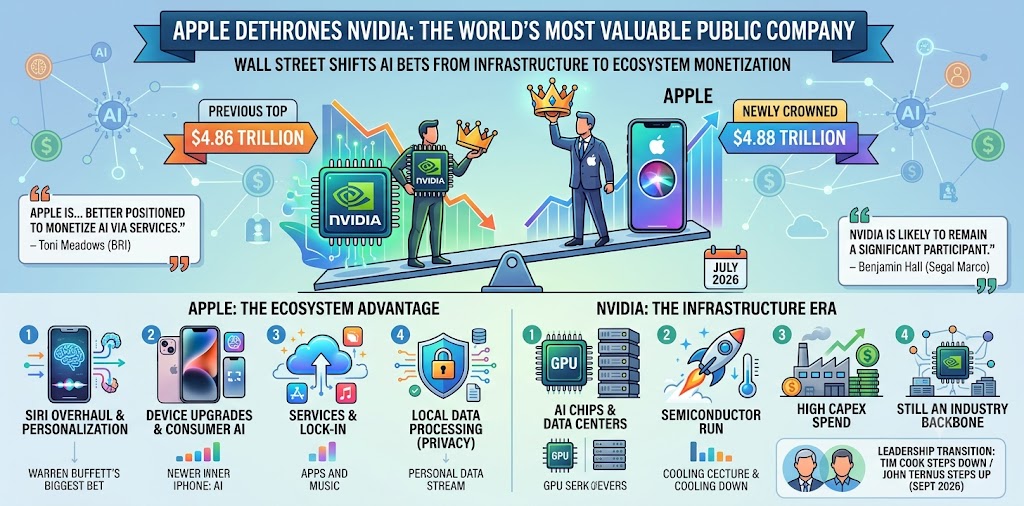
After a 3.5% drop in Nvidia’s shares on Friday, the chipmaker’s market capitalization slipped to roughly $4.86 trillion. Apple, holding steady against broader market volatility, edged past to command a $4.88 trillion valuation—securing the top spot for the first time since April 2025.
The CapEx Pivot: From Infrastructure to Ecosystem
The reshuffling at the top isn’t merely the result of daily market fluctuations; it reflects a broader reassessment by the investment community. For months, the market aggressively rewarded companies pouring billions of dollars into capital expenditures (CapEx) to build massive data centers and train foundational AI models. Today, investor sentiment is pivoting toward sustainable monetization.
Toni Meadows, head of investment at BRI Wealth Management, explained the underlying philosophy of this transition to Reuters. “Apple was seen as a laggard in the AI race because it wasn’t spending to develop models, but now sentiment has changed,” Meadows said. “Apple is less exposed to capex intensity and better positioned to monetize AI via services, ecosystem lock-in, and hardware upgrades.”
Warren Buffett’s long-standing stake in the iPhone maker—widely considered his firm’s “biggest bet”—has served as an anchor of stability as high-flying semiconductor stocks face intense scrutiny. In July, the Philadelphia Semiconductor Index dropped nearly 19% from its record highs as traders began to question the sustainability of the explosive AI trade. Rather than demanding Apple build the biggest models, Wall Street is increasingly confident that the company can leverage AI simply to encourage device upgrades and tighten the grip of its services ecosystem.
Siri’s Overhaul and an End of an Era
Apple’s resurgence is fundamentally tied to its unique consumer proposition: keeping data processing local. Rather than fighting Nvidia and Microsoft strictly on the grounds of sheer computing power, Apple is bringing AI directly to the pockets of over a billion users.
Following the rollout of a major, long-delayed overhaul to Siri last month, the Cupertino giant is aiming to narrow the gap with its big tech rivals. Analysts note that Apple’s greatest advantage lies in the vast reservoir of personal data securely stored on individual devices, allowing future AI integrations to deliver highly personalized responses while maintaining the brand’s signature privacy protections.
This market triumph also arrives at a historic juncture for the company’s internal leadership. Surpassing Nvidia serves as a capstone achievement for CEO Tim Cook, who is preparing to step down in September and hand control of the tech behemoth to veteran hardware chief John Ternus.
Will Nvidia Reclaim the Crown?
Despite losing the number one spot, analysts strongly caution against counting Nvidia out. The broader tech industry’s expansion is still deeply reliant on the company’s graphics processors, which remain the undisputed backbone of leading generative AI systems worldwide.
Benjamin Hall, vice president of alpha research at Segal Marco Advisors, emphasized the chipmaker’s enduring relevance in an interview with Reuters. “I don’t see any meaningful distinction. Nvidia is likely to remain a significant participant in whatever happens going forward,” Hall noted.
For now, the battle for supremacy on Wall Street highlights a maturing AI landscape. As the foundational infrastructure is laid, the market’s ultimate reward is shifting to the companies that can weave artificial intelligence seamlessly into the daily lives of consumers.
Sources Quoted:
Data, quotes, and market context were successfully aggregated from primary financial reporting by Reuters (via The Indian Express, India Today, and Hindustan Times), The Guardian, Yahoo Finance, and CNBC. Expert commentary was sourced from Toni Meadows (BRI Wealth Management) and Benjamin Hall (Segal Marco Advisors).
Leo Falsafi is a digital marketing veteran and senior journalist at Virlan.co, where he covers the intersection of digital marketing, gaming, and breaking US trending news. With nearly two decades of hands-on experience in SEO and digital strategy, Leo has consulted for and scaled hundreds of companies. His deep industry roots allow him to deliver sharp, fact-checked insights and analysis on the trends shaping today's digital landscape.