
iGaming SEO: Avoid Google’s Toxic Link Trap
The iGaming sector is currently navigating the most hostile search landscape in digital history. If you are executing SEO outreach and guest blogging like it’s 2023, you aren’t just wasting your budget—you are actively poisoning your domain.
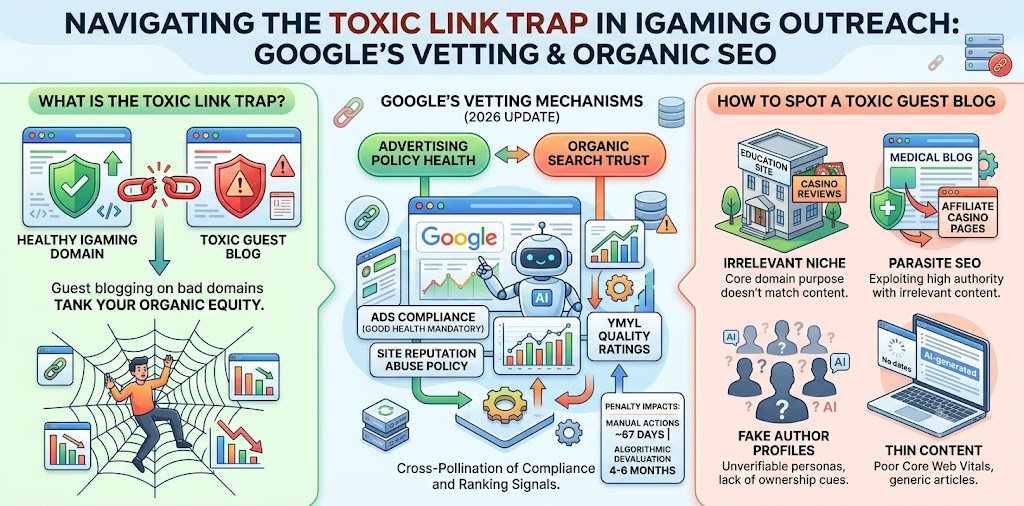
The game fundamentally changed with the enforcement of Google’s Site Reputation Abuse policies, but the real silent killer in 2026 is the cross-pollination of Google’s advertising compliance algorithms with organic search evaluations. As Google tightens its grip on the gambling sector, guest blogging on domains flagged for ad violations or reputation abuse has become a highly efficient way to tank your organic search equity.
- Google’s 2026 Gambling Crackdown: The Death of iGaming Silos
- Google Tightens Gambling Ads Policy: Stricter Vetting Rules Hit Advertisers
Here is exactly what is happening beneath the algorithmic hood, and how to protect your outreach strategy from domains that will drag you down with them.
The Intersection of “Policy Health” and Organic Trust
Historically, organic SEO and paid advertising compliance existed in silos. Today, that wall is actively deteriorating.
Under the March 23, 2026, Google Ads Gambling and Games Certification Update, the search giant began evaluating an advertiser’s entire account history. A “good health” status transitioned from an ideal standard to a mandatory prerequisite. The vice tightens further on September 14, 2026, when Google implements even stricter gambling advertising rules. Advertisers will be required to maintain ongoing “good policy health” alongside their prescribed gambling licenses. The certification process is no longer a one-time hurdle; it is a system of continuous, ruthless compliance monitoring.
For iGaming SEO professionals, this creates a perilous ripple effect. Agencies or host domains with persistent compliance violations—or those utilizing domains they do not entirely own and control—risk massive trust downgrades. Earning a backlink from a domain that has had its advertising privileges revoked or its policy health score decimated passes a highly toxic footprint directly to your backlink profile.
Site Reputation Abuse: The Guest Blogging Graveyard
Google officially classifies gambling as a YMYL (Your Money or Your Life) topic. Specifically, the 182-page September 2025 Quality Rater Guidelines place gambling firmly under the “Financial Security” umbrella, meaning casino and betting SEO faces the highest quality standards applied to any content category on the internet.
This standard is rigorously enforced through the Site Reputation Abuse policy (initially introduced in May 2024), which specifically targets affiliate content hosted on high-authority domains meant to manipulate ranking signals—a tactic historically rampant in gambling affiliate guest posting.
The consequences of ignoring this shift are catastrophic. The March 2026 Core Update devastated the industry, triggering severe ranking declines for a staggering 71% of monitored affiliate sites. Sites caught attempting to leverage parasite SEO or relying on low-quality guest posts face manual penalties that are notoriously difficult to reverse. In 2025 and 2026, the average recovery time for a manual action stands at 67 days, while algorithmic devaluation takes an agonizing 4 to 6 months to overcome. Furthermore, attempting a self-recovery on these penalties yields only a 45% success rate.
How to Recognize Toxic Blogs Before You Pitch
When a single bad placement can invite a manual penalty that takes months to clear, the vetting phase of your outreach strategy becomes your primary defense mechanism. You must be able to identify sites operating as toxic link traps before you ever negotiate a guest post.
The Core-Relevancy and “Parasite” Test
Google defines site reputation abuse as publishing third-party pages in an attempt to manipulate the host site’s ranking signals. Look closely at the host domain’s core purpose. If you are looking at a well-known medical site hosting online casino reviews, or an education site inexplicably serving payday loan advertisements, they are actively violating Google’s policies. Even if the site claims to have “editorial oversight,” if the topic is wildly out of sync with the domain’s primary niche, a penalty is imminent. Do not post there.
Fake Author Profiles and AI-License Verification
Author authenticity is no longer a vanity metric; it is a core survival trait. Google now utilizes AI-driven license verification to cross-reference operator credentials against actual government databases. Domains utilizing fake author profiles or failing to provide transparent, verifiable ownership cues are automatically assigned the lowest possible quality rating by search algorithms. If an outreach prospect features faceless authors, non-existent personas, or lacks clear editorial credentials, any link earned from that site is radioactive.
Thin Content and Missing Trust Cues
Sites that blend expert-attributed editorial content with credible iGaming link profiles consistently outperform high-volume, thin-content operations. Toxic blogs often lack proper technical infrastructure. If a blog ignores Core Web Vitals (e.g., failing to lazy-load heavy game grids or blocking the main thread with massive affiliate scripts) and publishes generic, AI-spun casino listicles without current-year date stamps, it is signaling low trust to Google’s crawlers.
Also read:
- Top 50 Guest Posting Marketplaces (2026 Reviews & Pricing)
- The 2026 Guide to Hiring a Local SEO Expert: Agency Services, ROI, and AI Search
The Path Forward
The era of buying arbitrary links on authoritative-but-irrelevant domains is dead. As Google’s vetting algorithms grow exponentially more sophisticated—combining strict Ads “policy health” tracking with aggressive core updates targeting reputation abuse—your outreach strategy must be surgically precise.
Prioritize specialized iGaming media with verifiable authors, flawless technical foundations, and a pristine compliance track record. A clean, highly targeted link profile won’t just protect you from the next core update; it is the only way to survive in an industry where a single toxic link trap can cost you a year of organic growth.
Sources Quoted:
Data, statistics, and policy insights were directly sourced and synthesized from recent 2025–2026 industry publications, including reports by ICODA (iGaming SEO guidelines & March 2026 Core Update data), TheGamblest (Milena Yeghiazaryan on the upcoming Sept 2026 Google Ads rules), YeezyPay (March 2026 Ads Certification Updates), eSearch Logix (Manual vs. Algorithmic Penalty Recovery statistics), The Growth Shark (Site Reputation Abuse examples), and Absolute Digital Media.
Leo Falsafi is a digital marketing veteran and senior journalist at Virlan.co, where he covers the intersection of digital marketing, gaming, and breaking US trending news. With nearly two decades of hands-on experience in SEO and digital strategy, Leo has consulted for and scaled hundreds of companies. His deep industry roots allow him to deliver sharp, fact-checked insights and analysis on the trends shaping today's digital landscape.