
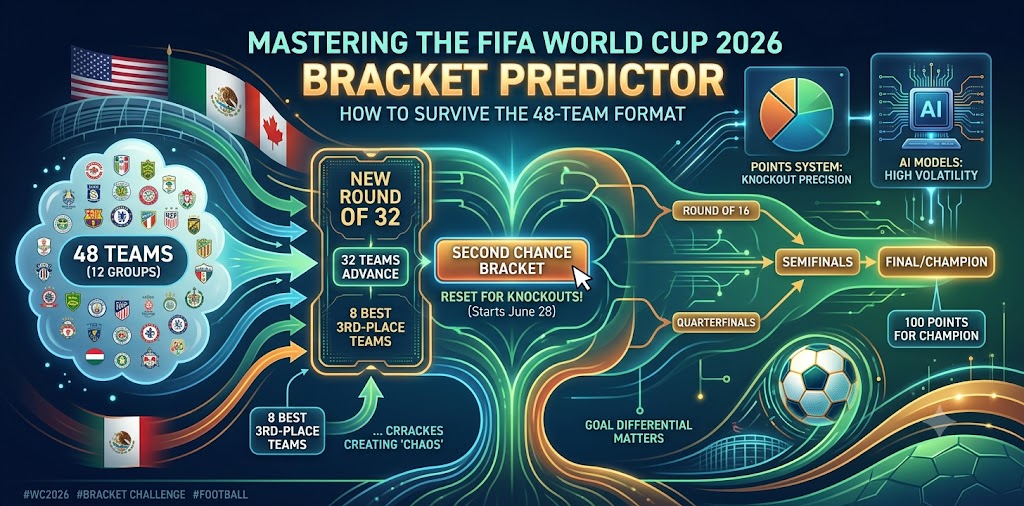
June 28, 2026 — The group stages have finally concluded, and the world’s biggest sporting event has officially entered uncharted territory. For the first time in history, the FIFA World Cup has expanded to 48 teams. The introduction of 12 four-team groups and a sprawling 104-match schedule has completely rewritten the rulebook for analysts, supercomputers, and millions of fans interacting with the FIFA World Cup 2026 bracket predictor.
If your initial bracket imploded during the group stage, you are not alone. Artificial intelligence models running thousands of tournament simulations have struggled to account for the chaotic influx of the “eight best third-place teams” advancing to the knockout rounds. As the inaugural Round of 32 kicks off today across the United States, Mexico, and Canada, understanding the underlying mathematics of this expanded bracket is essential for survival.
The Anatomy of the 48-Team Bracket
In past tournaments, mapping the bracket was a fairly straightforward exercise in identifying the top two teams in each of the eight groups. The 2026 expansion shatters that simplicity. Now, 32 teams survive the group stage.
Goal differential has never been more critical. According to FOX Sports coverage of the bracket mechanics, a team that starts slow but manages a third-place finish can still advance if they sit among the top eight globally. This creates a highly volatile Round of 32, where dominant group winners might unexpectedly face battle-tested, high-scoring third-place teams whose paths were shaped purely by goal margins.
Cracking the Official FIFA Bracket Predictor
For fans competing in the official FIFA World Cup Bracket Challenge via the FIFA Play Zone, victory requires more than just blindly picking heavyweights like France, Spain, or Argentina. It requires understanding the platform’s exact scoring math.
FIFA heavily incentivizes precision. Participants who accurately mapped the group stage earned 50 points for predicting a team’s correct finishing position, alongside a 30-point bonus for perfectly predicting an entire group’s final standings. But as the tournament pivots to the knockouts, the stakes escalate dramatically. To climb the global leaderboard, predictors must chase the heavy knockout modifiers:
- Round of 16: 20 points for each correct team.
- Quarterfinals: 30 points.
- Semifinals: 40 points.
- Final: 75 points.
- World Champion: 100 points.
The “Second Chance” Lifeline
Perhaps the most heavily trafficked feature of this year’s digital experience is the “Second Chance Bracket.” FIFA officially opened this secondary predictor on June 27, directly following the conclusion of the group stage.
With the Round of 32 locked in, the Second Chance Bracket offers a completely clean slate. It asks users to simply predict the outright winner of the tournament starting from today’s matchups, bypassing the damage done by early-tournament upsets. But take note: the lockout for this fresh bracket triggers the exact moment the first Round of 32 whistle blows today, June 28.
Supercomputers vs. Human Instincts
While the official FIFA game is entirely free to play, many fans are actively looking for an analytical edge. External simulators, like the World Cup 2026 calculator built by AS.com, have surged in popularity, allowing users to manually test specific matchups and simulate the cascading effects of their predictions.
Meanwhile, sports analytics firms and supercomputers have been busy assigning precise mathematical probabilities of success to the remaining playoff field. According to recent AI analysis, the geographic distribution in the first-ever Round of 32 is striking: 13 European teams lead the pack, followed by a record nine African nations, five South American squads, three from CONCACAF, and two from Asia. Navigating this diverse, expanded field requires moving beyond traditional biases and leaning into the data.
- Expanded Format Mechanics: The 2026 World Cup features 48 teams divided into 12 groups; the top two teams from each group, plus the eight best third-place teams, automatically advance to the newly created Round of 32.
- Official Platform: The FIFA World Cup Bracket Challenge operates on the FIFA Play Zone and requires a free FIFA ID to submit and save predictions.
- Points Weighting: Knockout stage predictions heavily outweigh group stage points, culminating in a massive 100-point reward for correctly naming the final World Champion.
- The Reset Button: A “Second Chance Bracket” opens exclusively for the knockout stages, wiping group-stage errors clean and allowing users to predict solely from the Round of 32 onward.
World Cup 2026 Predictor
How do you predict the third-place teams in the 2026 World Cup bracket?
Predicting the advancing third-place teams requires evaluating goal differential and total points across all 12 groups simultaneously. In the official FIFA Bracket Challenge, users simply rank the four teams in each group, and the platform’s algorithm automatically calculates and advances the best eight third-place teams into the correct Round of 32 slots.
When does the World Cup bracket lock?
The core tournament bracket officially locked before the first match on June 11, 2026. However, the newly introduced Second Chance Bracket—which covers only the knockout stages—locks exactly when the first Round of 32 match kicks off on June 28, 2026.
Also read:
- FIFA World Cup 2026 Bracket Revealed: Round of 32 Schedule, Matchups, and Format Explained
- The Final Dust Settles: A Deep-Data Retrospective on the 2026 FIFA World Cup Qualifiers Table
- How Many World Cup Goals Does Kylian Mbappé Have? (2026 Update)
- Why Is Everyone Wearing Pink Cleats at the 2026 World Cup? The Science and Strategy Behind the Turf
Sources Quoted: This article integrates data and reporting from the official FIFA Play Zone (Bracket Challenge rules, timelines, and scoring structures), FOX 29 Philadelphia / FOX 10 Phoenix (tournament structure and third-place advancement analysis), RBC Ukraine (supercomputer probabilities and geographic team distribution in the Round of 32), and AS.com (bracket simulation tools).
Leo Falsafi is a digital marketing veteran and senior journalist at Virlan.co, where he covers the intersection of digital marketing, gaming, and breaking US trending news. With nearly two decades of hands-on experience in SEO and digital strategy, Leo has consulted for and scaled hundreds of companies. His deep industry roots allow him to deliver sharp, fact-checked insights and analysis on the trends shaping today's digital landscape.