
Listen up, bettors. If you’re still throwing blind money at standard “Match Winner” markets based on gut feeling or team name value, you are actively bleeding your bankroll dry. The 2026 VALORANT Champions Tour (VCT) ecosystem is an entirely different beast. It is highly optimized. It is data-driven. And it is incredibly punishing to the casual punter.
I’ve dug deep into the latest reporting, match analytics, and expert models to bring you the definitive guide to betting on VALORANT esports. This isn’t your standard surface-level advice. We are talking about exploiting market inefficiencies, understanding regional agent preferences, and navigating economy-driven prop bets.
Let’s get into the hard data.
1. The Statistical Blueprint: What the Data Actually Dictates
Every successful betting model relies on parsing the right statistical parameters. Discard the noise. Focus strictly on these three data points to establish your baseline:
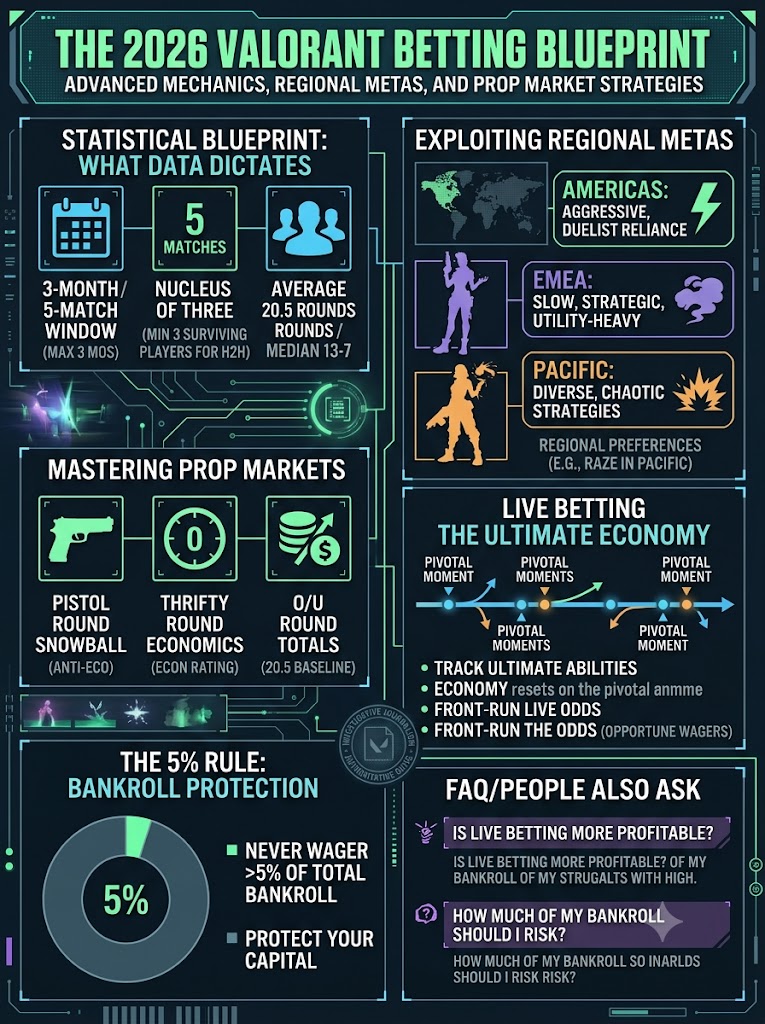
- The 3-Month / 5-Match Window: Recency bias is a trap, but historical data is equally dangerous given the constant frequency of Riot’s patch updates. Analysts stress that you should strictly evaluate a team’s last five matches, keeping the maximum evaluation distance to no more than three months. Anything beyond that is playing in an outdated META (Most Effective Tactics Available).
- The ‘Nucleus of Three’ Rule: Roster shuffles happen constantly in esports. When evaluating head-to-head match history between two teams, the data is only statistically significant if a “nucleus of three” core players has survived on both sides. If a roster has turned over more than two players, previous face-off data is void.
- Averages & Totals: According to large-scale dataset analyses of professional play, the average VALORANT game lasts roughly 20.5 rounds, with a median score settling around 13-7. This specific mathematical baseline is your absolute holy grail when attacking Over/Under total round markets.
2. Exploiting Regional Metas and Agent Comps
One of the largest betting inefficiencies occurs during international LAN events (like Masters or Champions) when vastly different regional playstyles clash. Oddsmakers frequently struggle to accurately price these distinct, geographic approaches to the game.
- Americas: Characterized by hyper-aggressive, aim-focused gameplay. Expect higher volatility, faster early-round executions, and heavy reliance on individual duelist heroics.
- EMEA (Europe, Middle East, Africa): The undisputed kings of slow, strategic, utility-heavy executes. EMEA teams heavily favor agents like Astra to surgically control map pacing and limit variable engagements.
- Pacific: Known for deeply diverse, chaotic strategies and highly unique agent compositions. The Pacific region has a notable, statistically proven preference for Raze compared to the rest of the world.
The Sharp Angle: When a slow-paced EMEA team faces a hyper-aggressive Americas team, look closely at the Map Vetoes. If the map selected favors heavy choke-point utility (like Ascent or Bind), back the EMEA squad. If the map is a sprawling, aim-duel playground, the Americas squad holds the edge.
3. Mastering the Micro-Markets: Props, Economy, and Live Betting
The sharpest value in VALORANT isn’t found in predicting who wins the overall match. True ROI is found in the granular, round-by-round prop markets.
Pistol Rounds and the Snowball Effect
Pistol rounds dictate the entire early-game economy. Teams drafting agents with strong early-round abilities (specifically flashes and smokes) inherently hold a massive competitive advantage before heavy rifles are ever purchased. If a team consistently wins pistol rounds, they mathematically secure the subsequent anti-eco round. You aren’t just betting on one round; you are betting on an instant 2-0 lead.
The Economics of “Thrifty” Rounds
Economy management separates the elite from the average. A “Thrifty” round occurs when a team wins despite possessing loadouts averaging at least 2,500 fewer credits than the enemy team. Teams with exceptionally high Econ Ratings—meaning they successfully convert low-investment rounds into improbable wins—are incredibly dangerous live-betting underdogs.
Live Betting the Ultimate Economy
Live betting is where the professionals thrive. Unlike traditional tactical shooters, VALORANT features devastating, game-breaking Ultimate abilities. These abilities are highly situational, cost zero credits, and do absolutely nothing until they are unlocked. By actively tracking which team has crucial Ultimates coming online in the next round, you can front-run the live odds before the bookmaker’s algorithm adjusts. The absolute optimal time to strike a live wager is immediately following a massive economic reset or a pivotal round win that secures a financial advantage for your chosen team.
How much of my bankroll should I risk per VALORANT match?
Expert consensus is remarkably strict on this rule: never wager more than 5% of your total betting bankroll on any single bet. Esports is inherently volatile. A 13-12 overtime thriller can flip on a single missed shot or a poorly timed smoke. You must protect your capital to survive the variance.
Is live betting more profitable than pre-match betting in VALORANT?
It absolutely can be, provided you understand the in-game economy. Pre-match odds often fail to account for mid-game snowball mechanics. By betting live, you can visually assess momentum shifts, Ultimate ability tracking, and tactical adaptations that a static, pre-match algorithm simply cannot predict.
Sources Quoted: This article utilizes data and strategic frameworks from EGamersWorld (Match prediction mechanics & the “Nucleus of Three” rule), Nxtbets (Regional META breakdowns & live betting strategy), Esports-betting.pro (Bankroll management), and VLR.gg / Red Bull (Dataset averages & Thrifty round economics).
Leo Falsafi is a digital marketing veteran and senior journalist at Virlan.co, where he covers the intersection of digital marketing, gaming, and breaking US trending news. With nearly two decades of hands-on experience in SEO and digital strategy, Leo has consulted for and scaled hundreds of companies. His deep industry roots allow him to deliver sharp, fact-checked insights and analysis on the trends shaping today's digital landscape.