
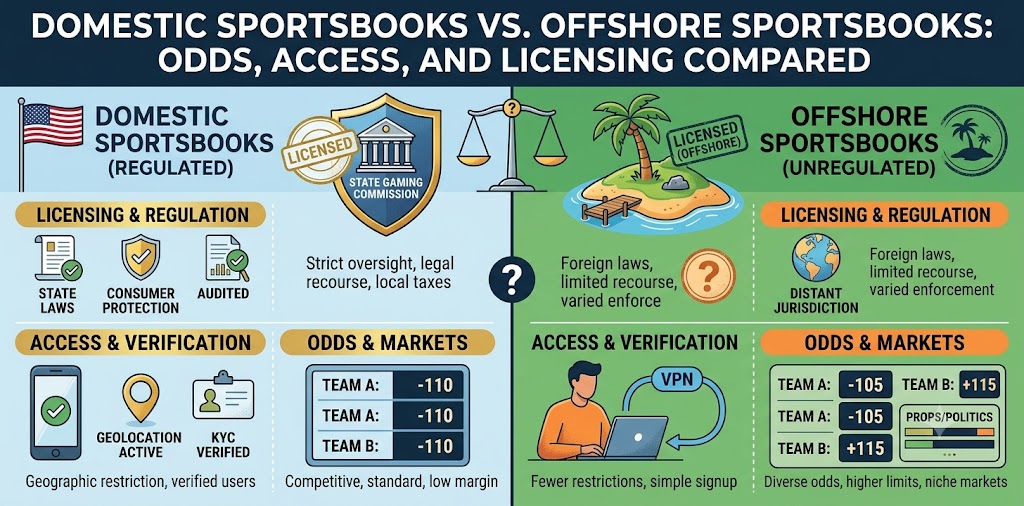
The U.S. sports betting landscape has split into two distinct worlds. On one side, state-licensed domestic sportsbooks operate under strict regulatory frameworks with clearly defined tax obligations and consumer protections. On the other, offshore operators — licensed in jurisdictions like Curaçao or Anjouan — serve U.S. customers from outside the reach of American law. For bettors deciding where to place their money, the differences go well beyond branding.
Understanding these differences means examining four core areas: how odds are priced, what licensing actually guarantees, how payments and withdrawals work, and ultimately which model fits which type of bettor.
Odds Pricing and Market Availability Compared
Domestic sportsbooks and offshore books both use standard American odds formats, but their pricing incentives diverge significantly because of tax burdens and regulatory costs. U.S.-licensed operators in high-tax states like New York, where the sports betting tax rate sits at 51 percent, often build higher theoretical hold into their lines to offset compliance costs. This can result in narrower value on standard markets, particularly on moneylines and spreads. Parlays have become the product of choice for regulated books precisely because the margins are larger and the tax impact per dollar wagered is more favorable for the operator.
Offshore books, operating without state tax obligations, can afford to run leaner lines on individual game markets. They frequently offer broader bet-type menus — including markets on international leagues, niche sports, and live props that some domestic books restrict. The tradeoff is real: better headline odds can mask higher counterparty risk, since there is no state enforcement mechanism guaranteeing that a winning bet actually gets paid.
Licensing Models: State Regulation vs. Offshore Jurisdictions
Since PASPA’s repeal, 39 states and Washington, D.C. have legalized some form of sports betting. State-licensed books must pass identity verification requirements, maintain financial reserves, submit to audits, and comply with geolocation technology — ensuring bettors are physically located in a permitted state. Regulators like the Ohio Casino Control Commission can suspend or fine operators that fail to honor payouts or mislead customers through promotions.
The offshore licensing picture is more complex. A detailed regulatory comparison notes that older Curaçao frameworks historically required minimal consumer protections, though recent reforms under the new LOK regime have introduced a dedicated Gaming Authority and stricter know-your-customer requirements. In that light, there’s an increase of offshore sportsbooks for players who aim at a more diverse bonus structure, faster payments, and less strict regulations.
Withdrawal Speed, Payment Methods, and Crypto Options
Payment infrastructure is one of the clearest practical differences between the two models. Domestic sportsbooks offer ACH bank transfers, debit cards, and PayPal, but processing times for withdrawals can range from 24 hours to several business days depending on the method and state. Regulatory requirements around anti-money-laundering and identity verification add checkpoints that, while protective, can slow the payout process.
Offshore sportsbooks have leaned heavily into cryptocurrency as a solution to payment friction. Bitcoin, Ethereum, and stablecoin withdrawals on offshore platforms can settle within hours, and many offshore books explicitly market crypto deposits as a way to bypass traditional banking restrictions. According to SiGMA’s 2025 analysis, unlicensed operators captured approximately 74 percent of a $90.1 billion U.S. online gambling market in 2024, driven in part by this ease of access. The speed is genuine, but the lack of a regulated dispute-resolution process remains a significant risk if a withdrawal request is denied or an account is flagged.
Which Model Suits Which Type of Bettor
Bettors in states with legal sportsbooks who prioritize account security, enforceable payouts, and transparent bonus terms are generally better served by domestic operators. State-licensed books are subject to advertising standards that require clear disclosure of rollover requirements and maximum payout caps. That regulatory layer matters when a dispute arises.
Bettors in states like California or Texas — where no state-licensed sportsbooks currently operate — face a different reality. Offshore books serve that demand by default. The AGA’s 2026 State of the States estimates that unregulated gambling, including offshore sportsbooks, generates $53.9 billion in annual U.S. revenue, which underscores just how significant offshore demand remains. For experienced bettors who understand the counterparty risks and use cryptocurrency to manage payment friction, offshore platforms offer genuine advantages in market depth and odds competitiveness. For those who want regulatory recourse and straightforward account management, domestic books remain the more reliable choice — assuming legal access exists in their state.
Leo Falsafi is a digital marketing veteran and senior journalist at Virlan.co, where he covers the intersection of digital marketing, gaming, and breaking US trending news. With nearly two decades of hands-on experience in SEO and digital strategy, Leo has consulted for and scaled hundreds of companies. His deep industry roots allow him to deliver sharp, fact-checked insights and analysis on the trends shaping today's digital landscape.