
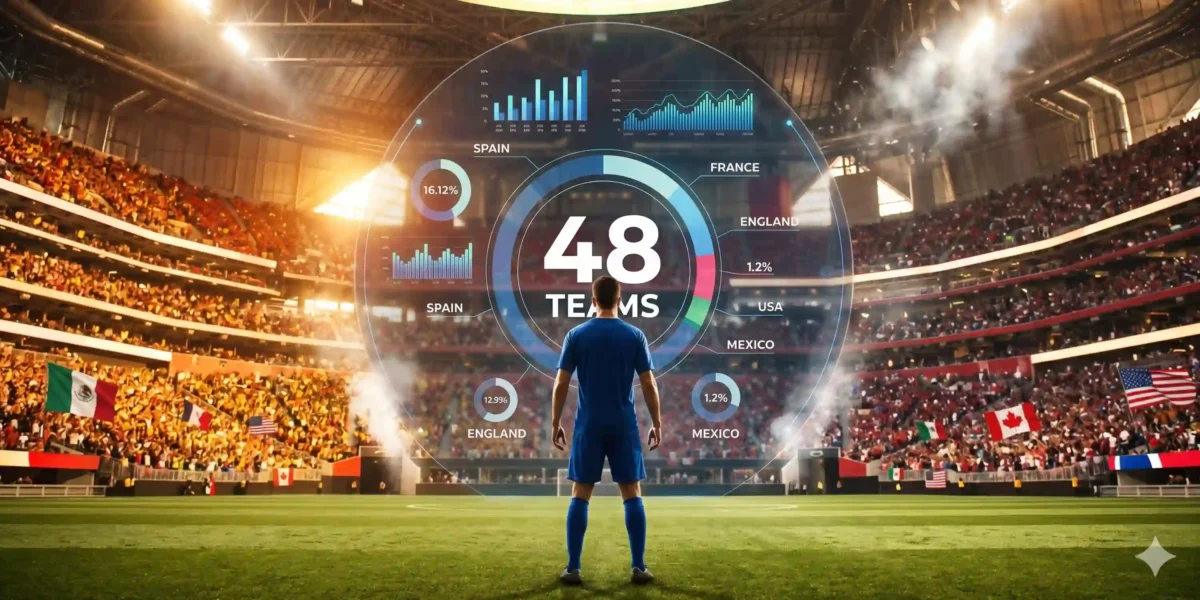
The excitement is reaching an absolute fever pitch. With the 2026 FIFA World Cup kicking off on June 11, soccer fans worldwide are desperate to know one thing.
Who will ultimately lift the trophy?
This tournament is already historic. For the first time ever, a staggering 48 nations will battle it out across the United States, Mexico, and Canada.
That means more matches, more unpredictability, and wilder betting odds than we have ever seen in the history of the sport.
From the bustling prediction markets of Polymarket to the raw calculating power of the Opta Supercomputer, data is flying everywhere.
But who can you actually trust? Which teams are genuinely contenders, and who are simply pretenders riding on past glories?
Let’s dive deep into expert analyses, investigate swirling locker-room rumors, and decode the actual probabilities to solve the real problem: figuring out where the smart money is going.
What the Bookmakers and Prediction Markets Are Saying
When people are forced to put their money where their mouth is, the truth often floats to the top.
This is the core philosophy behind prediction markets like Polymarket and Kalshi, where thousands of traders essentially crowd-source the probability of real-world events.
Currently, the consensus is razor-thin at the absolute top of the mountain. Spain and France are virtually neck-and-neck in trader consensus across the board.
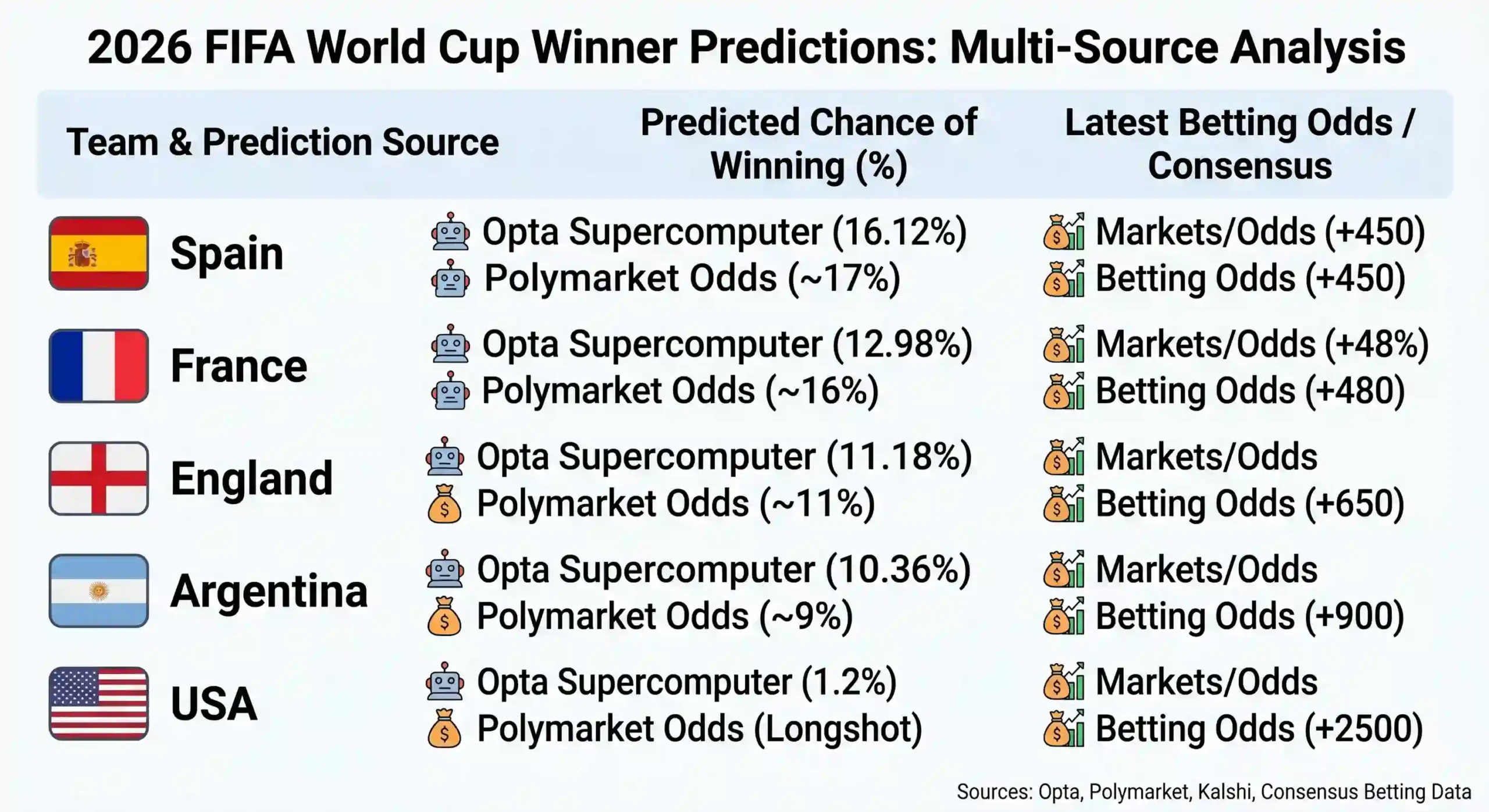
According to the latest Polymarket data, Spain and France both hover around a 16% to 17% implied probability of winning the entire tournament.
Why Spain? La Roja has been a dominant, unyielding force recently. They are fresh off a spectacular Euro 2024 triumph that silenced their critics.
They boast a staggering array of young talent, with Lamine Yamal and Pedri at the forefront of their attack. Their ability to control possession and dictate the tempo makes them a nightmare in tight knockout scenarios.
Why France? France has reached the finals in four of the last seven World Cups. They won it all in 2018 and barely missed out in a penalty shootout in 2022.
Kylian Mbappé remains arguably the most dangerous player on the planet. He is already chasing Miroslav Klose’s all-time World Cup goal record of 16, and traders know he can flip a match on its head in seconds.
The Opta Supercomputer’s Cold, Hard Truth
It is one thing to trust human bettors, who are often swayed by emotion and recency bias. It is entirely another to trust a cold, calculating machine.
The Opta supercomputer simulated the entire 2026 tournament an astonishing 10,000 times to map out every possible scenario.
The results are fascinating. The AI gives Spain a 16.12% chance of winning, crowning them the undisputed pre-tournament favorites.
France follows closely behind with a 12.98% chance of victory. The supercomputer respects their undeniable pedigree but notes their challenging group, which features tricky, physical opponents like Norway and Senegal.
Then comes England. The Three Lions are given an 11.18% chance by the supercomputer to finally end their drought.
Can manager Thomas Tuchel finally bring it home? England fans have been waiting in agony since 1966.
With Harry Kane leading the line alongside generational talents like Jude Bellingham, Bukayo Saka, and Declan Rice, this is one of their deepest squads in decades.
Yet, Opta still sees them falling just short of the two European juggernauts, likely due to their historical tendency to falter in high-pressure penalty shootouts.
The Defending Champions and A French Farewell?
Rumors always swirl before a World Cup, and 2026 is certainly no exception.
For Argentina, the central question is simple: Can Lionel Messi capture lightning in a bottle one more time?
Defending a World Cup title is notoriously difficult. In fact, in the modern era, it is almost impossible. The last team to successfully do it was Brazil all the way back in 1962.
Argentina sits at around 10.36% on the Opta supercomputer and roughly 9% in prediction markets. They are heavily respected, largely due to their elite defensive structure and the presence of penalty-saving specialist Emiliano Martinez.
However, whispers suggest the grueling MLS schedule might take a toll on the 38-year-old Messi. Will he genuinely have the legs for another magical, exhausting month of tournament soccer?
Meanwhile, over in the French camp, it is widely rumored that manager Didier Deschamps will step down after this tournament concludes.
After 14 years at the helm, the 2026 World Cup is viewed as his grand, emotional farewell.
Will this narrative distract the squad, or will it galvanize them to win it for their legendary manager? The next few weeks will reveal the truth, but it adds immense psychological pressure to the French side.
Are the Old Kings Dead? Examining Brazil and Germany’s Slump
For decades, writing off Brazil or Germany at a World Cup was considered foolish. In 2026, it might just be the most realistic approach.
Brazil is currently the sixth favorite according to the Opta supercomputer, holding a mere 6.61% chance of victory.
Even their own captain, Casemiro, is actively tempering expectations. He recently admitted to the press: “There are other teams a step ahead, that already have a consolidated project.”
Casemiro noted that manager Carlo Ancelotti has only been at the helm for a short period. This lack of cohesion could be fatal in a high-stakes knockout game against a well-drilled European opponent.
Germany faces very similar struggles. Die Mannschaft sits at just a 5.12% chance of winning via Opta’s calculations.
While they have incredible young talents like Jamal Musiala and Florian Wirtz, experts consistently point out their glaring lack of a truly world-class, traditional number nine.
Without a reliable, prolific striker to finish off their intricate build-up play, their path to the final looks incredibly steep.
How the 48-Team Format Changes Everything
Bettors, analysts, and managers are facing a very real problem this year: The underlying math of the tournament has fundamentally changed.
With 48 teams entering the fray, we now have an added Round of 32. This means teams must survive an extra knockout game to lift the trophy.
More games mean a significantly higher probability of fatigue, soft-tissue injuries, yellow card suspensions, and shock upsets.
Squad depth is no longer just a nice advantage; it is an absolute necessity to survive a seven-game gauntlet.
This is exactly why Spain, France, and England are favored by both AI and human experts. They can field two entirely different starting XIs without experiencing a massive drop in overall quality.
Nations reliant on a single, aging superstar—like Portugal with Cristiano Ronaldo or even Argentina with Messi—face a monumental physical challenge.
The expanded format also introduces several debutants and lower-ranked teams. This could lead to dramatic, high-scoring group-stage storylines, but it also means the knockout rounds will be a brutal war of attrition.
Can Home Soil Work Miracles for the USMNT and Mexico?
Historically, host nations perform exceptionally well at World Cups. The roar of a home crowd can push a mediocre team to greatness. But will that historical trend continue in 2026?
The Opta supercomputer isn’t entirely sold on a Cinderella story for the hosts. The USA, Mexico, and Canada are considered massive longshots for the ultimate title.
However, they are highly favored to make noise in the group stages. Mexico, for instance, has a massive 87.61% chance of advancing beyond the first round, according to Opta.
CBS Sports soccer expert Martin Green specifically highlighted El Tri as a remarkably smart bet to reach the Round of 16.
“Mexico will play all of their group stage games on home soil, and they’ll benefit from passionate support,” Green noted. Facing teams like South Africa, South Korea, and Czechia gives them a highly manageable path.
Meanwhile, the USMNT, under new manager Mauricio Pochettino, boasts what many call a “golden generation.”
Yet, they still struggle consistently against elite European and South American competition. They are certainly a trend to watch, and the home-field advantage is real, but they are far from a safe bet to reach the final.
Dark Horses and Longshots: Who Could Shock the World?
If you are looking for betting value, the markets offer a few highly intriguing longshots that could flip the script.
The Netherlands, led by a remarkably solid defense featuring Virgil van Dijk, holds about a 3.62% chance of winning according to Opta. They are consistently a threat and incredibly difficult to break down.
Norway is perhaps the most fascinating dark horse of the entire tournament. With a 3.51% chance on Opta, they are priced cautiously.
But when you have the sheer physical dominance of Erling Haaland and the creative genius of Martin Ødegaard, you possess the firepower to stun absolutely anyone on a given day.
Colombia, riding a wave of recent solid performances and an undefeated streak in qualifiers, sits at roughly 2.06%. South American teams are notoriously tough, gritty, and physical in tournament play, and Colombia has the edge to pull off an upset.
Even Morocco, who captivated the entire world with their historic semi-final run in 2022, is hanging around the 1.86% mark. Discounting them again would be a massive mistake.
The Verdict: Where Should You Place Your Trust?
Prediction markets, traditional sportsbooks, and AI supercomputers rarely align perfectly. But in 2026, they are all singing the exact same tune.
Spain is the team to beat. Their unique combination of youthful exuberance, strict tactical discipline, and Euro 2024 momentum makes them the undisputed favorites to claim the crown.
France is the absolute safest secondary bet. They have the unmatched tournament pedigree, the experienced manager, and the single best individual attacker in the world in Mbappé.
England remains the emotional wildcard. They have the raw talent across the pitch, but the eternal question remains: do they have the psychological fortitude to finally end 60 years of hurt?
As the opening whistle approaches, the odds will inevitably continue to fluctuate. Strange injuries will happen in training camps. Tactical formations will suddenly change.
But as the data clearly shows right now: The path to World Cup glory in 2026 runs straight through the heart of Europe.
Frequently Asked Questions (FAQ)
What are the current odds for the 2026 World Cup winner?
Spain (+450 to +488) and France (+480 to +500) are the current co-favorites across most sportsbooks and prediction markets like Polymarket and Kalshi. They are followed closely by England (+650 to +801).
What does the Opta Supercomputer predict for the 2026 World Cup?
After running 10,000 simulations, the Opta supercomputer gives Spain the highest probability of winning at 16.12%. France is right behind them at 12.54% to 12.98%, and England sits in third at around 11%.
Can the USMNT actually win the 2026 World Cup?
While the USMNT is co-hosting the tournament and boasts a talented squad, they remain significant longshots. The Opta supercomputer gives them roughly a 1.2% chance of winning the whole tournament, though they are heavily favored to advance past their group stage.
How does the new 48-team format affect predictions and odds?
The expanded field introduces an extra knockout round (the Round of 32). This means teams must win an additional match to reach the final. This structural change heavily favors nations with deep squads like France, Spain, and England, as the physical toll of the tournament will be higher than ever before.
Both legendary players are expected to be on their respective rosters for Argentina and Portugal. If they step onto the pitch, they will make history by becoming the first players to ever participate in six separate FIFA World Cups.
While Brazil is always a threat, they have struggled with recent coaching changes and team cohesion. Captain Casemiro recently admitted they are “a step behind” other consolidated projects, and Opta only gives them a 6.61% chance of winning.
Also read: Odds of Winning 32 Hands of Blackjack in a Row
Leo Falsafi is a digital marketing veteran and senior journalist at Virlan.co, where he covers the intersection of digital marketing, gaming, and breaking US trending news. With nearly two decades of hands-on experience in SEO and digital strategy, Leo has consulted for and scaled hundreds of companies. His deep industry roots allow him to deliver sharp, fact-checked insights and analysis on the trends shaping today's digital landscape.