
The artificial intelligence landscape in the spring of 2026 looks vastly different than the initial chatbot boom of 2023. We have officially moved past the era of thin “wrapper” apps and novelty use cases. Today, AI is an integrated layer of our digital infrastructure, powering everything from our internal operating systems to our complex, multi-step enterprise workflows.
If you are trying to find the best AI apps for productivity, or researching top artificial intelligence platforms for 2026 to scale your business, the sheer volume of options is paralyzing. To cut through the noise, I have synthesized data and technical insights from four foundational industry barometers: the automation experts at Gumloop, the AI platform builders at Lindy.ai, the rigorous software testers at Efficient App, and the financial data from the definitive Forbes 2026 AI 50 List.
What emerges is a fascinating dichotomy: a market dominated at the base layer by financial juggernauts like Anthropic and OpenAI, but fiercely contested at the application layer by hyper-specialized agents that actually do the daily work.

The Shift from Standalone Tools to Composable AI Platforms
One of the most critical insights from the Lindy.ai blog on the best AI platforms is the fundamental distinction between an “app” and a “platform.” As Marvin Aziz and Jack Jundanian note in their breakdown, standalone tools are often rigid, built for narrow, single-use cases. Platforms, by contrast, offer flexibility, allowing operators to chain together outputs and integrate directly into a company’s existing tech stack.
From a deeper technical perspective, this shift is being driven by the standardization of Model Context Protocol (MCP) servers and API interoperability. We are no longer copying and pasting text into a generic chat window. Instead, we are giving AI systems read/write access to our databases, CRMs, and email clients.
This composability means that the best AI software for business operations acts more like a nervous system than a calculator. You aren’t just generating text; you are triggering automated, logical cascades that replace hours of human grunt work.
Agentic Automation: Building Your Digital Workforce
The evolution of automation has moved from deterministic triggers (like old-school Zapier) to probabilistic, AI-driven agents.
According to Gumloop’s analysis of the best AI apps they “can’t live without,” their own platform stands out for exactly this reason. Gumloop allows users to build multi-agent systems via a drag-and-drop interface. Instead of just moving data from App A to App B, Gumloop introduces an LLM into the middle of the workflow to analyze the data, make a decision, and then route the action accordingly. Whether it’s scraping competitor blog posts or enriching SEO keyword lists, it brings reasoning to automation.
Similarly, Lindy.ai highlights its own platform’s power in creating custom AI agents, or “Lindies.” Lindy operates as a no-code builder for multi-step automations, excelling in tasks like lead generation and complex email follow-ups. In one case study, Lindy was able to source highly specific job titles from a database and auto-populate a Google Sheet within 20 minutes—a task that typically eats up hours of manual labor.
Contrasting Viewpoint: While platforms like Lindy and Gumloop offer incredible power, there is a hidden cost: maintenance overhead. As business logic changes, probabilistic AI workflows can sometimes break in unpredictable ways compared to rigid, rule-based APIs. Teams must implement strong monitoring to ensure these autonomous agents don’t hallucinate actions—like sending an unverified email to a high-value client.
The Generalist Titans: Claude vs. ChatGPT in 2026
The battle for the definitive foundational model is translating into massive financial windfalls. According to the Forbes 2026 AI 50 List, OpenAI and Anthropic have vacuumed up a staggering $242.6 billion in venture funding. To put this in perspective, these two companies account for roughly 80% of the funding across the entire Forbes top 50 list.
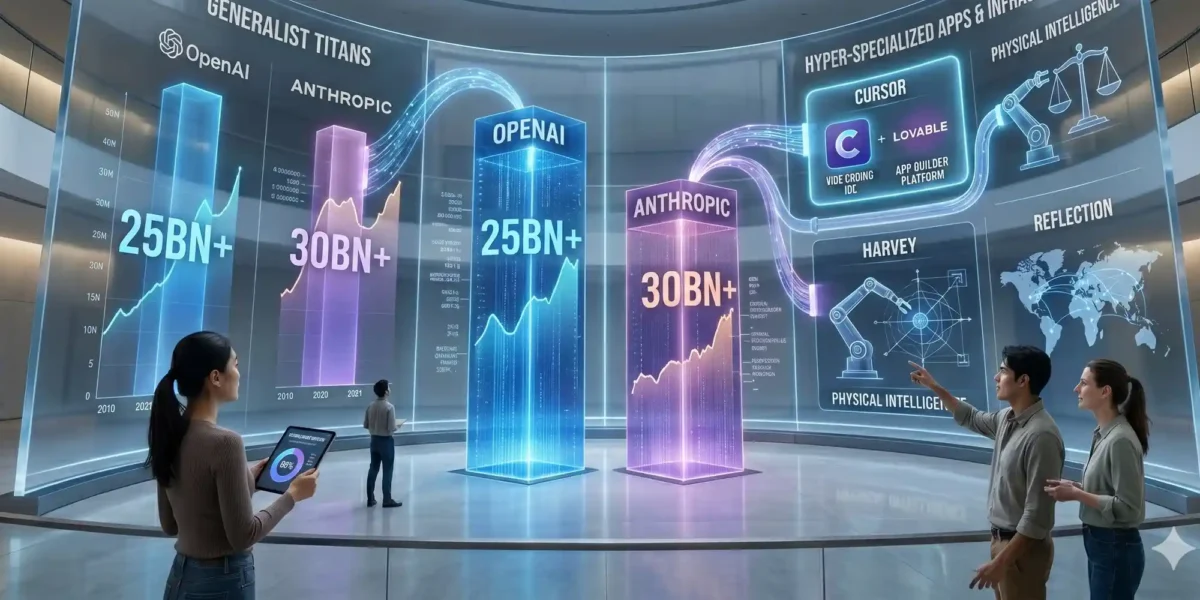
This capital has translated into staggering revenue: by early 2026, OpenAI reportedly surpassed $25 billion in annualized revenue, while Anthropic announced a run rate crossing $30 billion.
But how do these behemoths compare in daily use?
Efficient App’s hands-on testing provides a practical breakdown. ChatGPT (powered by GPT-4o) remains the best overall AI chat app for fast, all-purpose brainstorming and logic-based tasks. Its custom GPTs, built-in code interpreter, and flawless voice mode make it an indispensable daily driver.
However, Claude (by Anthropic) has secured the crown for deep reasoning and context-heavy execution. Both Efficient App and Gumloop emphasize Claude’s superiority in handling large documents and long-context reasoning without losing the plot.
Gumloop specifically points to Claude Code and Claude Cowork. Claude Cowork acts as a local desktop agent, interacting with your local files to build internal tools. By leveraging “Skills” and Projects, Claude retains highly specific writing briefs and brand voices in a way that feels organic and deeply integrated, rather than requiring endless prompt engineering.
Hyper-Specialized Productivity Apps: The Unsung Heroes
While the massive LLMs take the headlines, the daily grind is being streamlined by hyper-focused AI applications that solve one problem flawlessly. Efficient App’s rigorous ranking of the 11 best AI tools in 2026 highlights several apps that have mastered the user experience.
Granola: The Botless Meeting Notetaker
Meeting bots have become a corporate nuisance, awkwardly joining Zoom calls and occasionally getting kicked out by hosts. Efficient App champions Granola, an AI note-taker that runs in the background of your Mac without requiring a bot to join the call. It transcribes audio locally and uses AI to organize notes, allowing users to query the transcript mid-conversation. It’s a prime example of AI fading into the background to enhance, rather than interrupt, human connection.
Wispr Flow: Flawless Voice Dictation
Traditional dictation has always been frustrating, plagued by transcription errors. Wispr Flow uses advanced AI to capture spoken word perfectly, formatting it intelligently for Slack, email, or documents. As Efficient App notes, speaking a paragraph is fundamentally faster than typing one, and 2026 is the year dictation finally became reliable enough to change daily workflows.
Superhuman Mail: The AI Email Assistant
For those handling high-volume correspondence, Superhuman Mail remains the gold standard. Going beyond mere drafting, it utilizes AI to auto-label and triage inboxes, and proactively queues up follow-up emails in your exact brand tone when a recipient hasn’t replied.
The Developer Revolution: “Vibe Coding” and AI IDEs
Perhaps the most disruptive sector in the 2026 AI landscape is software engineering. We have entered the era of “vibe coding”—a term popularized for building applications using natural language rather than writing syntax.
Cursor is the undisputed heavyweight in this arena. As highlighted by both the Forbes AI 50 list (valuing Cursor at an astounding $29.3 billion) and Gumloop’s platform review, Cursor is an AI-powered IDE that allows developers to write, refactor, and debug code at lightning speed.
For non-developers, tools like Lovable are bridging the gap. Lovable allows users to describe an application in plain English, generating a working prototype connected to databases like Supabase in real-time. While it won’t replace senior engineers for complex enterprise architecture, it allows product managers and founders to ship functional MVPs in hours instead of months.
Enterprise Scaling and Geopolitics: Following the Forbes Data
When evaluating how to choose the right AI tools for business growth, it’s vital to look at where the smart money is moving. The Forbes 2026 AI 50 list paints a picture of massive infrastructure build-outs and shifting geopolitical tides.
Reflection, a two-year-old startup based in Brooklyn, recently debuted on the list with an $8 billion valuation. Backed by Nvidia and Sequoia, Reflection is building open-source AI models explicitly to rival Chinese giants like DeepSeek. With the U.S. government pushing for domestic open-source alternatives, Reflection is spending billions on data centers to create bespoke AI for international corporate clients.
Another fascinating new data point from Forbes is the pivot toward the physical world. Physical Intelligence has raised $1 billion to train foundational models for robotics. By collecting data from human teleoperators, they are teaching AI to navigate chaotic, real-world environments like kitchens. This signals that the next frontier of AI platforms won’t just live in our browsers—they will operate our physical supply chains.
Meanwhile, specialized industry applications are proving incredibly lucrative. Harvey, a legal automation software, has reached a $1 billion valuation, while Abridge is transforming doctor-patient interactions with an $830 million war chest.
How to Choose the Right AI Tools for Business
With this avalanche of technology, how do modern teams decide what to adopt? If you are searching for the best AI software for small business operations, or exploring long-tail queries like “how to implement AI agent workflows in marketing,” my expert advice comes down to three core pillars:
- Audit Your Repetitive Tasks, Not Your Tech Stack: Do not buy an AI platform just because it has a high valuation. Look at the tasks that drain your team’s energy. If you spend hours researching, invest in Perplexity (an AI search engine highlighted by Lindy.ai for its fact-checked, real-time citations). If you are drowning in SEO formatting, look at Clearscope.
- Prioritize Interoperability over Features: The true value of 2026’s AI is composability. A tool like Notion AI is powerful precisely because it exists where your team already works. When choosing automation software, look for platforms like Lindy or Gumloop that offer native API connections to your existing CRM.
- Guard Your Brand Voice: As AI content becomes ubiquitous, sounding like a robot is a liability. Tools like Jasper (for enterprise marketing) and Originality AI (for AI detection and fact-checking, as noted by Gumloop) are essential guardrails to ensure your output remains authentic and strategically sound.
Conclusion
The best AI apps and platforms in 2026 are categorized by a stark division: the multi-billion-dollar foundational models doing the heavy lifting in the cloud, and the hyper-specific, beautifully designed applications bringing that intelligence to our desktops.
Whether you are “vibe coding” an app with Lovable, utilizing Claude Cowork to analyze financial data, or deploying Lindy agents to automate your sales pipeline, the mandate is clear. AI is no longer a novelty to experiment with; it is the fundamental fabric of the modern workforce. The companies that learn to wield these platforms effectively won’t just save time—they will outmaneuver their competition entirely.
Leo Falsafi is a digital marketing veteran and senior journalist at Virlan.co, where he covers the intersection of digital marketing, gaming, and breaking US trending news. With nearly two decades of hands-on experience in SEO and digital strategy, Leo has consulted for and scaled hundreds of companies. His deep industry roots allow him to deliver sharp, fact-checked insights and analysis on the trends shaping today's digital landscape.