
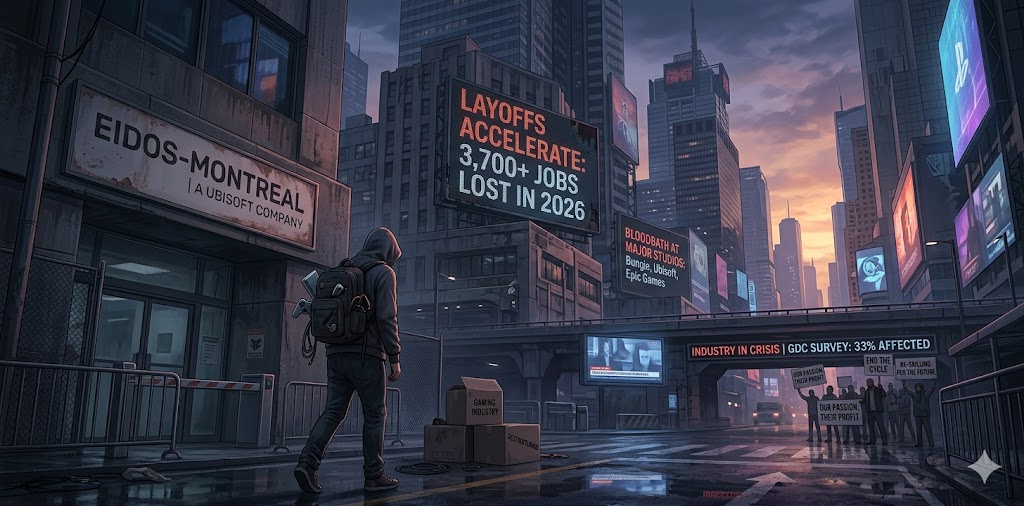
If you’ve been paying attention to the video game industry recently, you’ve likely noticed a grim and recurring theme: layoffs. And not just a few trimmings around the edges—we are talking about entire studios shuttering and thousands of developers being handed pink slips.
Despite gaming being one of the largest and most lucrative entertainment sectors on the planet, the industry is currently undergoing what insiders are calling a brutal “correction phase.”
But why is an industry that makes billions bleeding so much talent? Let’s dive into the data, the root causes, and the dark rumors of what’s still to come.
The Staggering Numbers Behind the Cuts
According to recent industry data, the layoff crisis is continuing unabated into 2026. As of mid-2026, over 3,700 verified job losses have already been recorded globally, with unverified cuts and quiet closures pushing that number well past 4,000.
This isn’t an isolated year. The bloodletting began in 2022, peaked in early 2024, and has resulted in an estimated 45,000 jobs lost between 2022 and mid-2025. According to recent GDC surveys, a staggering 33% of American video game industry workers reported being laid off at some point during the last two years.
The United States remains the epicenter of this crisis, accounting for over 58% of the global total in 2026. Massive reductions have hit major players: Epic Games laid off roughly 1,000 employees, while Bungie—the legendary studio behind Halo and Destiny—announced plans to cut about 400 people this summer. The pain is global, too. France’s Ubisoft has seen around 680 layoffs across multiple studios as part of sweeping restructurings, and Canada has recorded hundreds of cuts, heavily impacting developers like Eidos-Montreal.
Why is This Happening?
It’s tempting to point a finger at a single villain, but the reality is a “perfect storm” of economic, structural, and strategic failures:
1. The Post-Pandemic Hangover & Over-Expansion
During the COVID-19 lockdowns, gaming saw an unprecedented financial boom. Publishers aggressively acquired studios and bloated their headcounts, assuming the hyper-growth would last forever. As player engagement normalized and returned to pre-pandemic levels, these massive publishers found themselves dangerously overextended.
2. Ballooning AAA Budgets
The cost of making a blockbuster AAA game has spiraled out of control. Games now take 5 to 7 years to develop, often costing hundreds of millions of dollars. If a game fails to meet astronomical sales expectations upon release, the studio is immediately placed in financial jeopardy.
3. The Geography of Development
Many major studios are based in prohibitively expensive tech hubs like San Francisco, Los Angeles, and London. Sustaining a massive workforce in cities with skyrocketing costs of living is proving financially unviable for many publishers during an economic crunch.
4. The Live-Service and Subscription Squeeze
The industry pivot toward live-service games and subscription models (like Xbox Game Pass) has fundamentally altered consumer spending. Gamers are playing fewer, older games for longer periods. If a newly launched live-service title doesn’t instantly hook a massive audience, it dies quickly, often taking the development studio down with it.
The Looming 2026 “Bloodbath”
If you thought the worst was over, industry insiders warn that you should brace yourself. The summer of 2026 is reportedly shaping up to be utter carnage for established developers.
French journalist Sylvain Trinel recently sparked panic across the industry by warning of an imminent “bloodbath” for studios owned by mega-publishers like Sony and Microsoft. Following the controversial closures of beloved Xbox studios earlier in the decade, rumors are now swirling around heavyweights like BioWare, Bethesda, and id Software. Trinel also highlighted that major independent European studios like Don’t Nod and Quantic Dream are facing serious financial hurdles and production woes.
What Does This Mean for Gamers?
In the short term, expect a contraction. We will likely see fewer massive, risk-taking AAA games, as publishers retreat to the safety of established franchises, remasters, and guaranteed bets.
However, there is a silver lining. As thousands of highly talented developers leave the monolithic corporate structures of EA, Microsoft, and Sony, we may be on the verge of an incredible indie renaissance. Unbound by corporate red tape and impossible sales targets, these laid-off creators might just band together to build the next generation of innovative, boundary-pushing games.
The industry isn’t dying, but it is brutally shedding its old skin.
Source Report: This article was synthesized from data published by ETHRWorld (on 2026 job loss statistics), Udonis Blog by Andrea Knezovic (tracking historical layoff trends), and Push Square by Robert Ramsey (citing journalist Sylvain Trinel’s warnings of an impending industry “bloodbath”).
Leo Falsafi is a digital marketing veteran and senior journalist at Virlan.co, where he covers the intersection of digital marketing, gaming, and breaking US trending news. With nearly two decades of hands-on experience in SEO and digital strategy, Leo has consulted for and scaled hundreds of companies. His deep industry roots allow him to deliver sharp, fact-checked insights and analysis on the trends shaping today's digital landscape.