
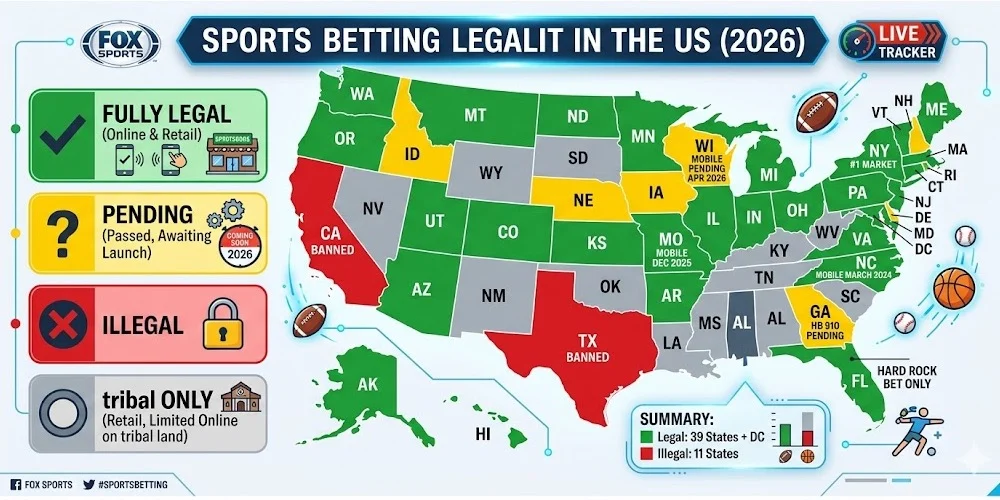
The US sports betting landscape has transformed significantly since the Supreme Court overturned the Professional and Amateur Sports Protection Act (PASPA) in May 2018. Fast forward to 2026, and the vast majority of the country has embraced legalized wagering.
Currently, sports betting is legally operational in 39 states and Washington, D.C. Within these jurisdictions, 30 states offer legal online sports betting through licensed sportsbook apps. The remaining legal states either limit betting to in-person retail sportsbooks, operate under tribal-only markets, or restrict wagering geographically.
Here is a breakdown of the legal landscape for US sports betting in 2026.
States Where Sports Betting is Legal
The map of legal sports betting is expansive, featuring a mix of full mobile access, retail-only locations, and tribal gaming compacts.
States with fully legal, robust online and retail betting include major markets like New York, New Jersey, Ohio, Pennsylvania, Illinois, and Michigan. Recent additions to the legal landscape include Missouri, which officially launched in December 2025 following voter approval, and North Carolina, which rolled out legal mobile betting in March 2024.
Several states have opted for an online-only approach, meaning there are no brick-and-mortar sportsbooks. This includes Maine, New Hampshire, Tennessee, Vermont, and Wyoming. Conversely, places like Montana, Nebraska, North Dakota, South Dakota, and Mississippi rely heavily or entirely on retail betting locations.
Florida remains a unique market, offering statewide online betting, but it is limited exclusively to the Hard Rock Bet platform due to legal compacts. Washington state and New Mexico have legalized betting, but strictly on tribal lands. Wisconsin has also officially legalized online betting as of April 2026, though its launch is currently pending.
States Where Sports Betting Remains Illegal
While the green wave of legalization has swept the nation, 11 states remain steadfast holdouts where sports betting is completely prohibited:
- Alabama
- Alaska
- California
- Georgia
- Hawaii
- Idaho
- Minnesota
- Oklahoma
- South Carolina
- Texas
- Utah
Among these, Utah and Hawaii hold the strictest anti-gambling stances in their constitutions, making future legalization highly unlikely. California, the largest untapped market in the country, saw two ballot measures fail spectacularly in 2022, and complex tribal gaming disputes continue to halt any near-term progress.
Which States Could Legalize Next?
The push for legalization hasn’t stopped, and several of the remaining illegal states have active legislation pending or in the works for the near future:
- Georgia: A 2026 bill (HB 910) aims to legalize mobile betting under the state lottery, bypassing the need for a complex constitutional amendment.
- Minnesota: While legislation exists and there is legislative support, ongoing disputes between tribal gaming interests and racetrack operators have stalled the launch.
- Texas: After a House bill passed for the first time in 2023, lawmakers are eyeing current sessions as their next realistic opportunity for legalization.
- South Carolina: A Senate committee hearing in early 2026 signaled notable progress for a state that has historically opposed sports gambling.
- Alabama: A 2026 constitutional amendment proposal could finally let voters decide the fate of sports betting at the ballot box if it gains enough legislative support.
As the US market continues to mature in 2026, the lines between legal and illegal jurisdictions are constantly shifting. Bettors should always check their local state regulations before attempting to place a wager.
Leo Falsafi is a digital marketing veteran and senior journalist at Virlan.co, where he covers the intersection of digital marketing, gaming, and breaking US trending news. With nearly two decades of hands-on experience in SEO and digital strategy, Leo has consulted for and scaled hundreds of companies. His deep industry roots allow him to deliver sharp, fact-checked insights and analysis on the trends shaping today's digital landscape.