
The July 16, 2026 showdown between Sentinels and Cloud9 in the VCT Americas arena was more than a battle for server dominance. It was a stress test for a rapidly maturing financial ecosystem.
Prediction markets are aggressively carving out territory traditionally held by legacy sportsbooks. The Sentinels-Cloud9 matchup sits at the exact intersection of competitive Valorant and blockchain-native wagering. Bettors are no longer just fans. They are active market participants.
The VCT Americas ‘Group of Death’
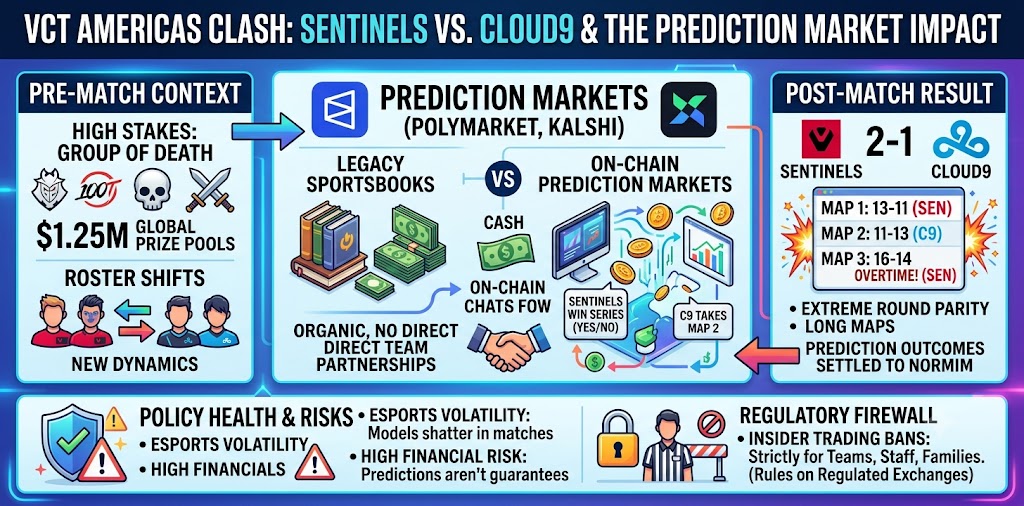
For context, this was never a standard regular-season match. Group Omega—widely dubbed the “Group of Death”—forced Sentinels, Cloud9, G2 Esports, and 100 Thieves into a logistical bloodbath. Every single map heavily dictated playoff positioning for the wider competitive circuit, which culminates in massive $1.25 million global prize pools.
According to Crypto Briefing, a prominent digital asset analytics outlet, prediction platforms saw massive volume precisely because the stakes were existentially high. Both Sentinels and Cloud9 underwent routine roster changes heading into VCT Americas Stage 2. These shifts fundamentally reshaped team dynamics. In turn, they heavily influenced the opening betting lines.
Breaking Down the Kalshi and Polymarket Action
Bettors on platforms like Polymarket and Kalshi didn’t just wager on the overall series outcome. They fragmented their positions.
Users bought algorithmic shares on hyper-specific outcomes. While “Sentinels win series” served as the primary market, secondary contracts like “Cloud9 takes Map 2” drove massive engagement. The mechanics are brutally simple. Users purchase outcome shares. If the prediction lands, the contract pays out, with transactions settling entirely on-chain.
Interestingly, this market activity is completely organic. Neither Sentinels nor Cloud9 holds any direct digital asset partnerships, token sponsorships, or NFT tie-ins for this specific event. The crypto influence here is entirely market-driven, not marketing-driven.
Post-Match Reality: Sentinels Take the 2-1 Victory
Predictions are only as reliable as the final scoreboard. The regulated Kalshi market officially resolved to a “Yes” payout for Sentinels backers following a grueling best-of-three series.
Sentinels secured a 2-1 victory over Cloud9. The match pushed both rosters to their absolute limits. Extracted match data reveals map completion times stretching from 39 to 67 minutes, featuring extreme round parity. Maps pushed to razor-thin 13-11 margins and culminated in a massive 16-14 overtime finish. This brutal back-and-forth highlights the inherent volatility of forecasting esports. Pre-match analytical modeling frequently shatters upon contact with actual server reality.
Policy Health: Navigating Esports Prediction Markets
Forecasting competitive gaming involves acute financial risk. Market odds reflect public sentiment and trading volume. They are never guaranteed outcomes.
The extreme parity seen in the Sentinels vs. Cloud9 match proves why prediction markets must be approached strictly as data analysis rather than secure financial planning. To maintain market integrity, regulated exchanges like Kalshi enforce strict compliance rules. They explicitly prohibit league staff, coaches, players, team owners, and immediate family members from trading these contracts. This regulatory firewall ensures that betting lines remain a pure reflection of external forecasting rather than insider manipulation.
Sources Quoted:
- Crypto Briefing: Digital asset and blockchain analytics outlet (Provided market volume context, Polymarket mechanics, and VCT Group Omega details).
- Kalshi: Regulated financial exchange platform (Provided verified VCT Americas Stage 2 match outcomes, round statistics, and insider-trading compliance data).
Leo Falsafi is a digital marketing veteran and senior journalist at Virlan.co, where he covers the intersection of digital marketing, gaming, and breaking US trending news. With nearly two decades of hands-on experience in SEO and digital strategy, Leo has consulted for and scaled hundreds of companies. His deep industry roots allow him to deliver sharp, fact-checked insights and analysis on the trends shaping today's digital landscape.