
A Unanimous Decision: Nevada Gaming Regulators Defeat Kalshi
On Friday, August 28, 2026, the U.S. Court of Appeals for the Ninth Circuit delivered a severe blow to the prediction market operator Kalshi, affirming a lower court’s decision to dissolve a temporary injunction. In a unanimous 3-0 ruling by a three-judge panel, the federal appeals court cleared the way for the Nevada Gaming Control Board to rigorously enforce its state gambling laws against the unlicensed prediction market.
The legal battle stems from March 2025, when the Nevada Gaming Control Board issued a cease-and-desist letter to Kalshi. The regulator demanded the company halt its election and sports event contracts in the state, threatening criminal and civil charges. Kalshi immediately sued, seeking a preliminary injunction to prevent Nevada from regulating its trading platform. While U.S. District Judge Andrew Gordon initially granted the injunction, he later dissolved it—a decision the Ninth Circuit has now definitively upheld, concluding that Judge Gordon did not abuse his discretion.
“Prediction markets offering sports-event contracts constitute gambling and must comply with Nevada’s gaming laws and regulatory framework,” stated Nevada Gov. Joe Lombardo (R) in a statement released by the control board following the decision.
Swaps vs. Sports Gambling: The CEA Jurisdiction Battle
At the heart of the dispute was a complex question of federal versus state jurisdiction, turning on whether Kalshi’s sports event contracts qualify as federally shielded financial instruments. Kalshi, which characterizes itself as a “designated contract market” (DCM), argued that its contracts are legal “swaps” governed by the Commodity Exchange Act (CEA). Under this overly broad reading, Kalshi claimed the Commodity Futures Trading Commission (CFTC) holds exclusive jurisdiction, thereby preempting state gaming regulations.
The Ninth Circuit vehemently disagreed. According to the panel’s August 28 opinion, Kalshi’s sports event contracts are not swaps under the CEA.
Writing for the panel, Judge Ryan D. Nelson dismantled Kalshi’s core defense: “The substance of the sports event contracts offered on Kalshi’s DCM is sports gambling, regardless of whether Kalshi calls them swaps”. The court also highlighted that Kalshi’s own marketing copy previously advertised the platform as “the first app for legal sports betting in all 50 states”.
Washington, D.C., attorney Nicole Saharsky, who represented the Nevada gaming regulators during oral arguments in San Francisco, asserted that allowing the contracts to bypass state law would constitute “a severe intrusion on state sovereignty”.
Control Board Chairman Mike Dreitzer echoed this sentiment, stating the court’s ruling “vindicates” that sports betting “needs to be properly regulated by the state,” a duty Nevada has performed for over 70 years. “We will continue to vigorously enforce Nevada law to safeguard gaming in our state,” Dreitzer added.
The Circuit Split: Why the Supreme Court Must Step In
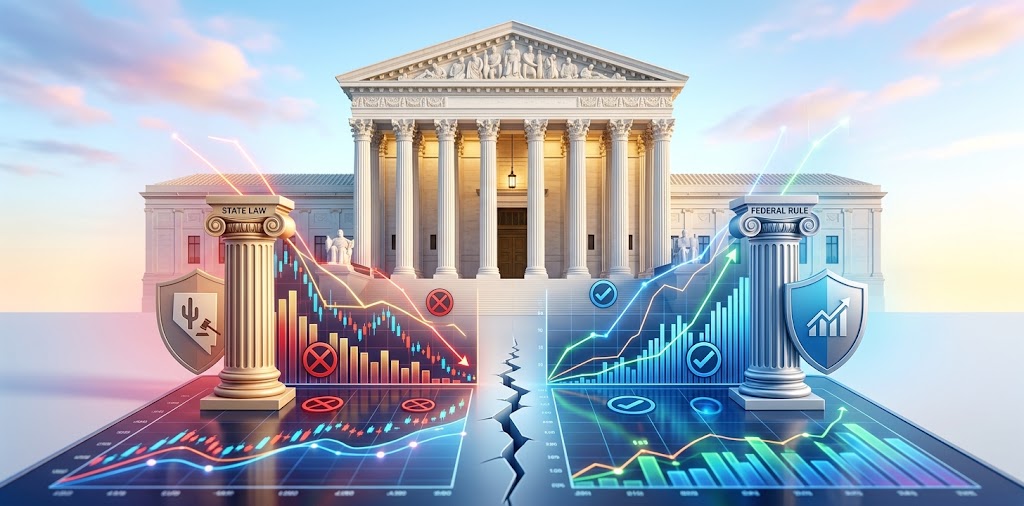
The Ninth Circuit’s ruling has massive commercial and regulatory stakes, as it actively fractures the national legal landscape regarding prediction markets. Kalshi now faces strict state gaming enforcement in Nevada, while identical products remain federally shielded in New Jersey.
This is because the Ninth Circuit reached the exact opposite preliminary conclusion from the Third Circuit Court of Appeals. In April 2026, the Philadelphia-based Third Circuit backed Kalshi’s position, establishing a legal precedent that federal law prevents states from regulating trading on federally licensed exchanges.
With two federal appellate courts completely divided on whether the CEA preempts state regulation, legal experts and industry analysts believe the U.S. Supreme Court will ultimately be forced to decide the fate of prediction markets.
Zach Fulton, a spokesman for the CFTC, told the New York Times that the Ninth Circuit “erred” in its decision. “The Ninth Circuit has now teed up a circuit split that calls out for resolution by the Supreme Court,” Fulton declared. Kalshi spokeswoman Dani Lever confirmed that the company intends to seek further legal review.
Future Impacts and The Election Contract Gray Area
While the ruling is a devastating blow to Kalshi’s sports betting aspirations in the West, it was a massive victory for traditional gaming advocates. American Gaming Association CEO Bill Miller celebrated the decision as “a significant win for consumer protections and taxpayers,” labeling it a “big loss for Kalshi and other backdoor sports gambling operations who defy state laws”.
However, one major question remains unresolved: political election markets. While the panel affirmed the dissolution of the injunction regarding sports event contracts, the Ninth Circuit remanded the case back to the district court to specifically consider Nevada’s challenges to Kalshi’s election contracts. As prediction markets continue to surge in popularity, the ultimate legality of trading on state and federal elections remains in the balance, awaiting further judicial scrutiny—and likely, a final showdown at the Supreme Court.
Sources: Sports Betting Dime, The Block, The Defiant, The Nevada Independent, and Mashable.
Max Newman is Deputy Editor and Data Strategy at Virlan.