
The rapid expansion of legalized sports betting and online casinos has brought the reality of problem gambling from the shadows into the mainstream. It is an unseen epidemic. According to the World Health Organization, an estimated 1.2% of the global population faces gambling disorder. In the United States alone, the National Council on Problem Gambling (NCPG) estimates that 2.5 million adults—roughly 1% of the population—meet the criteria for a severe gambling problem in any given year, with another 5 to 8 million experiencing mild to moderate gambling-related issues.
Yet, despite the staggering $14 billion annual national social cost attributed to problem gambling in the U.S., a critical question remains for those impacted: What exactly does recovery look like? Treating a gambling addiction requires a multi-layered approach. It demands addressing the neurological, behavioral, and financial wreckage left in the addiction’s wake. Because gambling fundamentally alters how the brain’s reward system functions—creating tolerance, withdrawal, and intense cravings similar to a substance use disorder—clinical intervention is often a necessity.
What are the most effective gambling addiction treatment options?
Gambling addiction treatment is a highly structured clinical process designed to help individuals manage their urges, restructure distorted thought patterns, and rebuild their financial and relational health. Because no single approach works for everyone, treatment is fundamentally highly individualized.
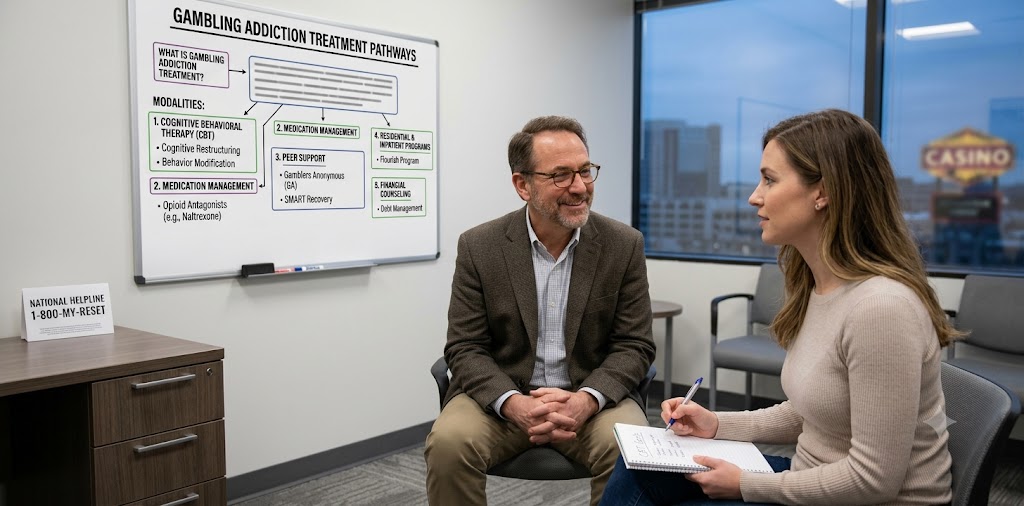
Based on clinical consensus from addiction health institutes and mental health professionals, the core modalities of gambling addiction treatment include:
- Cognitive-Behavioral Therapy (CBT): Widely considered the gold standard and the most common method for tackling gambling addiction. CBT focuses on redirecting misguided thinking and challenging the distorted thought patterns that fuel the addiction. By teaching patients to solve problems without gambling, CBT successfully reduces depression, lowers anxiety, and decreases the amount of money spent on betting.
- Medication Management: While there is no specific “cure-all” pill for gambling disorder, certain medications effectively manage the symptoms. Opioid receptor antagonists—such as Naltrexone and Nalmefene—work by blocking the brain’s pleasure receptors, which decreases the urge to gamble by making the act less enjoyable. Antidepressants and mood stabilizers are also heavily utilized to treat co-occurring mental health conditions like depression and impulse control disorders.
- Motivational Interviewing (MI): This specialized therapeutic technique helps individuals explore their motivations and goals related to quitting. It is designed to increase intrinsic motivation and promote behavioral change without pressure or judgment.
- Peer Support and Coaching: Group-based accountability is a vital component of long-term recovery. Organizations like Gamblers Anonymous (GA), which follows a 12-step program similar to Alcoholics Anonymous, and SMART Recovery provide community support. Furthermore, modern approaches now include specialized apps like GamStop and Gamban to digitally block access to betting sites.
- Financial Management and Debt Counseling: Because financial devastation is the most acute symptom of gambling addiction, recovery intrinsically requires financial rehabilitation. Debt counseling helps individuals regain control over their finances, implement strict budgeting, and establish healthier financial habits.
A Systemic Shift: Funding the Future of Treatment
The severity of the issue has recently prompted legislative action. On January 11, 2024, U.S. Senator Richard Blumenthal and Representative Andrea Salinas introduced the Gambling Addiction Recovery, Investment, and Treatment (GRIT) Act.
If passed, this landmark legislation would establish the first-ever federal funding stream dedicated to preventing, treating, and researching gambling addiction. The GRIT Act proposes setting aside 50% of the federal sports excise tax revenue—funneling 75% of those funds to states for prevention and treatment through the Substance Abuse Prevention and Treatment Block Grant, and 25% to the National Institute on Drug Abuse for dedicated research.
How do inpatient and outpatient programs differ for gambling disorder?
When choosing a recovery pathway, understanding the varying levels of care is critical to ensuring long-term success.
- Outpatient Treatment Programs: These allow individuals to live at home and manage daily responsibilities while attending scheduled counseling sessions. For more severe needs, Intensive Outpatient Programs (IOP) provide 9 or more hours of structured clinical programming per week.
- Residential Treatment: Delivered in non-hospital, community-based settings (such as the Flourish program by the Priory Group), residential care removes individuals from their daily pressures and gambling triggers. It focuses on immersive therapy, practicing everyday coping skills, and sometimes even incorporates virtual reality (VR) exposure therapy.
- Inpatient Treatment Programs: Reserved for severe cases requiring medical stabilization and psychiatric supervision. Inpatient care takes place in a hospital setting and provides 24/7 integrated care to protect the individual from imminent financial or psychological self-harm.
Help is immediately accessible for those trapped in the cycle. By calling, texting, or chatting with the National Problem Gambling Helpline at 1-800-MY-RESET, individuals can connect directly with localized treatment resources and take the first critical step toward reclaiming their lives.
Sources Quoted:
- National Council on Problem Gambling (NCPG): Sourced for statistics on U.S. gambling prevalence (2.5 million severe cases), the $14 billion annual social cost, and the 1-800-MY-RESET helpline.
- Prevention Technology Transfer Center (PTTC) Network: Sourced for legislative data regarding the 2024 GRIT Act introduced by Sen. Richard Blumenthal and Rep. Andrea Salinas.
- Cleveland Clinic: Sourced for the World Health Organization (WHO) estimate of a 1.2% global gambling disorder prevalence and diagnostic symptomology.
- Priory Group: Sourced for information on holistic treatment approaches, residential care models (Flourish), and blocking apps (GamStop/Gamban).
- J. Flowers Health Institute: Sourced for clinical data on Opioid Receptor Antagonists (Naltrexone/Nalmefene) and the efficacy of Cognitive-Behavioral Therapy (CBT).
- LifeStance Health / Addiction Center: Sourced for treatment modalities including Motivational Interviewing, SMART Recovery, and the necessity of financial debt counseling.
Leo Falsafi is a digital marketing veteran and senior journalist at Virlan.co, where he covers the intersection of digital marketing, gaming, and breaking US trending news. With nearly two decades of hands-on experience in SEO and digital strategy, Leo has consulted for and scaled hundreds of companies. His deep industry roots allow him to deliver sharp, fact-checked insights and analysis on the trends shaping today's digital landscape.