
Austria is officially dismantling one of Europe’s last state-backed digital casino monopolies. Following months of legislative drafts and industry speculation, the ruling coalition government—comprising the Austrian People’s Party (ÖVP), Social Democratic Party (SPÖ), and NEOS—has established a hard timeline for regulatory overhaul.
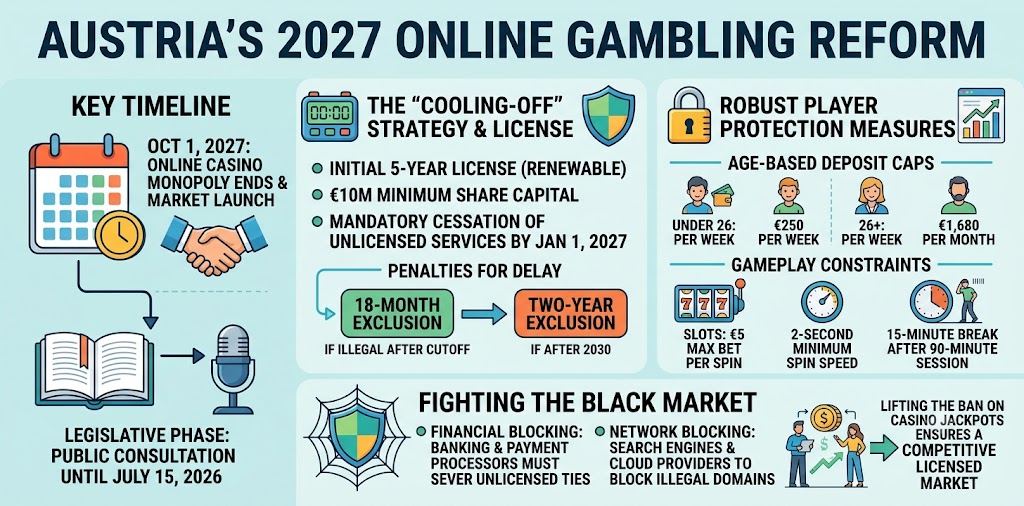
October 1, 2027, marks the finish line. On this date, the 15-year exclusive license held by Casinos Austria’s digital arm, Win2Day, will expire. In its place, Austria will launch a highly regulated, multi-operator iGaming market.
But the transition is not a free-for-all. The government’s legislative draft, currently navigating a public consultation phase until July 15, 2026, reveals a complex balancing act. Regulators are attempting to open the market to private enterprise while simultaneously enforcing some of the strictest responsible gaming protocols in the European Union.
The Cost of Compliance and the “Cooling-Off” Strategy
For international operators eyeing the Austrian market, the barrier to entry will be exceptionally steep.
To qualify for an initial five-year license (renewable for up to 10 years), operators must hold a minimum paid-up share capital of €10 million and maintain functional anti-money laundering compliance systems. The immediate hurdle for established “grey market” brands, however, is a mandatory cessation of existing operations.
Under the proposed rules, any applicant must cease offering unlicensed services to Austrian players by January 1, 2027. This creates an enforced temporary blackout. Companies that ignore this deadline and continue operating illegally beyond the January cutoff will face an automatic 18-month exclusion from the licensing process. For brands that defy the regulations into 2030, the penalty jumps to a two-year exclusion.
This tactic closely mirrors the regulatory strategy deployed by the Netherlands in 2021, forcing a period where established offshore brands drop out of the market entirely to sanitize their regulatory standing. During this gap, operators are also expected to clear up legacy tax liabilities and finalize pending player reimbursement claims—a sum industry insiders estimate reaches into the millions of euros.
Andreas Ottenschläger, the ÖVP finance spokesperson, views this strict transition as a necessary economic pivot. “Opening up the online market ends outdated monopoly structures, creates new investment incentives, and strengthens Austria as a business location,” Ottenschläger stated, adding that the framework achieves “the right balance between effective player protection and a legally secure, functioning market.”
Structuring Player Protection and Deposit Limits
Austria’s regulatory framework heavily prioritizes harm reduction and addiction prevention. The new legislation imposes rigorous financial and behavioral limits on the consumer level, shifting the focus away from unrestricted access toward controlled spending.
Regulators have introduced age-tiered statutory deposit caps. Players under the age of 26 will be restricted to maximum weekly deposits of €250. For players aged 26 and above, the threshold increases to €1,680 per month.
Digital slot machines, identified by health authorities as having a high prevalence of addiction, will face aggressive operational constraints. The maximum betting limit per spin will be halved to €5, and the game speed will be throttled to a minimum of two seconds per spin.
To forcefully disrupt extended gambling sessions, the law mandates an automatic 15-minute break after 90 minutes of continuous play. During these required intervals, players will be shown educational video content explicitly detailing the financial and psychological risks of gambling.
Aggressive Black Market Blocking Mechanisms
The central vulnerability of any regulated transition is the black market. If the licensed market becomes too restrictive, offshore operators simply absorb the player base.
To counteract this, the Austrian government is deploying an aggressive technological dragnet. The coalition plans to legally obligate banks and international financial processors, including Visa and PayPal, to block IBANs and sever business relationships with unlicensed operators.
Simultaneously, the state intends to enforce network-level blocking. Authorities will collaborate with search engines and major international cloud infrastructure providers like Amazon Web Services (AWS) and Cloudflare to render illegal gambling domains inaccessible within Austrian borders.
In a subtle regulatory concession designed to keep the newly regulated market competitive against offshore alternatives, the existing national ban on casino jackpots will actually be lifted. The government noted this specific measure is intended to ensure an “attractive legal gambling market” and directly “counteract the migration to the black market.”
Sources Quoted:
Data and quotes were extracted from June 2026 coverage by Gaming Intelligence, iGamingToday, CDC Gaming Reports, and legal analysis by DLA Piper. Key entities quoted include Andreas Ottenschläger (ÖVP finance spokesperson) and the Austrian ruling coalition government statements.
Leo Falsafi is a digital marketing veteran and senior journalist at Virlan.co, where he covers the intersection of digital marketing, gaming, and breaking US trending news. With nearly two decades of hands-on experience in SEO and digital strategy, Leo has consulted for and scaled hundreds of companies. His deep industry roots allow him to deliver sharp, fact-checked insights and analysis on the trends shaping today's digital landscape.