
Behind the Handshake: A Strategic Defense in Nairobi
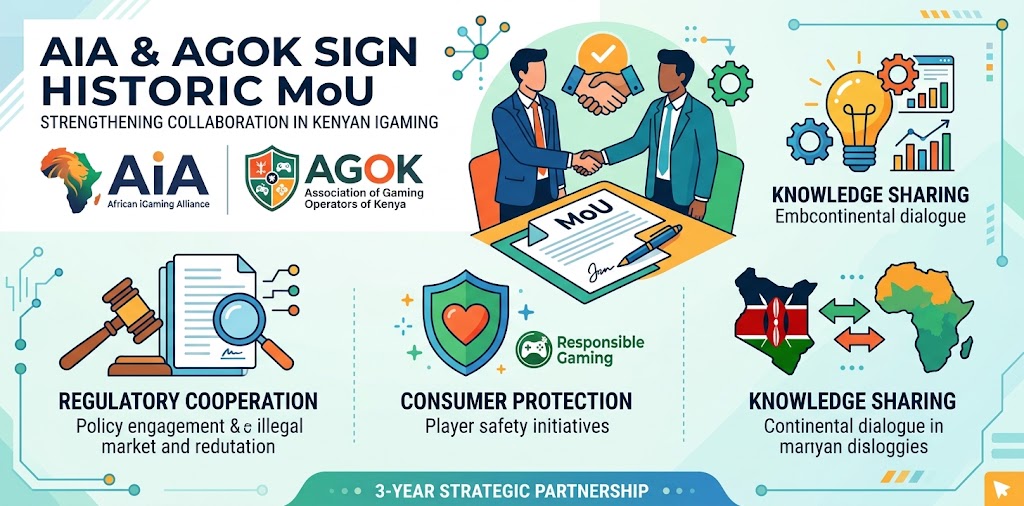
Nairobi, Kenya — Beneath the surface of standard corporate press releases, a high-stakes alignment is taking shape in East Africa. On August 20, 2026, the African iGaming Alliance (AiA) and the Association of Gaming Operators of Kenya (AGOK) signed a landmark three-year Memorandum of Understanding (MoU).
Signed by AiA CEO Emolemo Peter Kesitilwe—a regulatory veteran and former CEO of the Gambling Authority of Botswana—and AGOK Chief Executive Officer John Mutua, the pact officially focuses on collaboration, regulatory engagement, and consumer protection. However, an investigative look into the timing of this MoU reveals a strategic defensive maneuver. Kenya’s regulated operators are actively consolidating power to combat a volatile legal environment and a massive underground economy.
The Financial Stakes: Battling a $2 Billion Shadow Market
To understand the weight of this MoU, you have to follow the money. The African iGaming Alliance (AiA) serves as the primary trade association for licensed betting and gaming operators across the continent.Their members are heavyweight economic contributors, generating over $500 million USD in annual tax revenues and sustaining more than 5,000 jobs across Africa.
Yet, these regulated entities are fighting a losing battle against the black market. According to H2GC data cited by the AiA, Africa hemorrhages nearly $2 billion USD in tax revenues annually due to unregulated gaming and betting, with billions in Gross Gaming Revenue (GGR) leaking out of the continent entirely.Millions of players are left utilizing illicit sites without any consumer protection mechanisms.
Locally, AGOK has championed responsible gaming since its incorporation in 2005. The trade body has successfully spearheaded player safety campaigns and advocates heavily on behalf of licensed operators in Kenya. By merging AGOK’s local lobbying power with the AiA’s pan-African influence, licensed operators are building a united front to force governments to crack down on the illegal market rather than financially suffocating compliant businesses.
The Real Catalyst: Kenya’s Regulatory Powder Keg
The true catalyst for this alliance is the unprecedented regulatory chaos currently gripping Kenya. In August 2025, the Kenyan government enacted the Gambling Control Act, 2023, entirely dismantling the archaic 1966 Betting, Lotteries and Gaming Act.
The new legislation replaced the Betting Control and Licensing Board (BCLB) with a new enforcer: the Gambling Regulatory Authority of Kenya (GRA). Initially praised for modernizing the industry and addressing online gambling, the reality of the GRA’s new framework triggered an industry-wide crisis.
Under the new regulations, operators faced draconian fee hikes ranging from 200% to an astronomical 49,900%. The application fee for an online bookmaker skyrocketed to KES 5 million, while a three-year operating license was set at KES 50 million. Furthermore, regulators demanded a KES 100 million minimum capital requirement.
The High Court Intervention
This financial squeeze led to an immediate legal showdown. In July 2026, High Court Justice William Musyoka issued a stay order, effectively freezing the licensing sector. The plaintiffs successfully argued that the exorbitant fees bypassed mandatory public participation—a constitutional requirement in Kenya.
While the High Court partially lifted the stay order on August 11, 2026, allowing the GRA to process licenses and conduct Anti-Money Laundering (AML) oversight, the controversial fee structures remain frozen. The industry is currently holding its breath for a final judicial review ruling scheduled for October 2, 2026.
Legal experts predict widespread industry devastation if the fees are upheld. As David Sarinke, a partner at McKay Advocates, recently noted regarding the capital requirements: “There are, I think, more than 150 licensed firms right now. I don’t think even half or even a quarter of that number will meet the capital requirements.”
The 5-Pillar Blueprint for African iGaming
In the shadow of the October ruling, the AiA and AGOK MoU outlines five core pillars designed to stabilize the market and serve as a blueprint for the rest of the continent:
- Regulatory & Public Policy Engagement: Creating a unified lobbying voice to negotiate sustainable taxation and realistic licensing fees with bodies like the GRA.
- Combating Illegal Betting:Prioritizing the eradication of unregulated sites that siphon $2B in tax revenue, ensuring a level playing field for operators who pay their dues.
- Consumer Protection:Expanding initiatives like AGOK’s responsible gaming campaigns to shield players from the predatory practices of offshore, unlicensed platforms.
- Taxation & Payments: Harmonizing cross-border financial regulations and advocating against punitive tax regimes that inadvertently drive consumers to the black market.
- Knowledge Exchange: Utilizing Kenya’s volatile but advanced market as a real-time case study to inform policy in emerging African jurisdictions.
Why Kenya is the Domino That Matters
“Kenya is one of Africa’s most important and dynamic gaming markets, and what happens here increasingly has relevance beyond Kenya’s borders,” noted AiA CEO Emolemo Peter Kesitilwe.
He is exactly right. Kenya’s deep mobile-money penetration (via M-Pesa) and mobile-first consumer base make it the ultimate testing ground for iGaming innovation. Regulators in Nigeria, South Africa, and Ghana are watching the GRA’s legal battles closely.
If Kenya’s exorbitant licensing fees successfully wipe out 75% of its regulated domestic market, other African nations may adopt similar cash-grab legislative tactics. By signing this three-year MoU, the AiA and AGOK are drawing a line in the sand. They are signaling to lawmakers that the path to economic growth lies in protecting compliant operators and targeting the $2 billion shadow market—not taxing the regulated industry out of existence.
Leo Falsafi is a digital marketing veteran and senior journalist at Virlan.co, where he covers the intersection of digital marketing, gaming, and breaking US trending news. With nearly two decades of hands-on experience in SEO and digital strategy, Leo has consulted for and scaled hundreds of companies. His deep industry roots allow him to deliver sharp, fact-checked insights and analysis on the trends shaping today's digital landscape.