
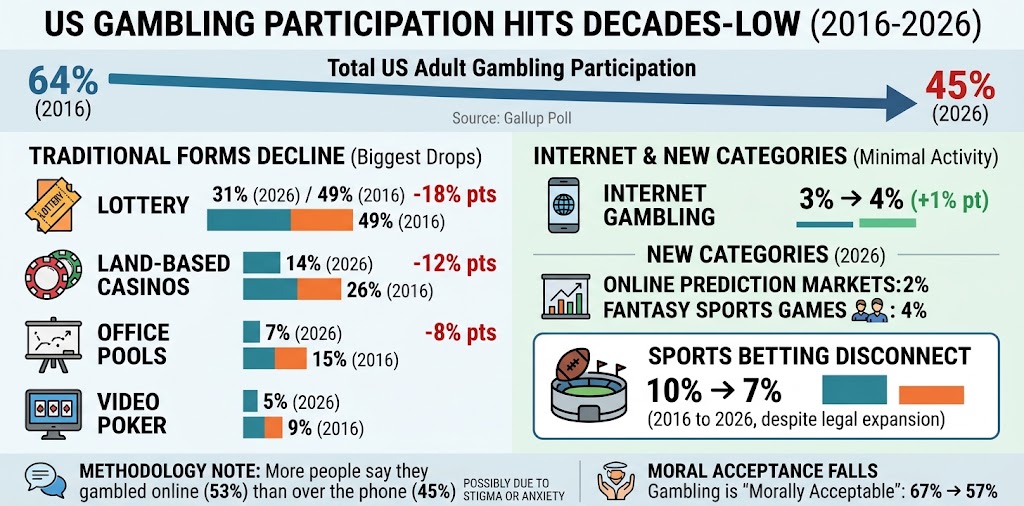
Around half of American adults say they partake in at least one form of gambling, but confirmed participation in almost every category fell in recent years.
New research from analytics and advisory film Gallup has revealed that the percentage of US adults who have taken part in one or more forms of gambling over the past year has fallen to its lowest level in over two decades. The phone survey concluded that 45% of respondents reported they had gambled in at least one form in the prior 12 months, down from 64% in 2016. Earlier surveys, conducted in 2003 and 2007, also recorded participation at around two-thirds of US adults, at 66 per cent and 63 per cent, respectively.
These lower reported gambling rates coincide with a decline in the percentage of Americans who say that gambling is ‘morally acceptable,’ from 67% in 2016 to a new low of 57% earlier this year.
The Collapse of Traditional Betting Methods
Much of the decline is due to a drop in participation in traditional gambling.
The results showed that the largest drops in activity came in longer-established gambling methods, such as in-person gaming at casinos (down 12 percentage points) or buying lottery tickets (down 18 percentage points). The purchase of state lottery tickets saw the biggest decline over the past decade, with participation falling from 49 per cent in 2016 to 31 per cent in 2026. The next-largest drop was among those who had gambled at a land-based casino, which decreased from 26 per cent in 2016 to 14 per cent in 2026.
Office pools, such as wagers tied to the Super Bowl or World Series, have also become less common. Gallup reported that 7% of adults participated in an office pool, down from 15% in the early 2000s. The change may reflect the shift toward remote work, which has reduced the traditional workplace settings where informal betting pools often formed.
Furthermore, video poker fell from 9 per cent to 5 per cent, horse racing declined from 6 per cent to 2 per cent, and wagering on college sporting events dropped from 5 per cent to 4 per cent.
Disconnects in Sports and Online Gambling
Yet the findings arrive after a decade in which legal sports betting has expanded to most of the U.S.
Just 7% of respondents told Gallup they had bet on a professional sporting event during the previous year. That is down from 10% in 2016 and identical to Gallup’s 2007 reading, despite the U.S. sports betting market’s expansion since the Supreme Court’s 2018 decision overturning the federal prohibition against most states authorizing sportsbooks.
Online gambling was the only category measured by Gallup to record growth, with the number of US adults who had gambled for money on the internet increasing from 3 per cent in 2016 to 4 per cent in 2026. Meanwhile, two new gambling methods were listed as options in the 2026 survey that were not included 10 years earlier: Betting on online prediction markets and playing fantasy sports games for money. Those scored 2% and 4% from respondents, respectively.
Survey Methodology and the Stigma Factor
So are fewer people actually gambling, or are fewer people admitting it — or a bit of both?
Gallup’s historical findings are based on telephone interviews. In a parallel probability-based online survey conducted this year, 53% reported gambling during the previous 12 months, eight percentage points above the 45% recorded by phone.
Regarding the higher affirmative response rates for the online poll than the telephone survey, Gallup suggested that people may be more inclined to discuss their gambling activity via typed responses than by admitting it to a person on the other end of a phone call.
Gallup acknowledges that more people say they gambled when they respond online than when speaking to an interviewer, a dynamic that may become more pronounced if, as some data suggests, stigma around gambling increases.
Whether that decline represents a sharp turn away from gambling, reluctance from survey respondents to indicate they gamble, or both, is unclear, noted Gallup. To the extent it indicates that Americans are less comfortable saying they gamble, it could be tied to lessening public acceptance of gambling or not wanting to appear to take risks with money when rising costs and affordability are major concerns.
None of these issues necessarily invalidate Gallup’s broader finding. The decline in traditional gambling participation is substantial. Lottery participation alone has fallen 18 percentage points since 2016, while casino gambling and several other long-established activities also declined. Even Gallup’s higher online estimate of 53% remains below the participation levels recorded in its historical telephone surveys, suggesting that Americans may really be gambling less in at least some forms.
Leo Falsafi is a digital marketing veteran and senior journalist at Virlan.co, where he covers the intersection of digital marketing, gaming, and breaking US trending news. With nearly two decades of hands-on experience in SEO and digital strategy, Leo has consulted for and scaled hundreds of companies. His deep industry roots allow him to deliver sharp, fact-checked insights and analysis on the trends shaping today's digital landscape.